At Google I/O on 19 May 2026, Google set out its clearest signal yet that Search is moving from a ranked list of blue links toward AI answers that weave sources into prose. For professional-services firms in Australia and the UK, and the agencies who market them, the shift changes a basic assumption: the goal is no longer only to rank a page, it is to be the source an AI answer cites.
What changed: the key AI Mode announcements
Google made several announcements at I/O, and a few matter directly for how firms get found.
Gemini 3.5 Flash became the default model behind AI Mode and the Gemini app, according to Google's own Search recap from I/O 2026. Google also described what it called the biggest upgrade to the Search box in more than 25 years, with the box able to expand dynamically and accept multimodal input across text, images, files, video and even Chrome tabs. The same rundown of all the I/O 2026 announcements frames these as core to the AI-first Search experience.
Two further items point at where search behaviour is heading. Google introduced Search agents, background agents that monitor the web around the clock and can take actions such as booking or calling businesses in select categories. Google positioned these for AI Pro and Ultra subscribers, with a wider rollout projected for summer 2026 (treat that timing as a projection, not a shipped date). Google also outlined a shopping push it described as a Universal Cart spanning Search, Gemini, YouTube and Gmail; the cart specifics are largely trade-press sourced, as covered in 9to5Google's I/O 2026 news wrap, so treat the details as provisional.
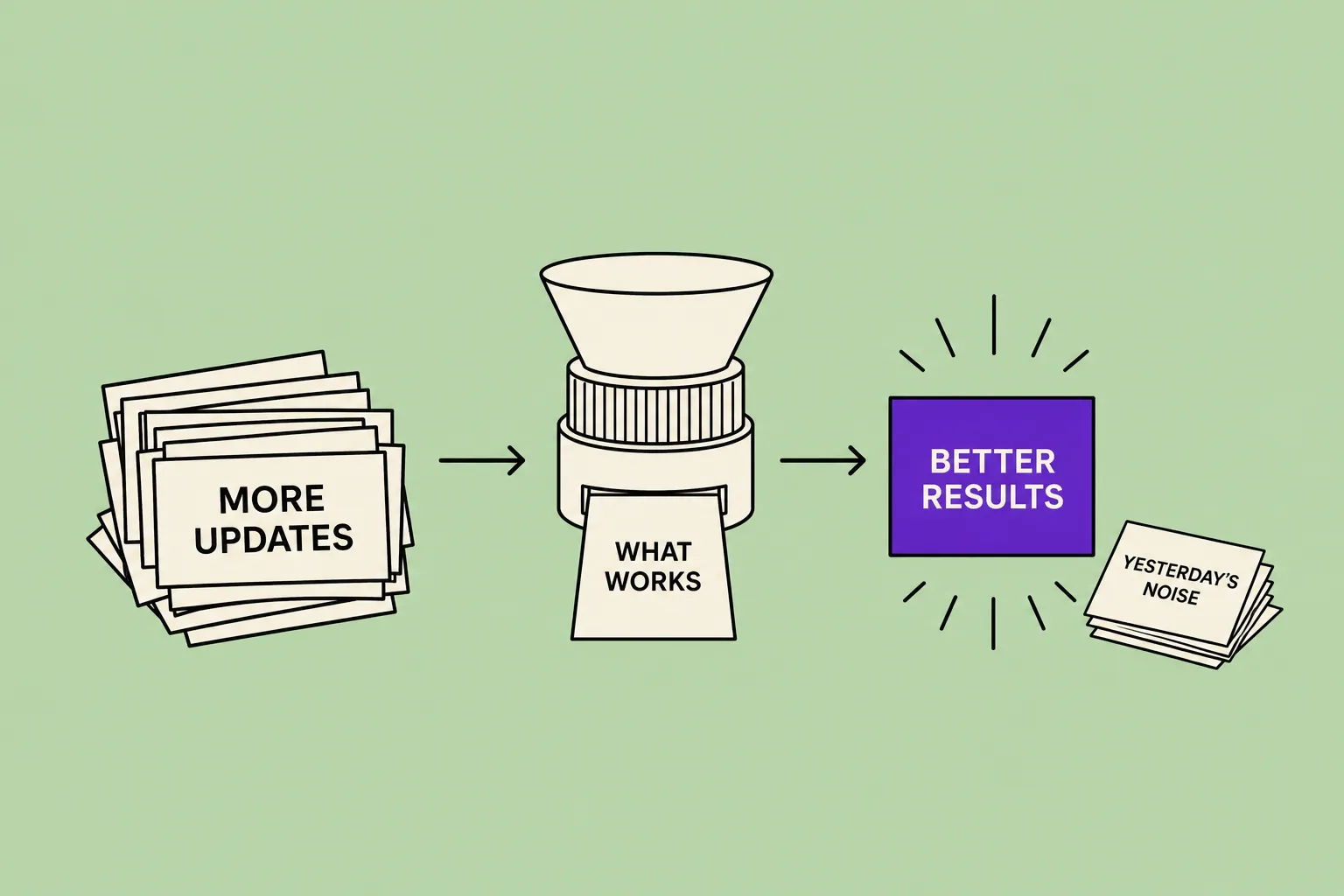
The throughline is presentation. In AI Mode, Google surfaces sources as inline citations inside the generated answer rather than as a ranked list of ten links. That single design choice is what most affects visibility.
What it means for your firm being found
When an answer is written for the user and sources sit inline, being cited inside that answer starts to matter as much as, and sometimes more than, ranking a URL in a classic list. A firm can hold a strong position in traditional results and still be absent from the AI answer a prospect actually reads.
It is worth being careful with the language here. Terms like GEO, AEO and "AI search visibility" are contested, and Google's own position is broadly that good SEO is good practice for AI surfaces too, not a separate discipline. Some SEO researchers have observed relatively low overlap between the pages that rank in the classic top ten and the pages AI Mode chooses to cite, but that is an observation from practitioner analysis, not a settled finding, so we treat it as a signal to watch rather than a rule to build on.
The regulatory picture gives Australian and UK firms a concrete reason to pay attention now. On 3 June 2026 the UK's Competition and Markets Authority ordered Google to give publishers clearer attribution, an opt-out from having their content used in AI summaries without losing normal Search visibility, and a dashboard to track where their pages appear in AI responses. As Press Gazette reported on the UK regulation of Google, Google is testing with a limited set of UK operators first and has roughly nine months to implement the changes, with SiliconAngle's coverage of the AI Overviews opt-out order noting the controls will extend globally over time. In Australia, the ACCC continues to monitor the platforms, but there is no equivalent binding order in place. That makes the UK move a useful preview of the controls AU firms may eventually get, and a reason to start measuring AI visibility today.
What to do now
Start measuring whether AI answers cite you, not just whether you rank. Pick the handful of questions a prospect would actually ask before hiring your firm, run them in AI Mode, and record whether your site appears as an inline citation. That single habit turns an abstract shift into a list of pages to fix.
Amina's AI Visibility Check does exactly this for professional-services firms, mapping where you are already cited and where competitors are winning the answer.
FAQ
Does ranking in Google still matter if answers are AI-generated?
Yes. Classic ranking still drives traffic and often feeds the sources an AI answer draws from. The change is that ranking is no longer the whole story: being cited inside the AI answer is a separate outcome worth tracking.
Is "AI search optimisation" a real, separate discipline?
It is contested. Google's broad position is that good SEO already supports AI surfaces. Some practitioners argue for AI-specific tactics, but the evidence is early, so treat strong claims with caution and focus on fundamentals first.
Do Australian firms get the same publisher controls as the UK?
Not yet. The attribution, opt-out and dashboard controls come from a June 2026 UK CMA order that applies to UK operators first. Australia's ACCC is monitoring but has issued no equivalent binding order, so AU firms should watch the UK rollout as a likely preview.