Most B2B marketing dashboards still treat keyword coverage as the scoreboard: rank for more terms, own more of the category. That logic held for two decades, so it still feels safe. It has quietly stopped describing the layer of search that now forms a buyer's first impression. New benchmark data shows the median enterprise B2B brand ranks for roughly 9,700 keywords, yet earns a citation in only 3% of the AI Overviews summarising those same searches. Ranking breadth, in other words, has become a vanity metric for the part of search that is growing fastest. The number your board actually needs is the citation-inclusion rate, and your rank tracker will never surface it.
The funnel that collapses: from 9,700 ranked keywords to a 3% citation rate
The clearest picture of that collapse comes from Walker Sands' B2B AI Search Visibility Benchmark, reported with an author disclosure in Search Engine Land, which analysed more than 45 million search queries across 828 enterprise B2B companies in 14 industries in March. Worth flagging up front: the author is Walker Sands' own director of SEO and GEO, and Search Engine Land is owned by Semrush, so read the benchmark as vendor-adjacent research rather than a neutral audit.
The study frames AI search as four sequential layers, and value leaks at every joint. The median company ranks for about 9,700 keywords, while top-quartile brands clear 37,000. Only around 4,500 of those keywords trigger an AI Overview at all, already less than half the footprint. AI Overviews then appear across a median 48.8% of a brand's relevant searches, rising to 61.7% for the top quartile. The final layer is where almost everyone falls off a cliff: the median citation-inclusion rate, meaning how often a brand is named as a source inside those AI Overviews, is 3.0%. The top quartile reaches only 4.5%, and the bottom sits at 1.7%.
Tens of thousands of ranking keywords compress into a low single-digit share of AI citations. Think of ranking as the shelf your product sits on. The citation rate tells you whether the shop assistant actually names you when a customer asks what to buy.
Why ranking breadth stopped predicting AI citation
The counterintuitive part is that the strengths which won traditional search real estate do not carry over. Sheer page volume, broad keyword targeting and years of accumulated domain authority do not translate into being the source an AI system chooses to cite. Ranking breadth alone simply does not predict citation.
The starkest evidence is the brands that have vanished from the answer entirely. The same benchmark found that 4.6% of these companies, all with $100 million or more in revenue, are not cited at all for their relevant keywords. They still rank in traditional results. They are, in the report's phrase, present in the index and absent from the answer.
Citation also varies sharply by category, which is another sign that breadth is not the driver. Cybersecurity leads on both fronts, with AI Overviews appearing in a median 59.9% of its searches and a citation rate of 4.2%. Enterprise software (55.3% incidence) and martech (56.3%) sit close behind. Professional services and distribution and logistics trail on citations at 2.1%, and distribution and logistics also see the fewest AI Overviews, at 29.6% incidence. These are US figures, so treat them as directional for an AU or UK category rather than a local map.
What the consistently-cited brands actually share: depth, not scale
So what separates the cited from the invisible? The benchmark points to three shared characteristics: deep topical authority across related content, clear and structured explanations that answer buyer questions directly, and consistent coverage across multiple relevant pages. The common thread is specificity, not size. Generative systems appear to reward content that resolves a question and demonstrates sustained expertise, rather than content that merely ranks.
That reframes the goal toward earned reputation more than raw output. Tom Capper of Moz argues that value in AI search shows up as recommendation and correct source description, not clicks or rankings, and that a brand can be recommended without being cited at all. A blanket label like GEO or AI search visibility is still contested (Google's own line is that good SEO is already good GEO), so treat it as a shift in emphasis, not a settled new discipline. Either way, the work that earns citations looks like building genuine subject-matter depth, not chasing keyword volume.
The measurement gap: your rank tracker is telling a flattering story
This is where the standard reporting stack quietly works against a growth-stage team. If your dashboard tracks ranking keywords and estimated organic traffic, it can climb all year while your citation share flatlines, and nobody in the room would know. The rank tracker measures a layer that is shrinking in influence and stays silent on the one that is growing.
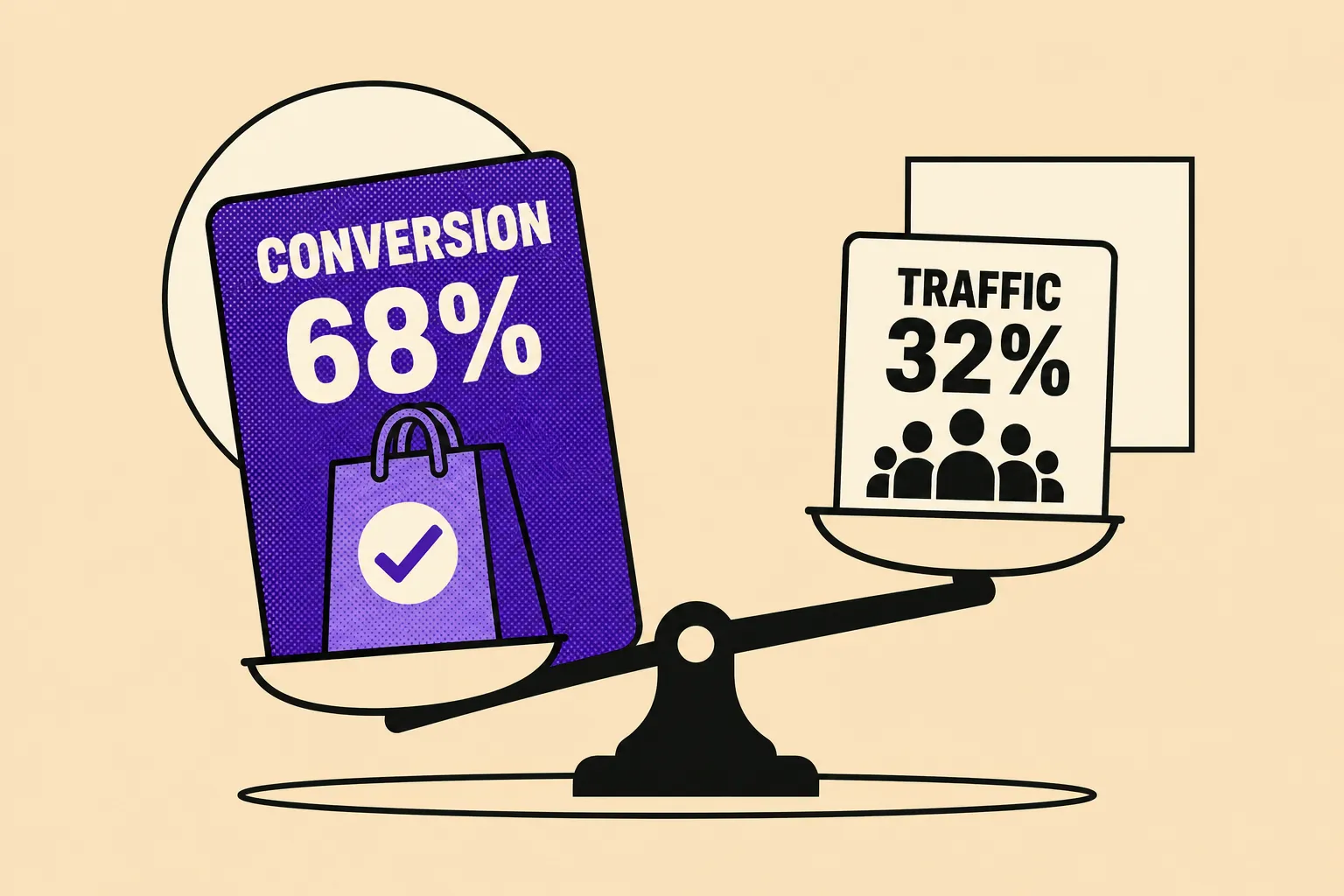
The local signals suggest the gap is not a US-only concern. Australian first-party data from 115 brands, analysed by Optimising and reported in SmartCompany, shows AI referral traffic is still tiny and converts worse than organic (ChatGPT visitors add to cart at 16.2% against 27.4% for organic, and purchase at 2.9% against 6.0%). For service businesses the pattern is explicitly inclusion first, traffic later: visibility inside AI answers rises well before any click or conversion follows. That is the whole argument in miniature, measured on AU brands, though the dataset is e-commerce-weighted so port it to B2B with care.
The infrastructure is here too. ChatGPT already accounts for 90.2% of identifiable AI-driven website traffic in Australia, and 88.5% of tracked AU projects received some AI traffic in 2025, up from 60.3% a year earlier. Google's AI Mode has also rolled out in Australia, building on AI Overviews that have appeared above local results since 2024. In the UK, aggregated vendor data suggests AI Overviews now correlate with a 58% lower average click-through rate for top-ranking pages, per a BusinessCloud roundup of enterprise AI-visibility tools; treat that as illustrative rather than a clean benchmark.
Buyer behaviour is the load-bearing claim under all of this, and the honest version is global, not local. G2 research found that 51% of B2B software buyers now start research with AI chatbots more often than with Google, up from 29% eleven months earlier, based on 1,076 decision-makers surveyed across North America, EMEA and APAC in March 2026. A separate survey of 300 enterprise technology buyers, published by Treble, put AI tools ahead of Google as the first stop for vendor research. Treble is a B2B tech PR agency and the sample is small, so read it as corroboration rather than proof. No AU or UK-specific cut of that buyer behaviour has been published, so apply it to your market as informed reasoning, not a local statistic.
Turning the citation gap into a number your board can act on
Let's turn this into something you can put in a board pack. The first move is to stop reporting AI visibility as a footnote to rankings and start reporting the citation-inclusion rate as its own line. It is a single, defensible percentage: across the category searches where an AI Overview appears, how often are you the named source? That number is invisible until you measure it on purpose, because ranking will never reveal it.
There is now an Australian incidence figure to anchor the local case. Digital Nomads HQ's State of AI Search study found that 51.7% of Australian B2B-services results display an AI Overview, and 47.8% of commercial-intent B2B queries trigger one, drawn from 6,495 B2B SERPs inside a larger 116,918-SERP sample. That is an agency-published benchmark rather than a peer-reviewed one, so hold it as directional. It sits close to the US incidence figure of 48.8%, which means the AI-answer layer is at least as present on AU B2B searches. It does not replicate the 3% citation rate, though: no AU or UK study yet measures brand citation inclusion, so that figure stays labelled as a US benchmark.
Regulators treat the shift as material, which helps when you are framing stakes for a board. The ACCC's December 2025 AI snapshot warned that agentic AI could change how users deal with businesses online and raise barriers to entry, and it continues to monitor generative AI's effect on search under its Digital Platform Services Inquiry. In the UK, the CMA has required Google to give publishers tools to opt out of AI features, a signal that the AI-answer layer is now contested and governed rather than incidental. The category variation in the benchmark also points to where to act first: in categories where few brands have cracked the mechanics, there is a genuine first-mover opening, much as early SEO adopters captured outsized organic share.
Key takeaways
- Report the citation-inclusion rate as its own board metric: the share of category AI Overviews that name you as a source. Rankings will not reveal it.
- Stop reading ranking breadth as AI visibility. The median B2B brand ranks for about 9,700 keywords and is cited in 3% of AI Overviews in the US benchmark; breadth does not predict citation.
- Build depth, not volume. Topical authority, structured answers and coverage across related pages are what consistently-cited brands share.
- Treat the AU layer as live. Google AI Mode and AI Overviews are present on AU searches, and AU incidence (47.8% to 51.7%) tracks the US figure, while the 3% citation rate remains US-only and un-replicated locally.
- Frame buyer behaviour as global-but-directional. G2 (1,076 respondents) and Treble (300 respondents) both show AI-first vendor research, with no AU or UK cut yet published.
Frequently asked questions
What is an AI Overviews citation rate?
The AI Overviews citation rate, or citation-inclusion rate, is how often a brand is named as a source inside the AI Overviews that appear for its relevant searches. In Walker Sands' US benchmark reported by Search Engine Land, the median enterprise B2B brand sat at 3.0%, even though those same brands ranked for about 9,700 keywords.
Does ranking well in Google mean I will appear in AI Overviews?
No. The benchmark found that ranking breadth alone does not predict AI citation, and 4.6% of companies with $100 million or more in revenue were not cited at all despite ranking in traditional results. Page volume, broad keyword targeting and domain authority do not automatically transfer into being cited.
Are Google AI Overviews live on B2B searches in Australia?
Yes. Google AI Mode has rolled out in Australia on top of AI Overviews, and a Digital Nomads HQ study found 47.8% of commercial-intent B2B queries trigger an AI Overview, close to the US median of 48.8%. That AU figure is agency-published, so treat it as directional rather than settled.
How should I measure AI search visibility for a board?
Report the citation-inclusion rate as a single line: across category searches where an AI Overview appears, how often are you the named source? It is distinct from rankings and traffic, and it has to be measured deliberately because a rank tracker will not surface it.
Is GEO a separate discipline from SEO?
It is contested. Google's position is that good SEO is already good GEO, so treat generative engine optimisation as a shift in emphasis toward topical depth and structured, question-led content rather than a settled, separate playbook.
Quantify your own ranking-to-citation gap
If your current reporting cannot tell you your citation-inclusion rate, that is the gap worth closing first. M2.0's AI Visibility Check quantifies your category's ranking-to-citation gap and turns it into board-ready reporting: one defensible number for how often AI answers name you, plus where the first-mover openings sit in your category.