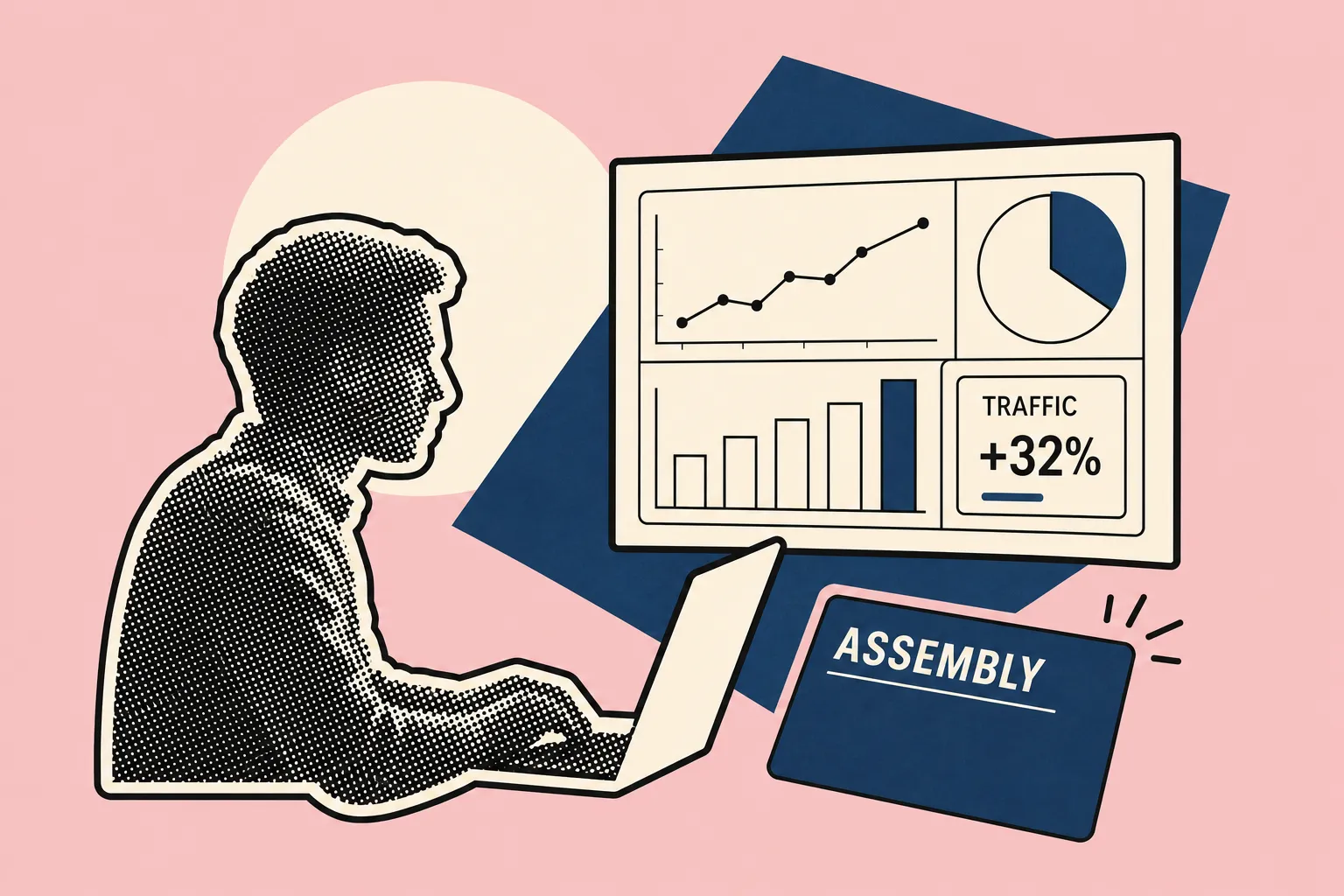
For businesses above $10 million in revenue that invest in both, conversion rate accounts for 68% of the growth outcome and traffic for 32%, according to NP Digital research, yet 93% of teams still spend most of their effort on acquisition. In Australia the case is sharper: one local index has click prices rising as search demand falls, the global evidence has AI answers taking clicks from pages that still rank, and the checkout details that lift conversion now sit inside a regulator's field of view.
Two numbers decide most growth plans, and most agencies are paid to move the smaller one. In NP Digital's research on businesses turning over at least $10 million a year that invest in both conversion work and traffic generation, conversion rate accounted for 68% of the outcome and website traffic for 32%. Against that, 93% of teams still put most of their effort into acquisition and 7% into conversion rate, which is close to an exact inversion of where the growth actually sits.
That research is US-shaped, and the reflex is to discount it locally. The opposite applies. Australia's addressable audience runs out sooner, the cost of buying the next visitor is rising faster than the pool of searchers is growing, and AI answers are quietly taking clicks from pages that still rank perfectly well. What follows is the case for selling conversion and search as one engagement, with the local numbers a client will recognise and the guardrails that keep the work defensible.
Two-thirds of the growth was already inside the site
The three assumptions that break growth plans are ordinary enough to pass unchallenged in a quarterly review. More impressions do not produce more clicks. More sessions do not produce more conversions. More leads do not produce more revenue. NP Digital's argument that traffic won't fix a growth problem is that each junction leaks on its own, so volume poured in at the top reaches the bottom having passed through every one of them. Pushing harder on acquisition does not repair a junction. It sends more people through it.
Australia supplies an unusually clean illustration. Online retail spending reached $82.6 billion in 2025, up 14% year on year and now close to a quarter of all retail spending, per SmartCompany's read of smaller, more frequent orders. Yet the average basket fell to $96, roughly $10 below its 2020 level, while shoppers made about four more purchases each than in 2024. Growth came from frequency, not from value per transaction. A market can get busier and less valuable per visit at the same time, which is the "more sessions do not mean more conversions" leak with an Australian dollar figure attached.
Anyone who has ever presented a session-growth chart to a board and then fielded a question about revenue already knows this in their body.
The acquisition ceiling dropped in 2026, and nobody repriced the retainer
The cost side moved first. An Australian agency's own index of Google Ads costs across more than 8,400 local service keywords puts click prices up 31% between January and May 2026, and up 21% year on year while search demand fell 23%, in Digital Nomads HQ's Australian click price index. Read that as one agency's proprietary index rather than a market statistic, because no independent Australian CPC index exists to cross-check it. The direction is corroborated by how much money is chasing the same auctions: Australian internet advertising expenditure reached $4.9 billion in the first quarter of 2026, up 15.3% on $4.22 billion a year earlier, with search and directories at $2.16 billion, up 13.9%, in the IAB Australia quarterly report prepared by PwC. That figure is advertiser investment, not price, so it explains the pressure on the auction rather than measuring it.
The long-run direction is less ambiguous. Average cost per click across all industries reached $5.42 in 2026, more than double the $2.32 recorded in 2016, in Search Engine Journal's read of the annual Google Ads benchmarks. That is a US sample, so it establishes the decade-long slope rather than an Australian number. An index reporting clicks 21% dearer while 23% fewer people are searching is the sound of an auction running out of room.
Then the free side moved. Ahrefs, an SEO tools vendor with a commercial interest in the finding, compared 150,000 keywords carrying an AI Overview against 150,000 without and reported a 58% lower average clickthrough rate for the top-ranking page, with position-one CTR falling from 0.073 to 0.016 between December 2023 and December 2025, in its study of AI Overviews reducing clicks. Published estimates across 2025 and 2026 sit roughly between 34% and 61% depending on method and query mix, so treat the magnitude as directional. Independent work points the same way. With an AI summary present, users clicked a traditional search result in 8% of visits, against 15% of visits without one, and clicked a link inside the summary in just 1%, based on the browsing activity of 900 US adults who shared it during March 2025, in Pew Research Center's analysis of AI summaries. The ranking did not move. The click did, which is the gap between ranking breadth and citation rate that reporting built on positions still misses, and the reason the AI Mode announcements from Google I/O 2026 belong in a conversion conversation rather than only a search one.
No Australian or UK segmented study of that click loss exists. Australian figures circulating as local zero-click rates trace back to no primary study, so the local application here is reasoning rather than measurement. What Australia does have is the conversion half. First-party data from 115 Australian brands, 61 e-commerce and 54 lead generation, gathered between September 2024 and September 2025 and reported in SmartCompany's coverage of AI referral traffic in Australia, found ChatGPT driving 90.2% of AI referral traffic locally while converting at 2.9% against 6.0% for organic search, with add-to-cart at 16.2% against 27.4% and average order value of $146.70 against $160.65. Perplexity and Gemini converted three to six times higher than ChatGPT on far smaller volume. AI sessions were up a median 1,200% year on year, while AI revenue share for e-commerce sat at roughly 0.1%. It is the most recent Australian first-party read available and it is now about ten months old.
Stack those and the Australian problem is larger than fewer clicks. The clicks that survive convert at roughly half the rate of ordinary organic, which is a conversion problem arriving through a search channel. The acronyms for this work (GEO, AEO, AI search visibility) remain contested, and Google's own position is that good SEO is good GEO, so hold the label loosely and the measurement tightly. What the evidence does support is that the structure of the page and the site around it now decides both whether a model can lift a fact and whether a human who arrives converts.
Cadence beats cleverness, and measurement beats both
Testing frequency has a measurable sweet spot. Companies running fewer than five tests a quarter saw 2.7% revenue growth, while those running 11 to 15 tests a quarter saw 5.6%, more than double, per the same NP Digital research. That points to roughly four tests a month, past which teams cannot review one result before the next launches, so the extra volume stops paying.
A rhythm like that assumes the numbers underneath it are real, and the best regional evidence says they frequently are not. Newcastle firm Leaf Signal audited 500 of the UK's leading Shopify sites and found 98% carrying at least one critical tracking issue: 52% missing core events entirely, 88% with incomplete parameters on live events, 76% with three or more critical issues at once, 74% firing non-essential tracking without consent, and six retail verticals at a 100% broken-tracking rate, reported by BusinessCloud on the Leaf Signal audit. A testing programme sitting on that is theatre with a dashboard attached. It also reframes a technical and conversion review as the precondition for a testing cadence rather than an optimisation upsell bolted onto a search retainer.
Benchmarks carry the mirror-image problem. A UK attribution vendor reporting on its own client base, Ruler Analytics, puts visit-to-lead conversion at 5.13% across 13 industries, with legal at 7.9% and software at 7.6%, drawn from more than 110 million sessions and £33.8 million in tracked spend in its 2026 conversion rate benchmarks. Its channel table makes the article's point without being asked: organic search converts at 4.9%, the same as email. On the retail side, e-commerce platform vendor IRP Commerce records a 2.23% average session conversion rate for August 2026 across merchants on its own platform in Great Britain, Northern Ireland and Ireland, up from 1.85% a year earlier, with sectors spread from 0.57% for baby and child to 5.81% for arts and crafts, in its monthly e-commerce market data. Both are UK datasets from vendors measuring their own customers. No credible Australian sector benchmark exists at all: every locally branded figure checked traced back to a relabelled global average with no sample and often no date. The honest position is to benchmark a client against its own baseline and use the UK tables for the shape of the spread, which is the useful finding anyway. A single "average conversion rate" covering a ten-fold range is close to meaningless.
Worth saying plainly, because it is a positioning opportunity rather than an embarrassment: no named Australian agency, retailer or SaaS company publicly runs a structured experimentation programme with a published cadence or result. The nearest regional evidence describes the absence of sound measurement, not the presence of a mature programme.
A higher conversion rate is not automatically a better business
LogRocket's account of what growth design looks like in 2026, updated in September 2026 to add experimentation quality, guardrail metrics and deceptive-design risk, defines the work as helping more users reach meaningful value rather than squeezing conversions out of an existing flow, run as a three-stage loop of strategy, launch and continuous improvement across a journey that already exists. Its worked example is the one to steal. When testing for more upgrades, track cancellation rates, support requests, user satisfaction and retention alongside the conversion number, because a higher conversion rate is not a better experience if users later regret the decision.
The B2B version of the leak is specific: NP Digital's funnel audits put the largest drop-off between leads and marketing-qualified leads at 59.4%, which is a qualification and follow-up problem rather than a landing-page one. In Australian retail the friction sits at the checkout and it is quantified. Among more than 1,000 Australian and New Zealand shoppers surveyed for the BigCommerce and PayPal 2025 Digital Payments Report, 96% would abandon a cart over unexpected charges, 93% over a failed coupon code, 89% over missing payment options and 86% say expensive delivery turns them off a retailer, while 56% will switch retailers outright after a poor checkout experience, per SmartCompany's summary of checkout abandonment. Buy now, pay later is used by 36%, with Afterpay at 83% of those users and PayPal Pay in 4 at about half, a 20-point jump since 2023. That payment mix is a live conversion variable a US-shaped playbook will simply get wrong, and it is the kind of thing a build review looks at alongside performance and accessibility.
That unexpected-charges figure is also the point where conversion work meets a regulator. In the UK, one year into direct consumer enforcement under the Digital Markets, Competition and Consumers Act 2024, the Competition and Markets Authority had opened investigations into 14 businesses, issued 157 advisory and warning letters and imposed £4.7 million in fines, according to its own review of direct consumer enforcement. The bulk of that sits in one case: the CMA's drip-pricing decision against the AA and BSM fined the driving schools £4.2 million and ordered refunds of more than £760,000 to over 80,000 learner drivers for showing prices that excluded a mandatory booking fee until checkout, reduced by 40% from an initial £7 million for early settlement. Two months later, the Marks Electrical pre-ticked-extras decision brought a £720,000 fine and around £600,000 in refunds to nearly 40,000 customers automatically opted into paid recycling services. A pre-ticked upsell box is a textbook conversion win that a naive A/B test would score as a success.
Australia has legislated the same ground on a clock. The Competition and Consumer Amendment (Unfair Trading Practices) Act 2026 received assent on 2 July 2026 and commences on 1 July 2027, prohibiting conduct that manipulates a consumer or unreasonably distorts the environment in which a decision is made, and adding drip-pricing disclosure and subscription-contract obligations. The maximum penalty for a body corporate is the greater of AU$100 million, three times the benefit obtained, or 30% of adjusted turnover during the breach period, with AU$2.5 million for individuals, per K&L Gates on the doubling of ACCC penalties. Nobody has been penalised under those provisions yet, because they are not in force. What already exists is the enforcement appetite: the ACCC named subscription traps and other dark patterns that manipulate consumer behaviour in its 2026-27 compliance and enforcement priorities, with chair Gina Cass-Gottlieb tying the priority to the case for an economy-wide prohibition. An Australian client therefore has a deadline and a penalty ceiling, and a UK client has live fines, and both make guardrail metrics a risk-management line rather than an ethical flourish.
What this changes in the pitch, the retainer and the scope
A conversion and technical website review stops being an upsell the moment the 68/32 split is on the table, because two-thirds of the growth being sold in a search engagement is decided after the visitor arrives. That is the one-sentence version for a client whose rankings are holding while revenue sits flat: the search work is still working, the site is where the money is going missing.
The commercial advantage is in saying the guardrails out loud. An agency that publishes what it will not damage while chasing a conversion target, cancellation rate, support volume, retention, lead quality, is selling something a cheaper competitor cannot match on price, and is doing it against a regulator's published priorities rather than a house style guide. The same discipline applies to how a brand appears in AI answers: a referral channel that converts at half the rate of organic is a measurement and experience problem long before it is a visibility one.
Key takeaways
- Lead the pitch with the 68/32 split and the 93/7 effort split. Two-thirds of the growth in NP Digital's data comes from what the site does with existing visitors, and almost all of the effort goes to the other third.
- Fix measurement before you sell a testing cadence. With 98% of the UK's largest Shopify sites carrying a critical tracking issue, assume the client's conversion data is wrong until proven otherwise.
- Target roughly four tests a month. Fewer than five a quarter tracked to 2.7% revenue growth and 11 to 15 a quarter to 5.6%, and beyond that teams stop learning from results.
- Write guardrail metrics into the scope, not the appendix. With CMA fines of £4.2 million and £720,000 already issued for drip pricing and pre-ticked extras, and Australia's unfair trading prohibition commencing 1 July 2027, a conversion win that hides a cost is now a liability with a number on it.
Frequently asked questions
What is CRO SEO, and why are the two treated as one job now?
CRO SEO is conversion rate optimisation and search optimisation run as a single engagement rather than two workstreams. They converged because the leaks now cross the boundary: organic clickthrough is falling on pages that still rank, and the AI referral traffic replacing some of it converted at 2.9% against 6.0% for organic search across 115 Australian brands measured by Optimising, which is a conversion problem arriving through a search channel.
Does more organic traffic still increase revenue?
Not reliably on its own. NP Digital's research on businesses above $10 million in revenue attributed 68% of the outcome to conversion rate and 32% to traffic, and its funnel work shows each step from impression to click to session to lead leaking independently. More volume through an unrepaired funnel reaches the same drop-off points.
How many CRO tests should an agency run for a client each quarter?
Around 11 to 15, which works out to roughly four a month. NP Digital found companies running fewer than five tests a quarter saw 2.7% revenue growth against 5.6% for those running 11 to 15, with the benefit tailing off beyond that because teams cannot review a result before the next test launches.
Are dark patterns illegal in Australia yet?
Not yet, but the date is set. The Competition and Consumer Amendment (Unfair Trading Practices) Act 2026 received assent on 2 July 2026 and commences on 1 July 2027, with a maximum corporate penalty of the greater of AU$100 million, three times the benefit obtained, or 30% of adjusted turnover. The ACCC has already named dark patterns and subscription traps among its 2026-27 enforcement priorities, and the UK's CMA is fining for equivalent conduct now.
Convert what you already earn
Amina builds performance-first websites for professional-services firms: fast, accessible, and engineered to be found in search and in AI answers from day one, and yours to keep. A site that converts what it already earns is worth more than one that simply ranks.