For two years, the SEO industry asked Google for exactly two things: more visibility into AI traffic, and more control over how content shows up in AI answers. In June, Google handed over both: an opt-out for AI Overviews and AI Mode, plus new AI reporting inside Search Console. The reflex in half the industry was to reach straight for the off switch.
The reality is more interesting than the debate. Opting out doesn't switch AI off for your buyers. It only makes your brand ineligible to be the answer, quietly handing the citation to whoever's next in line. The button half the industry wants to press is the one you should leave alone. The move that matters this quarter is the check you run before someone asks about it in a QBR.
What Google actually shipped (and what the opt-out does not do)
The announcement got flattened into "Google added an opt-out," and that framing lost the important half.
Google shipped two things, both in early beta and not yet available to everyone, as Search Engine Land's coverage stresses. The first is the control everyone fixated on: an opt-out of AI-powered experiences (AI Overviews, AI Mode and the like). The second, reported from Google's Search Central Live in Milan, is the one that matters more day to day: an AI Reporting (Beta) section in Google Search Console that isolates impression and click metrics for AI Overviews, AI Mode and Discover, plus an AI Settings panel that lets a site owner explicitly include or exclude their site (Search Engine Roundtable).
For UK readers, one detail reframes the whole thing. A regulator forced the opt-out into existence. On 3 June 2026, using its Strategic Market Status powers, the CMA required Google to give publishers "effective tools to stop publishers' content being used to power AI features in search, such as AI Overviews," to opt out of fine-tuning, and to "properly attribute publisher content, using clear links in AI-generated search results." Google is rolling these controls out to a subset of UK website owners ahead of a nine-month deadline, and CMA chief executive Sarah Cardell framed the rules as responding "to what Google is doing now and in the future" (The Register). [UK]
Australia is a murkier picture, and it's worth being precise rather than assuming parity. AI search itself is unambiguously live here. Google rolled AI Mode into Australia in early October 2025 as part of a 40-plus-country expansion, building on AI Overviews that have appeared above traditional results on AU SERPs since 2024 (SmartCompany). No source confirms the opt-out or the Search Console AI Reporting beta has reached Australian accounts specifically, and Australia has no CMA-equivalent mandate forcing the issue. The ACCC flagged in its 17 December 2025 AI snapshot that it's still monitoring generative AI's effect on search competition, rather than mandating opt-out or attribution. Treat the AU rollout status as unconfirmed, and the UK controls as the live template. [AU]
Why "off" is the most expensive button on the page
The trap sits inside one shaky assumption: that switching off AI inclusion switches AI off for your buyers. It doesn't.
Opting out of AI inclusion and opting your users out of AI experiences are two completely different things. Think of it like pulling your listing from a busy shopping centre's directory: shoppers don't leave, they just stop finding you, and the unit next door gets the walk-in. As the Search Engine Land piece puts it, if Expedia opted out tomorrow people wouldn't stop planning holidays, and if NerdWallet opted out people wouldn't stop researching credit cards. Google would simply surface someone else in its place. The user experience barely changes. The only thing that changes is which brands are eligible to appear.
The same argument is already live in your market, not just the US. An Australian analysis quoted the News Media Association warning that "opting out of AI uses will not translate into reduced prominence in general search through knock-on effects," and framed the choice for AU businesses as: allow your content in AI systems, or risk a traffic decline, because Google still controls ranking and surfacing either way (SmartCompany's Neural Notes). That piece ties the debate to Australia's News Media Bargaining Code as precedent, an AU-native hook the Expedia illustration lacks. [AU]
And the cost of being absent isn't hypothetical. The same Australian reporting cited ABC analysis of SimilarWeb data showing several of the country's largest news sites have lost year-on-year organic-search traffic since AI Overviews launched, some down as much as 35% (ABC/SimilarWeb analysis, reported by SmartCompany). That's a category-level proxy, not a single-brand case, but the direction is the point. [AU]
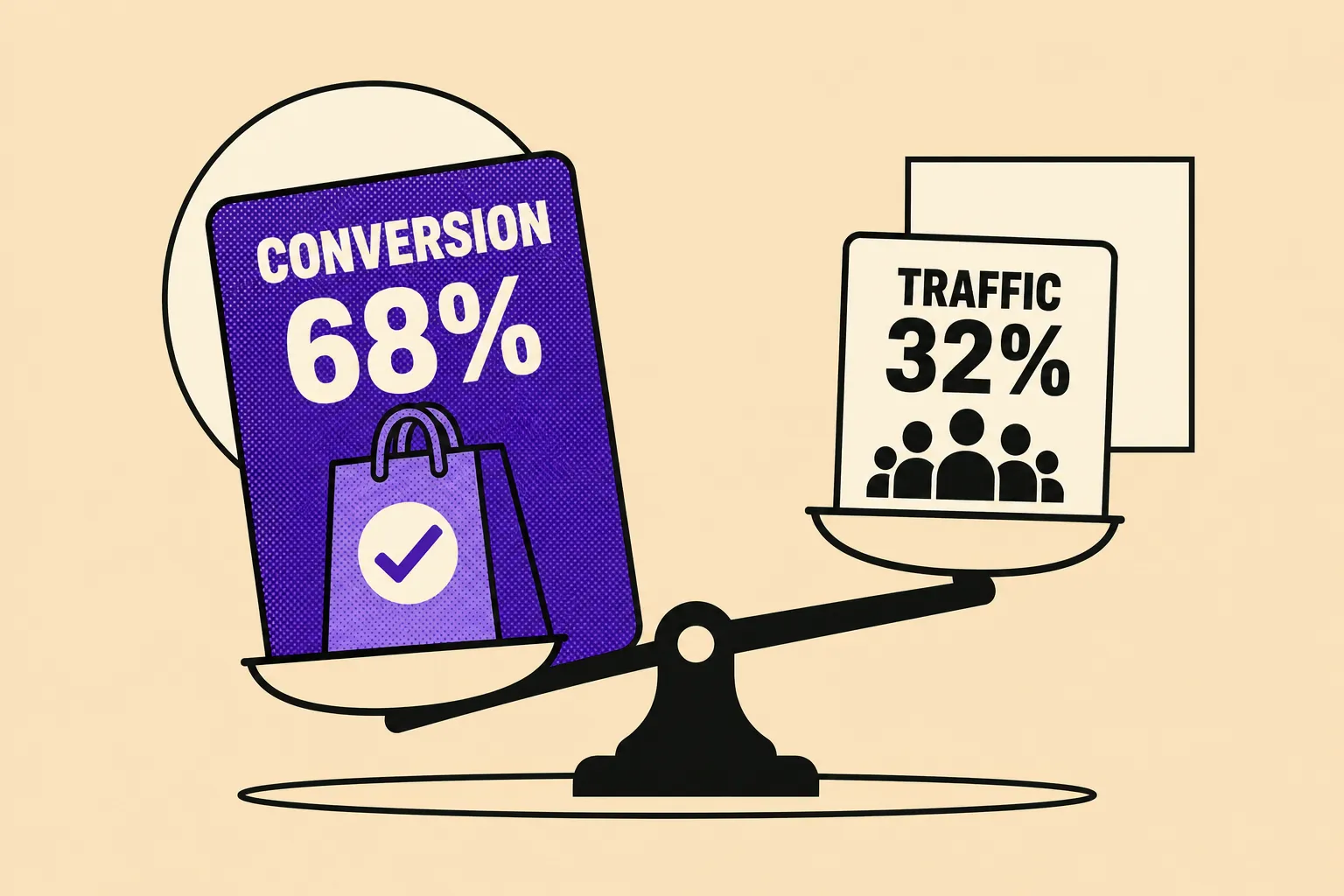
Let's weigh that against the scale of the surface. AI Overviews now appear on a large and rising share of queries: roughly 48% of tracked queries, up 58% year over year as of February 2026, according to BrightEdge's tracker. Coverage figures vary by vendor and keyword mix, so treat 48% as BrightEdge's number rather than a settled universal constant. The B2B cut is the one that should make Priya sit up. BrightEdge's data, reported by Search Engine Journal, shows AI Overview coverage in B2B Technology climbed from 36% to 82% of queries over the same twelve months. In the exact category where your decision-stage buyers search, being opted out means being invisible on roughly four queries in five. And they're not only on Google. OpenAI said ChatGPT reached 900 million weekly active users and 50 million paying subscribers as of 27 February 2026 (its own self-reported figure, via Search Engine Land, which is owned by Semrush). Your buyers are already asking AI. Your participation isn't what decides that.
The reporting is imperfect: use it anyway
The second half of Google's announcement, the reporting, got a colder reception, and that reaction is the real mistake.
The complaint is fair on its face: the new Search Console AI reporting doesn't answer every question, citations aren't fully attributable, and AI Mode interactions stay fuzzy. But SEO has always run on imperfect data, from estimated search volume to incomplete attribution and directional signals. Waiting for perfect attribution has never been a winning strategy; it just means your competitor acts on the directional read first. Google's own Milan slide made the case for engagement, noting that "when people click from AI Overviews, they're more likely to spend more time on the site." Notably, it gave no absolute figure to size that up (Search Engine Roundtable).
The useful reframe from the Search Engine Land piece is what its author calls "SEO+": don't abandon clicks, rankings and conversions, but expand what you measure to include discoverability. That means where you're cited, how often you're mentioned, how many unique URLs get surfaced, and whether branded demand is climbing across AI surfaces. A quick caveat on the jargon. The labels for this work (GEO, AEO, "AI search visibility") are contested, and Google has publicly pushed back on treating them as a separate discipline, arguing "good SEO is good GEO." Fair enough. Use the terms as shorthand, not as settled doctrine. The measurement discipline is what matters, not the acronym.
For UK teams, this has hardened into a governance question, not a marketing one. On 17 June 2026 the CMA placed AI Overviews inside a "fair ranking" regime, requiring Google to rank organic results and provide AI Overviews using "objective and non-discriminatory criteria," give businesses greater transparency into rankings and advance notice of major changes, with six months to implement ranking rules and three for data portability (The Register; Computer Weekly). Once "are we eligible and cited?" is a regulated, board-visible question, "we opted out" is a hard answer to defend. [UK]
The board-ready move: prove you're cited, not opted out
The decision actually in front of Priya this quarter is a different one. It isn't "should we opt out?" It's "can we prove we're present where the revenue decisions happen, before someone senior asks?"
That's a defined piece of work, and it's the opposite of the opt-out reflex. An AI Visibility Check runs a focused, representative set of your real decision-stage buying queries across the surfaces your buyers use (AI Overviews, AI Mode, ChatGPT, Perplexity) and reports whether your brand shows up as the cited answer or whether a competitor owns that spot. Pair it with the new Search Console AI reporting for the traffic side, and you've replaced a config panic with a number you can take into a QBR. The goal is confirmation that you never quietly disappeared from the answers your buyers already read.
Key takeaways
- The opt-out changes eligibility, not user behaviour. Switching off AI inclusion doesn't stop your buyers using AI; it just lets a competitor become the cited answer in your place (Search Engine Land; SmartCompany).
- B2B is where absence hurts most. AI Overview coverage in B2B Technology rose from 36% to 82% of queries in a year, per BrightEdge via Search Engine Journal. Treat opting out of an 82%-coverage category as ceding it.
- UK: the opt-out is a compliance artefact, not a shield. It exists because the CMA ordered it, and AI Overviews now sit inside a fair-ranking regime, so eligibility is a governance question (The Register). [UK]
- AU: don't assume parity. AI Mode and AI Overviews are live on Australian SERPs, but the opt-out and GSC AI reporting rollout to AU accounts is unconfirmed, and the ACCC has imposed no equivalent mandate. [AU]
- Use the imperfect reporting now. Act on directional AI-visibility signals rather than waiting for perfect attribution. Run a decision-stage AI Visibility Check to confirm you're cited.
Frequently asked questions
What does the Google AI Overviews opt-out actually do?
It removes your content's eligibility to appear in Google's AI experiences (AI Overviews and AI Mode), but it does not turn those experiences off for users. As Search Engine Land argues, users keep asking AI regardless; opting out simply makes it more likely a competitor becomes the cited answer instead of you.
Is the AI Overviews opt-out available in Australia and the UK yet?
In the UK, yes and it's regulator-driven: the CMA required Google to give publishers tools to stop their content powering AI features, rolling out to a subset of UK website owners ahead of a nine-month deadline (The Register). In Australia, the rollout status is unconfirmed. AI Overviews and AI Mode are live on AU SERPs, but no source confirms the opt-out or the Search Console AI reporting has reached Australian accounts, and the ACCC has no equivalent mandate.
How do I check whether my brand is cited in AI answers?
Run a focused set of your real decision-stage buyer queries across AI Overviews, AI Mode, ChatGPT and Perplexity, and record whether your brand appears as a cited source or a competitor does. Pair that with Google's new Search Console AI Reporting (Beta), which isolates impressions and clicks from AI Overviews, AI Mode and Discover (Search Engine Roundtable). Together they give you a defensible read on presence and traffic.
Is "AI visibility" just SEO under a new name?
Partly, and the distinction is genuinely contested. Google has pushed back on treating "GEO" or "AEO" as a separate discipline, with the line "good SEO is good GEO." The practical difference is what you measure: alongside clicks and rankings, AI visibility tracks whether you're cited and mentioned across AI surfaces, a broadening of the same craft rather than a rival one.
Ready to check you're still in the answer?
If your buyers research in B2B categories where AI Overviews now cover most queries, the risk that should worry you is silent absence, the kind you wouldn't spot without checking. A decision-stage AI Visibility Check from M2.0 gives you a fast, board-ready snapshot of whether you're cited or opted out at the queries that drive revenue, so the next time the opt-out question comes up, you're answering with data instead of a config setting. That's the low-friction first step; a full share-of-voice audit is the next.