Only partly. ChatGPT sends very little traffic (0.62% of Google organic sessions in Marie Haynes' 100-site GA4 sample), so GEO (generative engine optimization) tactics sold as a traffic play are a distraction. But AI answers increasingly shape which brands buyers consider before they click, so AI visibility should be judged like a brand channel, by share of voice and branded demand, not by referral clicks.
The verdict that spread through marketing feeds in late October was tidy: AI search barely sends traffic, so GEO is a distraction and you should get back to Google. Three studies landed in the same week, Rand Fishkin bundled them together, and Search Engine Roundtable's roundup of the three studies ran under a headline suggesting AI visibility isn't worth investing in.
The real story is more useful than the verdict. Within days, iPullRank published a rebuttal that accepted every number and rejected the conclusion. So when a client asks whether AI search deserves a 2027 line, "it's a distraction" and "it's the future" are both weak answers. Both camps agree on the numbers. They disagree on the ruler. Our position: split the question in two, judge each half with its own ruler, and fix the measurement gap that leaves many companies unable to judge either.
Both camps agree on the numbers, and on more than the headline suggests
AI assistants send a sliver of what Google sends, and nobody serious disputes it. Marie Haynes' GA4 analysis covered 12 months of data across 100 websites and more than 145 million sessions. ChatGPT sessions came to 0.62% of Google organic's volume, roughly one ChatGPT visit for every 160 from Google. Add every other LLM and the figure only rises to 0.73%.
The conversion picture is closer, but not close. Among the 55 sites that tracked conversions, ChatGPT visitors converted at more than 4.5x the rate of Google organic visitors. Google still drove 96.5% of the conversions from Google organic and AI assistants combined, and 27x more conversions than all LLMs together ("in my small dataset", as Haynes puts it). She also found that ChatGPT's referral growth ended in August 2025, around the GPT-5 release, and has declined since.
A second study points the same way. The SEO Works' AI referral benchmark, from a UK agency, analyzed 95 GA4 properties from September 2025 to August 2026. Organic search delivered 39 times the traffic of AI assistants, and for every 100 conversions from organic, AI referrals delivered 3.2. Its conversion edge was far thinner than Haynes': AI sessions converted at 7.18% against 6.08% for organic (1.18x pooled). AI converted worse than organic on 23 of the 63 sites with enough data, and B2B product businesses saw AI convert at 0.62x the organic rate. So "AI visitors convert better" depends heavily on whose sample you read.
The third, Kevin Indig's correlation study, ran 632 tests across four brands, looking for AI visibility to show up later as branded search or direct traffic. His conclusion: "I couldn't establish a reliable link between AI visibility and subsequent branded search or Direct traffic."
The headlines skipped the overlap. iPullRank's "branding channel" rebuttal, republished on Search Engine Land (which is owned by Semrush), concedes that GEO as a bag of tactics (schema hacks, llms.txt files, "write for the robots" advice) is a distraction, that Google still sends the most visitors, and that the brand effect has not been demonstrated at scale with analytics data. That's a lot of common ground for a fight.
The real disagreement is the ruler: a click metric applied to a brand channel
iPullRank's case is that the studies grade a brand channel with a traffic ruler. Its own analogy does the explaining: judging AI search by referrals is like judging a Super Bowl spot by its click-through rate and deciding television is a distraction. An AI answer resolves the need inside the conversation, so a low referral count is what you'd expect to see even if the channel works.
The zero-click evidence supports that mechanism. Users click less when an answer sits on the page, as Pew Research Center's browsing study of 900 US adults found. As of March 2025, they clicked a traditional result in 8% of visits when an AI summary appeared, against 15% without one, and clicked a link inside the summary in just 1% of visits. (Only 18% of searches in that study produced a summary, so read it as evidence of the mechanism rather than today's rate.) iPullRank adds Semrush clickstream figures from separate studies with different methods, so treat the exact numbers loosely: roughly 34% of sessions end without a click when there's no AI Overview, and about 93% in AI Mode. Indig's own think-aloud study found users never left the AI Mode pane in about three-quarters of sessions.
The sharpest point in the debate is that ChatGPT's referrals fell while its audience grew. OpenAI said in August 2025 that ChatGPT was on track to hit 700 million weekly users. It reported 900 million weekly active users in February 2026, and in late September 2026 the company said it had 1.2 billion weekly users. These are OpenAI's own figures, with no published counting method. Over roughly the same window, Haynes watched referrals decline. iPullRank reads that as more of the deciding happening inside the answer, which it calls "earned media composed by a machine."
Our read: both interpretations fit the same data, and a referral report can't tell them apart. Clicks measure whether AI sends visitors. They can't measure whether AI shapes the shortlist.
Where the brand-channel case is still thin
Steelmanning iPullRank means admitting where its evidence runs short. The consumer data is self-reported and vendor-funded, a caveat the rebuttal states up front. An Attentive survey of US consumers found 62% had bought a different product or brand than usual because of an AI chatbot, and 71% said AI affected which brands they considered at least half the time. A Semrush survey found nearly 59% of chatbot users had discovered a new brand through a chatbot, and nearly 81% of chatbot shoppers had decided against a purchase based on AI guidance. That same survey found only 29% of all consumers use chatbots for product research. A real channel, then. Not yet everyone's channel.
The correlations need care too. iPullRank answers Indig with per-site figures from Indig's own data: one site showed a 0.72 correlation between AI share of voice and direct traffic, peaking at a three-week lag, and 0.59 with branded search impressions; another showed 0.47 between ChatGPT mention rate and direct traffic. Those are single sites, not a general finding. Indig also ran a placebo test that paired deliberately mismatched weeks, and reported that "several wrong alignments produced equally strong or stronger correlations."
Timing cuts against both camps. iPullRank cites Les Binet and Peter Field's IPA Databank work, which found brand effects take around six months to overtake short-term activation. Indig's hidden-traffic check compared August with September 2026, and his correlation tests looked at lags of up to six weeks. A window that short can't prove a six-month effect, and it can't rule one out either.
Our analysis: the traffic case is proven and answers a narrow question. The brand case is plausible, partly evidenced and unproven at scale. Neither justifies a large GEO program, and neither justifies zero. Wil Reynolds of Seer Interactive, a US agency, sits close to that middle. Reynolds wrote in February that "AI visibility on its own is a vanity metric", and advised tracking it alongside offsetting measures such as branded search and direct traffic.
The distraction most companies actually have
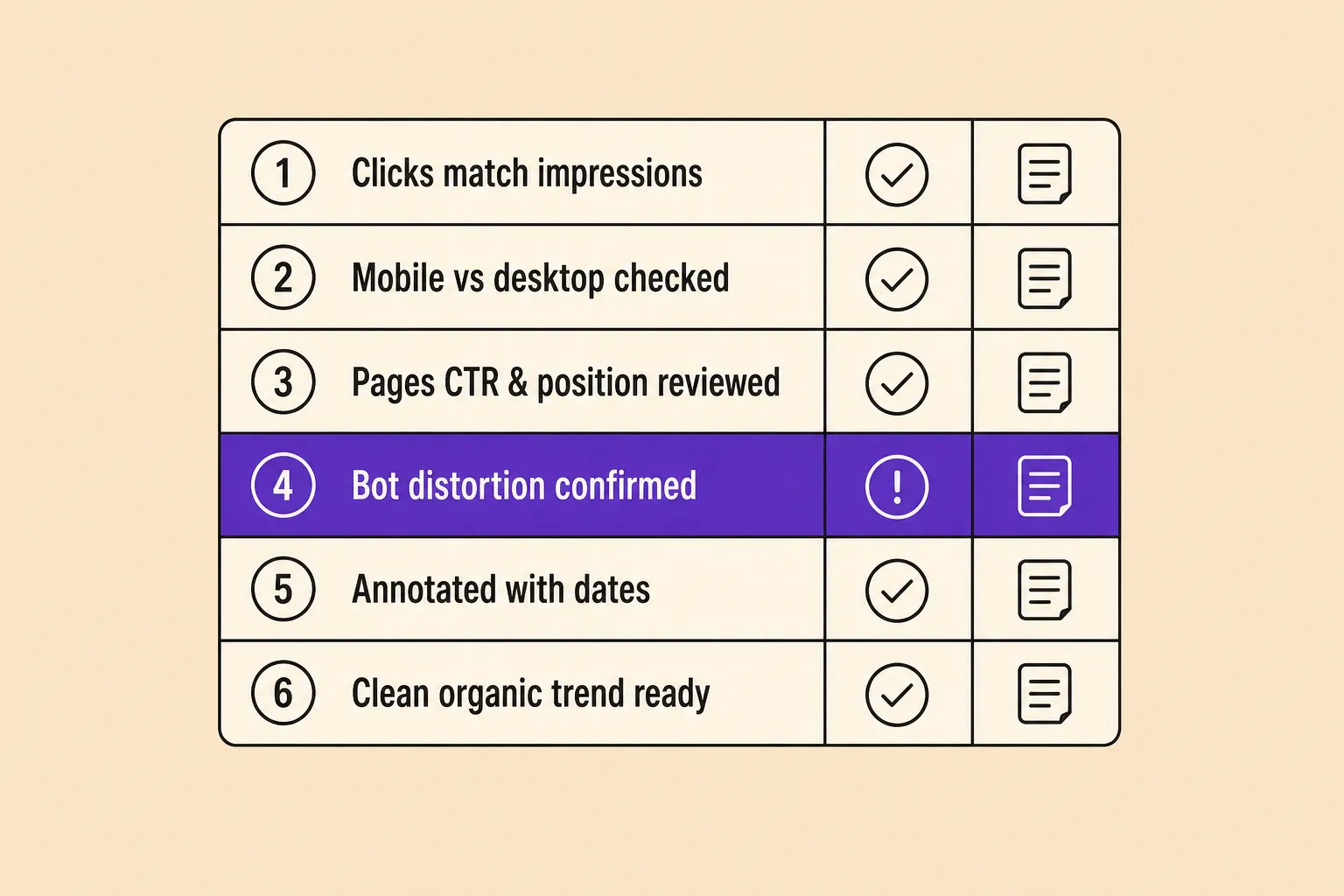
The most telling figure in Haynes' post isn't the 0.62%. It's that 45 of the 100 sites she randomly sampled weren't tracking any key events. A company that can't see conversions by channel can't judge Google, ChatGPT or anything else. For that company, the GEO debate is beside the point, and so is most of the anti-GEO debate.
The second point is where the two camps quietly converge (our analysis). Haynes argues that the AI search actually sending people to businesses is Google, through AI Overviews, AI Mode and AI-driven ranking. iPullRank argues that Google organic is becoming AI search. The coverage data backs both. Search Engine Roundtable reports that AI Overviews now appear on over 80% of Google searches, based on Semrush, SE Ranking and seoClarity data, up from 50% in June 2025. On brand searches, SE Ranking's US brand-search study found AI Overviews on 82.5% of 1,000 US brand keywords across three desktop checks in October 2026. (Both are vendor figures on different query sets, so keep them separate.)
So "focus on Google" and "AI search matters" point at the same place: what Google's AI summary says when a buyer searches your client's name. That's a brand reputation question in AI answers as much as a ranking one, and it belongs inside your client's core SEO work rather than a separate GEO budget.
How to split the 2027 budget question: three questions to put to a client
Let's turn the debate into a position you can take into a client meeting.
1. Can you see conversions by channel today? If not, fix that first. Define a key event, track it, and judge Google (including its AI surfaces) on conversions.
2. What does AI say about you when buyers ask about your category, and is it accurate? Set a baseline, then judge it like brand. iPullRank's split is a sensible template: channel metrics (share of voice across the prompts buyers use, mention frequency, citation position, sentiment) and lagging outcomes (branded search, direct traffic, self-reported attribution) read quarterly, not monthly. Accuracy matters as much as presence. Seer's October rethink of AI visibility KPIs tracks "anti-recommendations", where a brand is named but steered away from, and found Banana Republic ranked top 10 on Google for "ethical jeans" yet appeared in no AI answers across 1,000 checks. If the number is heading to a board, keep the AI visibility metrics defensible. Your client won't be first: TopRank Marketing found 30% of marketers report AI search visibility to leadership, as cited in Search Engine Land's 2027 B2B shifts piece (also Semrush-owned).
The inputs that move this baseline are mostly brand inputs. iPullRank claims earned media accounts for "the overwhelming majority" of what AI assistants cite, which puts digital PR for AI citations and the work of earning AI recommendations ahead of any file on your server.
3. What are you paying for that both camps call noise? Cut it. Schema hacks, llms.txt files and "write for the robots" content have no defender in this debate. The label itself is contested: Google's Danny Sullivan said in 2025 that "Good SEO is good GEO", so treat any GEO retainer that can't name its ruler with suspicion. Agentic commerce (Universal Cart, UCP, WebMCP), which Haynes urges businesses to prepare for, belongs on a 2027 watch list rather than a budget line. Haynes herself calls building WebMCP tools a little early for most businesses.
Key takeaways
- Treat the click data as settled: ChatGPT sent 0.62% of Google organic's sessions in Haynes' sample, so no AI budget should be sold as a traffic play.
- Judge Google, including AI Overviews and AI Mode, on conversions; judge AI answers as a brand channel, on share of voice, accuracy and branded demand read quarterly.
- Check conversion tracking before anything else. Haynes found 45 of her 100 sites tracked no key events, and those firms can't judge any channel.
- Cut spend on the GEO tactics both camps reject, and keep agentic commerce on a watch list.
- Present the brand-channel evidence to clients honestly: it is self-reported, vendor-funded and unproven at scale, which is why a baseline beats a big bet.
Frequently asked questions
Is GEO a distraction?
Partly. GEO tactics sold as a way to win traffic are a distraction, because AI assistants send a small fraction of Google's visitors. Being visible and accurately described in AI answers can still matter as a brand channel, so measure it by share of voice and branded demand, not clicks.
How much traffic does ChatGPT send compared with Google?
Very little. In Marie Haynes' 12-month GA4 sample of 100 websites, ChatGPT sessions equaled 0.62% of Google organic sessions, and all LLMs combined equaled 0.73%. A separate SEO Works study of 95 sites found organic search delivered 39 times the traffic of all AI assistants.
Should we stop investing in AI search visibility?
No, but stop funding it as a traffic channel. Set a baseline of how often and how accurately AI answers mention your brand, read it quarterly alongside branded search and direct traffic, and cut tactics such as schema hacks and llms.txt files that neither side of the debate defends.
How do you measure AI search if it doesn't send clicks?
Use brand measures. Track share of voice across the prompts buyers actually use, plus mention frequency, citation position, sentiment and accuracy, then read lagging outcomes such as branded search, direct traffic and self-reported attribution on a quarterly horizon.
What is the difference between GEO and SEO?
GEO (generative engine optimization) describes efforts to appear in AI-generated answers, while SEO targets search rankings, but the line between them is contested. Google's Danny Sullivan has said "Good SEO is good GEO", and AI Overviews now appear on most Google searches, so much of the work overlaps.
Settle it for one client
Not sure what AI tells buyers about your client's brand? Amina's AI visibility service starts with an AI Visibility Check, a single baseline of how often, and how accurately, the brand appears in AI answers. It's the evidence to settle this debate for one client, and the first step to a brand that's built to be found.