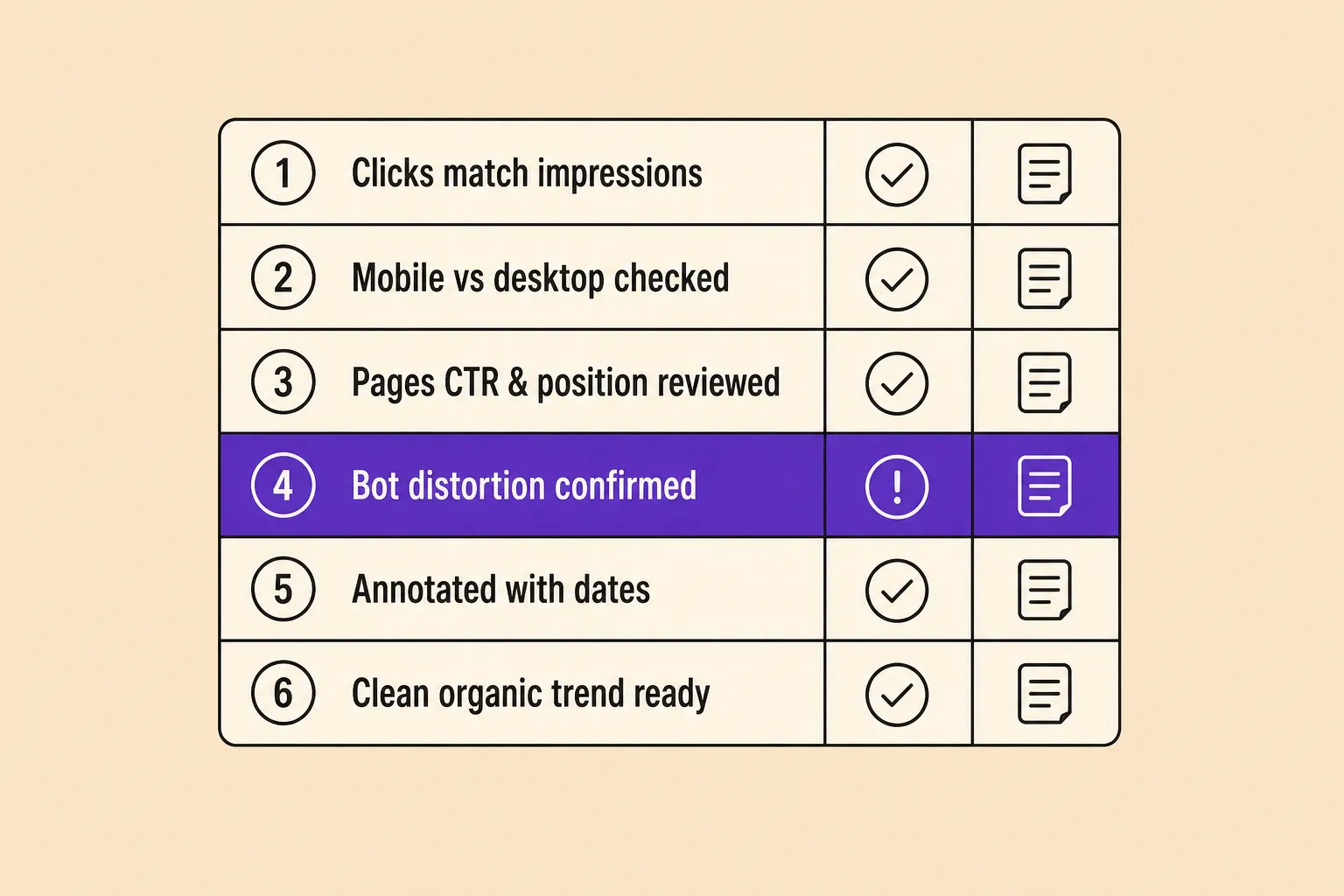
To check keyword rankings you can defend now, compare your rank tracker against Search Console's average position and trend for the same queries, spot-check any big movement by hand before you report it, and label each ranking figure with its source. Google is blocking and, in some cases, reportedly feeding false results to tools that scrape its pages, and Australian data looks more exposed than most.
Most agencies treat the rank tracker as the record of where a client ranks. It was always a sample of one results page, taken from one place at one moment, and since September that sample has become unreliable in a way that is hard to see. One rank-tracking vendor, Nozzle, found that Google has been answering suspected scrapers with complete, normal-looking pages whose results have been swapped out, and that Australian searches were among the worst affected: 11.5% of the Australian results pages it judged were poisoned.
So the confident ranking chart in last month's client report may be partly fiction. This guide gives you an eight-step check to find out which numbers still hold up, and a way to rebuild the ranking section so every figure says where it came from.
Before you start
Who it's for: agency client-services leads, white-label partners and in-house teams who pass ranking numbers to a client or a board.
What you need: the last two reports for each client, Search Console access for each client property, your rank tracker's keyword export, and its status page or support contact.
Rough effort: our estimate is an afternoon per client for the first pass, then far less once the new report template exists.
What changed, in one paragraph
According to Search Engine Roundtable's report on broken rank tracking, Google has been blocking scrapers more successfully over recent weeks, and Derek Perkins of Nozzle describes three tactics: very wide IP blocking aimed at major residential proxy networks, a big increase in CAPTCHAs, and injecting bad data into suspect results pages. SER's reading is that the target is AI bots and Google's dispute with SerpApi (which Google sued in December 2025), with SEO tools hit as a side effect. Scraping was already harder: in September 2025 Google stopped returning 100 results per page, which broke most third-party trackers at the time. Google has not confirmed the poisoning. Our Rundown covers the news; the rest of this guide is about your reports.
Step 1: List every ranking number in the report and where it comes from
Go through the last client report and tag every figure that describes a position: average rank, top-3 and top-10 counts, visibility scores, "keywords gained", the lot. Next to each, write the tool, the search engine and country it tracked, and the date the data was pulled.
This matters because most reports blend sources without saying so. A visibility index, a tracked position and a Search Console average are three different measurements, and the poisoning problem only affects the scraped ones. Done looks like a simple table: figure, source, market, date.
Step 2: Check your tracker's status notices, then ask your provider directly
Read your tool's own notices first, and date what you find, because the picture is moving week to week. As of mid-October:
- Sistrix's support page on data collection says Google returns results that "differ significantly" from regular search for some queries, that it now publishes only results that pass extra checks, and that on-demand updates have been off since September 2026. Sistrix says its top 10 rankings and Visibility Index "remain reliable"; that is its claim, not an independent finding.
- Advanced Web Ranking says the mismatch affects every rank tracker and SERP data provider, and that its pipeline now detects suspect pages and re-queries the keyword before storing a position.
- Morningscore admits that truncated Google results from 24 September were recorded as real drops, saying "recording them as real ranking drops was on us". It reported truncation back near normal, at about 1 to 2% of searches, by 4 October.
- SE Ranking told users it was "missing positions for some keywords" with most of the issue resolved, and DataForSEO posted a status notice, both as reported by Search Engine Roundtable on 12 October.
If your tool isn't on that list, don't assume it's fine; we found no public notice from several major platforms. Ask your provider (and your white-label partner, if one sits between you and the tool) three questions: what changed, which keywords and markets are affected, and what they now use to validate a position before it is stored.
Step 3: Compare the tracker against Search Console for your top keywords
Pull the client's top 20 to 30 tracked keywords and put the tracker's position beside Search Console's average position and its trend for the same query, same country, same period.
Expect the two numbers to differ, because they measure different things. Think of the tracker as a single photo and Search Console as a long exposure. Google's Search Console help page says position records the topmost position your link occupied, only when it earned an impression, averaged across all the real searches where you appeared. A tracker records one scraped page in one location.
So judge direction, not decimals. If the tracker shows a crash while Search Console impressions and clicks carry on as normal, Nozzle's guidance is that the drop is likely not real, and the tracker becomes the suspect, not the client's site. One practitioner's advice, quoted by SER, sums it up in three words: "GSC trend first."
Step 4: Spot-check big movements by hand before you report them
Any movement big enough to mention in a client meeting gets a manual check first. Search logged out, in a private window, and note what you see with a screenshot and a date. Google localises results to where you are searching from, so a check run outside the client's market shows that market's page only approximately; treat it as a visibility check, not a position.
Know the limits. A manual check is one more sample of one page, shaped by your own location and device, so it can confirm that a site is still visible but can't give you a precise position. Use it as a tie-breaker between a tracker that says "gone" and a Search Console line that says otherwise.
Step 5: Look at each keyword's own history for implausible jumps
The poisoned pages are hard to catch because, as Nozzle's Poisoned Google SERPs research puts it, "nothing on the page gives it away". The tell is the keyword's own history.
Nozzle's rule is a useful one to copy. Identify the sites that usually sit in a keyword's top 10 over several weeks. A results page is suspect when fewer than half of those usual sites appear at once, and they come back on a later check within days. A real ranking change persists; a poisoned page snaps back. In Nozzle's sample, 77.9% of poisoned pages had their usual sites back within three days (median two days), and a tracked site looked like it had fallen out of the top 10 on 58.6% of poisoned pages, against 2.7% at baseline.
Scale tells you why this step can't be skipped. Across 17.8 million judged results pages in 49 countries, Nozzle found 8.0% poisoned since 13 September against a 0.17% baseline, peaking at 27.0% on 29 September. Australia ran at 11.5% of 314,002 judged pages, above the US at 8.5%. The UK was lower at 3.0% of 1,727,225 pages, which is still roughly 18 times the baseline, so UK agencies shouldn't treat google.co.uk data as safe. A second vendor, DemandSphere, separately put spurious results at about 11% of its daily rank checks. Treat all of this as rank-tracking vendors measuring their own data, with a commercial interest; Nozzle also notes its poisoning rate varied by request route, from 1 to 7% on one route to 9 to 30% on another.
Step 6: Rebuild the ranking section around Search Console
Let's put the new section together. Lead with Search Console: clicks, impressions and average position for the client's priority queries, shown as a trend. Put the tracker underneath as a directional signal, reported as ranges and movement rather than an exact position. Label every figure with its source and the date range, in the chart title, not a footnote.
Then push the conversation one level up, toward the outcomes the client actually pays for: enquiries, calls and pipeline. Australian agencies are already moving this way. Writing in Mumbrella, Paul Hewett, CEO of In Marketing We Trust, argues that agencies should work out which report numbers are affected, shift weight to Search Console and analytics, and talk to clients about it. His example hits close to home for any agency: on 4 October page one for "white label local SEO" showed nine white-label SEO vendors, and three days later the tracked page showed none, though they were visible in a browser the whole time. That's his opinion and one example, but it shows how a poisoned page becomes a reported "crash".
One more trap to label. Sistrix's support page says that since September 2025 Google has returned a maximum of 10 results per query, and that many sites saw fewer impressions and a better average position in Search Console from mid-September 2025. A year-on-year comparison that crosses that date needs a note, or the client will read a measurement change as performance. (The current disruption is separate: Sistrix's status page logged Google delivering "incomplete or distorted search results" on 26 September 2026.) If the numbers that survive this check point to a genuine ranking problem, hand it to technical and on-page SEO work rather than smoothing it over in the report.
Step 7: Add AI visibility as a stated estimate, not a ranking
Clients will ask about AI Overviews and AI Mode, and Search Console now answers part of the question. Since June 2026 it has offered Search Generative AI performance reports, rolled out to all websites from 31 August, showing how often your pages appeared in AI Overviews, AI Mode and Discover's generative features. The metric is impressions only, by page, country, device and date; there are no queries or clicks. Google's help page also says an AI Overview occupies a single position and all its links share it, which can lift a page's average position and widen the gap with a tracker.
Beyond that, give leadership an estimate rather than a number that pretends to be exact. Ahrefs' AI search ROI method frames it as a repeatable, comparable estimate: (AI revenue minus AI cost) divided by AI cost, times 100, with costs split by asking whether you'd still pay for each one if AI search work stopped tomorrow, and revenue drawn from tracked AI referrals plus a "How did you hear about us?" question. If that question sits inside an enquiry form tied to a person, add a short collection notice, as Australia's APP 5 guidance from the OAIC expects. AI visibility measurement is still young and its terms are contested, so label it as an estimate; our piece on defensible AI visibility metrics for boards goes further, and our AI visibility service can set the baseline.
Step 8: Tell the client before they spot it
Don't wait for a client to notice that the new report looks different. A short script for the next QBR, our suggested wording:
> "Since September, Google has been blocking and, according to rank-tracking vendors, sometimes misleading the tools that check rankings automatically. So we've rebuilt this section. Search Console, which is Google's own data from real searches, now leads. The tracker sits underneath as a direction-of-travel signal. Every number shows where it came from, and any big movement has been checked by hand before it reaches you."
In our view, this honesty is what defends the retainer. A client forgives a noisier number far faster than a confident one that turns out to be wrong, and it is the standard a white-label partner should now be judged on.
Common mistakes
- Reporting a single day's swing. In Nozzle's data most poisoned spells lasted one results page; wait and re-check.
- Quietly swapping tools. Changing your data source without telling the client makes every trend line before and after look like a performance change.
- Treating Search Console average position as a tracker position. One is an average of real impressions, the other a single scraped page, so compare the direction of travel.
- Claiming an exact AI ROI. Present it as a dated estimate with its method attached, and keep it separate from rankings (our note on ranking versus AI citation rate explains why the two diverge).
How you'll know it worked
Your next report passes three checks. Every ranking figure carries a source and date label. The tracker and Search Console tell the same direction of travel, or the report explains the gap. And no question the client asks about a ranking movement leaves you without an answer.
Key takeaways
- Treat the rank tracker as a directional signal and lead the ranking section with Search Console trends.
- Before reporting any big drop, check the keyword's own history: if most usual sites vanish and return within days, suspect the data.
- Ask your tool provider and white-label partner, in writing, how they now validate positions.
- Australian tracking looks more exposed than US or UK data in Nozzle's sample, but no market is safe.
- Report AI visibility as a labelled estimate using Search Console's AI impressions, never as a ranking.
Frequently asked questions
Are rank trackers still accurate?
Rank trackers are less reliable than they were before September 2026, so treat them as directional. Nozzle found 8.0% of the results pages it judged were poisoned since 13 September, against a 0.17% baseline, and several vendors have posted notices. Google has not confirmed the poisoning.
Is Search Console average position the same as my ranking?
No. Search Console records the topmost position your link held when it earned an impression and averages that across all real searches, while a tracker records one scraped page in one location. Use Search Console to confirm the direction of travel, not a precise position on a given day.
How do I check my Google keyword ranking?
Start with Search Console's Performance report, which shows average position, clicks and impressions for each query for free. For a big movement, search logged out in a private window, ideally from the client's market, and compare the result with the keyword's history in your tracker.
Does Search Console show AI Overview data?
Partly. Since June 2026, Search Console's generative AI performance reports show how often your pages appeared in AI Overviews and AI Mode, as impressions by page, country, device and date. They do not show which queries triggered them or clicks from them.
Rankings you can stand behind
Rankings still matter, and Amina builds them properly: crawlable, well-structured sites and content engineered to be found in search and AI alike, with reporting that says where every number comes from. See how Amina does SEO, or ask for a sample report.