To manage a client's reputation on Google now, search their brand name logged out, record what the AI Overview says and which sites it cites, then correct or strengthen those third-party sources. On most branded searches an AI summary now appears, usually above the client's own website, drawing mainly on Wikipedia, YouTube and LinkedIn. That makes the fix earned-media work, which PR agencies already sell.
Ask an agency principal whether a client's reputation is safe on Google and you will usually hear the same reassurance: we rank first for the name. That answer made sense when a brand search returned ten links and some review stars. It no longer describes the first thing a searcher reads.
Google now puts an AI Overview on most branded searches. Ahrefs' analysis of 232.8 million US desktop crawls found one in 82.91% of branded-keyword results as of 29 September 2026, with the September monthly average at 73.3%, up from 65.1% in August and 61.3% in July. Our recommendation is to start every online reputation management engagement by auditing the sources that summary cites, not the sentiment around the brand. The six steps below take you from a client's name to a client-ready report.
Before you start
Who it's for. PR and communications teams who manage client reputations without an SEO specialist on staff. If your team can run a search and keep a spreadsheet, it can run this audit.
What you need. A logged-out browser window set to an Australian location (plus a UK check for clients with British audiences), a spreadsheet with one tab for searches and one for cited sources, and a way to take dated screenshots.
Effort. Our estimate is roughly half a day per client for the first pass, and less on each re-check once the search list exists.
One caveat on the data. The Ahrefs figures are US desktop results. A second tracker, DemandSphere's daily branded-keyword data, saw the same September jump and reached 82.06% on 29 September, but DemandSphere is a SERP-tracking vendor that does not disclose its sample size or country split, and its daily readings swung from 57.43% on 18 September to 31.15% the next day. Both datasets end on 29 September 2026; nothing later has been published, and we found no Australian or UK measurement of AI Overviews on brand searches. Treat the international pattern as the reason to check your own client, not as a description of their results.
Step 1: List the brand searches that matter
Write down the searches a journalist, customer, investor or job candidate would actually type. Start with these patterns and keep the list fixed, because you will rerun it on every check:
- the bare brand name
- the name plus its main product or service
- the name plus "reviews" and the name plus "pricing"
- the names of the CEO and other senior leaders
- the name plus "complaints"
Bare names deserve their own row. Ahrefs tracked 100 brand names from Interbrand's Best Global Brands 2025 and found AI Overviews on 63 of them by 30 September, against five of 98 usable results on 1 July. Done looks like: one list per client, saved in the spreadsheet.
Step 2: Capture the AI Overview for each search
Run each search in a private window with the location set to Australia, then again from the UK for UK-facing clients. For every search, record the date, the location, whether an AI Overview appeared, where it sat relative to the client's own site, and the full summary text. Screenshot it.
Position is the column that matters most. Of the 63 bare-name AI Overviews in the Ahrefs panel, 48 (76.2%) sat in position one, with an average position of 1.49. Ahrefs' earlier research found a 58% lower click-through rate for the top-ranking page when an AI Overview is present, so a summary above the client's site may be the only description many searchers read. Ahrefs' study was prompted by Chris Long, who found AI Overviews on 93 of the 100 enterprise brand names he tested. Done looks like: one row per search, with a screenshot file name.
Step 3: Record every cited source and label it
Think of the AI Overview as a briefing note written by someone who read your client's Wikipedia entry and watched a few YouTube videos, but never called the press office. Your job is to find out what they read. Expand the citations and log every linked page, then give each one a label: owned, reference (such as Wikipedia), platform (such as YouTube or LinkedIn), review site, media, or competitor.
Expect the reference and platform labels to dominate. Wikipedia accounted for almost 72% of external citations in Ahrefs' panel, followed by YouTube and LinkedIn, which Ahrefs notes are much harder for a brand to control than its own pages. Competitors rarely feature: only two of 58 visible answers discussed a rival, and just one verified competitor-owned site appeared across 57 source lists. The risk is third parties framing your client, not rivals being promoted.
These citations are ordinary search results. Google's guidance on AI features says a page only needs to be indexed and eligible to show with a snippet to appear as a supporting link, with no additional technical requirements, and that AI Overviews may run related "fan-out" searches across subtopics. For UK clients, log review platforms carefully: BusinessCloud reported that Trustpilot ranked as the fifth most cited domain on ChatGPT in January 2026, per Promptwatch. That is ChatGPT data, not AI Overviews, but it puts review sites firmly on the list. For Australian clients, record local review sites such as ProductReview.com.au wherever they appear. Done looks like: every citation in one tab, with its label and the search it came from.
Step 4: Check each claim for accuracy and currency
Go through each summary line by line and mark every claim accurate, outdated, wrong or missing context, then note which cited source it came from. Look hardest at discontinued products, former executives, old pricing and retired brand names. Videos need particular care. Ann Smarty, as reported by Ahrefs, noted that cited videos weren't from the brand's official account and "may very well include outdated product information". Done looks like: a verdict and a source beside every claim.
Step 5: Sort each source into fix, strengthen or monitor
Let's turn the spreadsheet into a plan. This triage is our method rather than any vendor's.
Fix: factual errors at a source you can legitimately correct. Correct owned assets (the website, the LinkedIn company page, the official YouTube channel) directly. Wikipedia needs a different route. Its conflict-of-interest guideline says editors with a conflict are strongly discouraged from editing affected articles directly and can propose changes on the article's Talk page using the Edit COI template. An agency paid by the client also counts as a paid editor, and the paid-contribution disclosure policy requires it to disclose its employer, client and affiliation under the Wikimedia Terms of Use, with non-disclosure agreements no exception. For media articles and third-party videos, ask the publisher or creator for a correction. You can also flag the summary to Google: Google's AI Overviews help page describes a thumbs-down button and a "Report a problem" option, and your feedback includes the query and its results. Google does not promise the overview will change, and it documents no correction or removal route for brands, so the durable fix sits at the source.
Strengthen: commercial-intent searches where third parties tell the story. This is where earned coverage pays. NP Digital's study of 9 million AI answers across nine platforms and 400+ enterprise brands found 82% of citations on commercial-intent prompts went to third parties and 3% to the brand's own pages, against up to 13% owned on navigational and informational queries. That is AI-answer data across assistants, not Google results, so keep it separate from the Ahrefs figures. The same study measured citation lift by channel: YouTube 2.8x, LinkedIn 2.7x, Reddit 2.4x, G2 1.9x and Gartner 1.6x. Australian research points the same way. Melbourne advisory LEOPRD, which sells AI-visibility services, found 86% of citations in AI answers came from outside brands' own properties, based on 31,200 AI responses drawn from more than 214,000 across Australia, the UK and the US. In a B&T opinion piece by LEOPRD founder Celia Harding, SafetyCulture (now Mitti) drew only 10% of its citations from its own content and 55% from commercial content, including competitor pages, and those sources repeated consistent attributes about it. In the same research, answers where a brand lost averaged 9.2 citations against 8.4 where it won, so what sources say matters more than how many there are. Our earlier piece on digital PR and AI brand citations covers the pitching side. (Some vendors call this generative engine optimisation; the label is contested, and Google's position is that good SEO is good GEO. The work itself is familiar coverage on the topics buyers check before they spend.)
Monitor: accurate, neutral sources. A correct Wikipedia entry or a fair news report needs no action now. Watch it at each re-check.
Done looks like: every source carries one label, an owner and a next action.
Step 6: Turn it into a one-page client report and set a re-check date
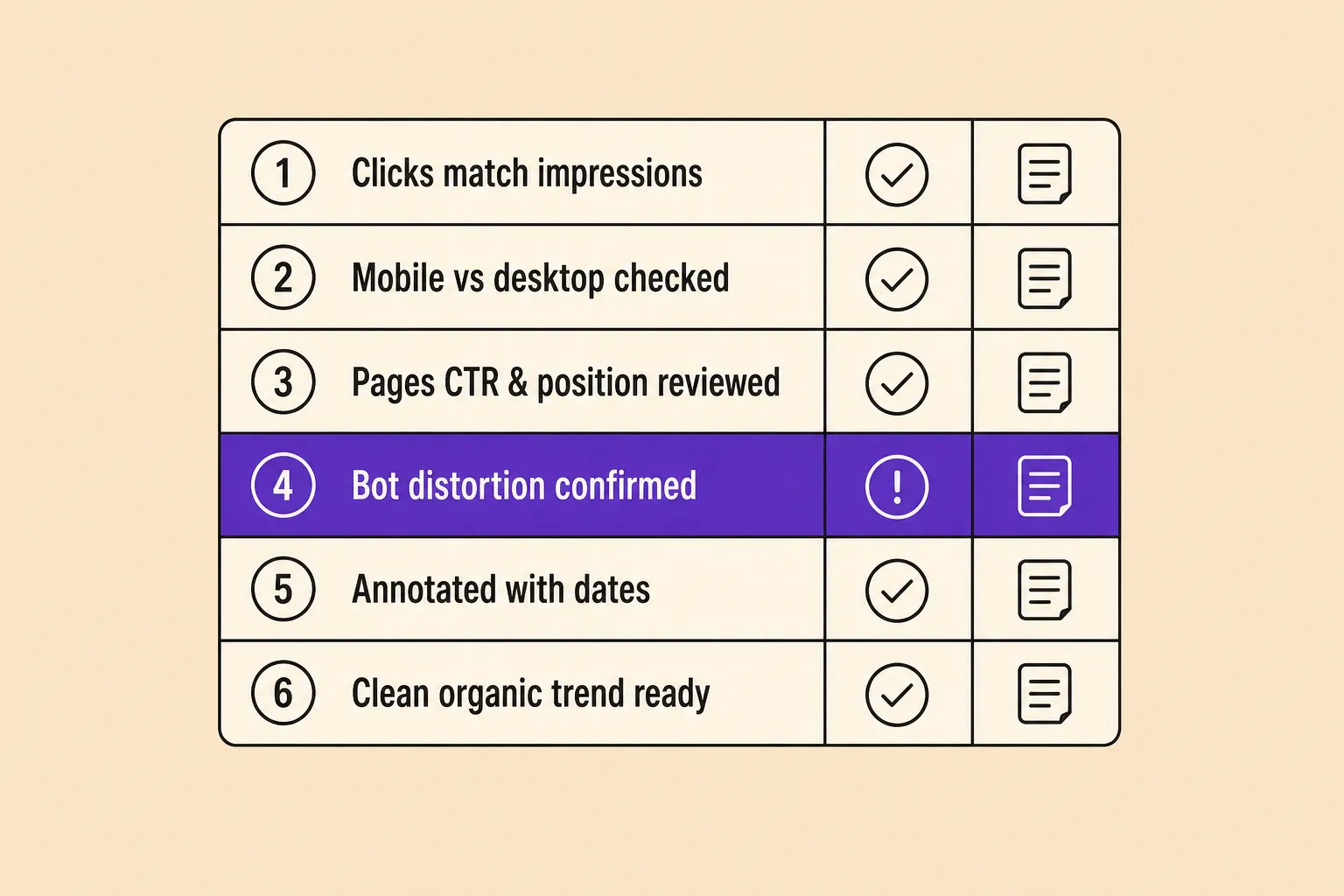
Put the audit on one page, so a managing director can present it and a client's head of strategy can take it to the board:
1. The searches checked, with date and location.
2. What the summary says, quoted from the screenshots.
3. A source table: source, label, accuracy verdict, and fix, strengthen or monitor.
4. The top three actions, each with an owner.
5. The re-check date.
Frame the findings in the board-level language of brand reputation in AI answers and keep the measures defensible for a board: what you observed, on which date, from which location. We recommend re-checking every six to eight weeks. The published data stops at 29 September, so your own re-check is the only reliable answer to "is it still like this?" Done looks like: a report the client can forward without edits, and a date in the diary.
Common mistakes
Funding review or sentiment work to move AI citations. NP Digital found sentiment correlates negatively or flat with citation frequency across ChatGPT, AI Mode, Gemini, Copilot and Grok, and advises against funding reputation work in the hope it moves citation counts. Reviews still matter for conversion and trust. Manufacturing them is a live enforcement risk in the UK: the CMA opened investigations into online review practices at Autotrader, Dignity, Feefo, Just Eat and Pasta Evangelists in March 2026, after a review found 54 of more than 100 businesses could be failing to comply with its fake-reviews guidance. Its Dignity case examines whether the company asked staff to write positive reviews. No findings have been made in either case.
Editing the client's Wikipedia page directly. Use the Talk page, disclose the relationship, and let editors review the request.
Treating one snapshot as permanent. DemandSphere's readings moved by more than 26 points in a day, and LEOPRD found only 40% of repeated-test groups returned the same outcome throughout (AI-answer data, not AI Overviews). Date every capture and compare like with like.
Assuming "we rank #1 for our name" means control. A summary in position one is read before the client's own listing, and a top ranking does not guarantee a citation. Our piece on AI citation rate versus ranking covers why.
Abandoning owned content. When a brand's own content is cited, NP Digital found its AI visibility rate jumps 5x. Owned-page hygiene still counts; on commercial searches it is simply outweighed by third parties.
How you'll know it worked
Rerun the same search list from the same locations six to eight weeks later and compare it with your first report. Three signals show the audit is working: the claims you fixed now read correctly in the summary, at least one source you strengthened appears among the citations on a commercial search, and no new factual errors have surfaced. If a corrected page still is not cited, confirm it is indexed and can show a snippet, since that is Google's stated eligibility test for supporting links.
Key takeaways
- Rank first for the name and an AI summary can still sit above you: Ahrefs found AI Overviews in 82.91% of US desktop branded results on 29 September 2026.
- Audit the cited sources before the sentiment. Label each one owned, reference, platform, review site, media or competitor.
- Fix errors at the source, through owned profiles, publisher corrections and Wikipedia Talk-page requests with full paid-editor disclosure. Google's feedback button promises nothing.
- Strengthen third-party coverage on commercial-intent topics, where NP Digital found 82% of AI-answer citations go to third parties.
- Re-check every six to eight weeks from an Australian (and UK) location, and report changes by date.
Frequently asked questions
What is online reputation management?
Online reputation management is the practice of shaping what people find when they search a brand or its leaders online. On Google that now includes the AI Overview, which Ahrefs found on 82.91% of US desktop branded-keyword results as of 29 September 2026, so an audit should start with what that summary says and which sources it cites.
Can you remove an AI Overview from your client's brand search?
No documented route exists. Google's help page offers a thumbs-down and "Report a problem" feedback option on each AI Overview, but it does not promise any change and describes no correction or removal process for brands, so the durable fix is correcting the sources the summary cites.
Do better reviews get a brand cited more by AI?
Not according to NP Digital's analysis of 9 million AI answers, which found sentiment correlates negatively or flat with citation frequency across ChatGPT, AI Mode, Gemini, Copilot and Grok. Reviews still matter for conversion and trust, but they are not the lever for AI citations.
Can a PR agency edit a client's Wikipedia page?
It should not edit the article directly. Wikipedia's conflict-of-interest guideline strongly discourages it and points paid editors to the article's Talk page, where they can propose changes using the Edit COI template, and the Wikimedia Terms of Use require paid editors to disclose their employer, client and affiliation.
How often should you re-check a client's AI Overview?
We recommend every six to eight weeks, using the same searches and locations each time. Branded AI Overview data has been volatile, with DemandSphere's daily readings swinging sharply in September 2026, and no published dataset yet covers the period after 29 September.
About Amina
This is the work Amina does every day. Our AI-visibility service checks what Google's AI Overviews and the major AI assistants say about a brand and closes the gap, so clients are built to be found and described accurately when someone searches their name. Ask for the PR-edition AI Visibility Check to see a white-labelled sample report before you pitch it.