Ask a PR leader who owns the way a client shows up in AI answers, and most will point down the hall to the SEO team. The assumption is that being described well by ChatGPT or Google's AI answers is a technical job, solved on the client's own website. It rarely is. When an assistant explains what your client does, it assembles that description from whatever sources it trusts, and most of those sources are earned coverage, not the homepage. Australian buyers have already moved, in the words of one local study, from "search and click" to "ask and trust." That shift relocates the lever on brand perception to exactly where a PR agency already works: off-site. The argument here is simple. AI visibility is earned-media work, and it is finally measurable as one.
The question your client is really asking has changed
For years the search question about a client was simple: do we rank? The more useful question now is whether the sources an AI system trusts describe the client correctly. In a Moz AMA on measuring AI search, Tom Capper argues that historical SEO asked "how do I appear for this query?", while the job now is making sure the sources AI systems use describe your brand accurately. The label for this work is contested, and worth keeping loose. Capper is careful that AI search is not a wholly separate discipline: "it's still SEO," he notes, but the blend, the priority and the way you think about the tactics all change. Treat "AI search visibility" as a useful lens, then, not settled doctrine.
Buyers are forming those first impressions inside an assistant before they reach anything a brand owns. A ChannelEngine survey of 4,500 marketplace shoppers across five markets including the UK found 58% had used AI tools to research products and 37% had started a purchase journey through an AI assistant (ChannelEngine sells marketplace-integration software, and that sample is consumer rather than B2B). For business buyers the pattern is sharper. Forrester's 2025 Buyers' Journey Survey reported that 94% of business buyers now use AI somewhere in the buying process, up from 89% a year earlier, and that twice as many named generative AI or conversational search a more meaningful source than any other, ahead of vendor websites and sales reps. Those are respondent-based readings of fast-moving behaviour, so treat them as directional. No confirmed Australia-specific figure has been published yet, but the local trend line points the same way: a study of 115 Australian businesses by the agency Optimising recorded a median rise of 1,200% in AI referral traffic year on year, with 88.5% of those sites now receiving AI traffic and ChatGPT driving 90.2% of it.
Why the answer comes from off-site
The reason earned coverage matters is mechanical. When an assistant needs current information, Capper explains, it runs a grounding search and pulls the best answer from wherever it lives, and the system does not care whether that source is your client's site or a masthead. In his words, this puts a greater emphasis on off-site work than search has seen in a long time, "or possibly ever." He calls it digital PR taking its seat at the adult table.
You can watch the mechanism operate locally. When Google's AI Mode launched in Australia in October 2025, it used a "query fan-out" technique that breaks one question into several sub-searches and assembles a single answer from across the web. Think of the assistant less as a librarian pointing you to one shelf and more as an editor commissioning quotes from every source it rates on the topic. Whoever the editor trusts gets to shape the story.
The clearest local proof that PR now holds this lever is where the money is moving. Australian performance-PR platform Linkby raised $23 million in a round led by Volition Capital on the explicit thesis that brands are shifting from SEO to AI discovery, running paid editorial across more than 600 publishers. Its chief executive, Chris Wirasinha, put the case in one line: "LLMs are what they eat, and what they eat is content."
Recommended without being cited still counts as a win
One reason a PR agency should not report AI visibility like a rank tracker is that a win does not always carry a citation. Capper's example is worth holding onto: ask an assistant for the best smartphone and it may recommend Samsung while citing PCMag. Samsung was not the cited source, yet it got the recommendation, and for the brand that is the outcome that matters. That maps cleanly onto what earned media has always sold, favourable third-party description, now surfacing inside the answer a buyer reads first. It also means the right metrics look more like the ones other marketing channels already use: visibility, recommendation and brand association, rather than link position or clicks.
Earned coverage only helps if the machine can read it
There is a catch a PR team controls less than it would like. Third-party coverage lifts AI visibility only when the systems can actually access it. If a target publication blocks the crawlers that assistants use for live retrieval, that coverage may never surface in a live answer, so it is worth checking which of a client's earned placements are reachable.
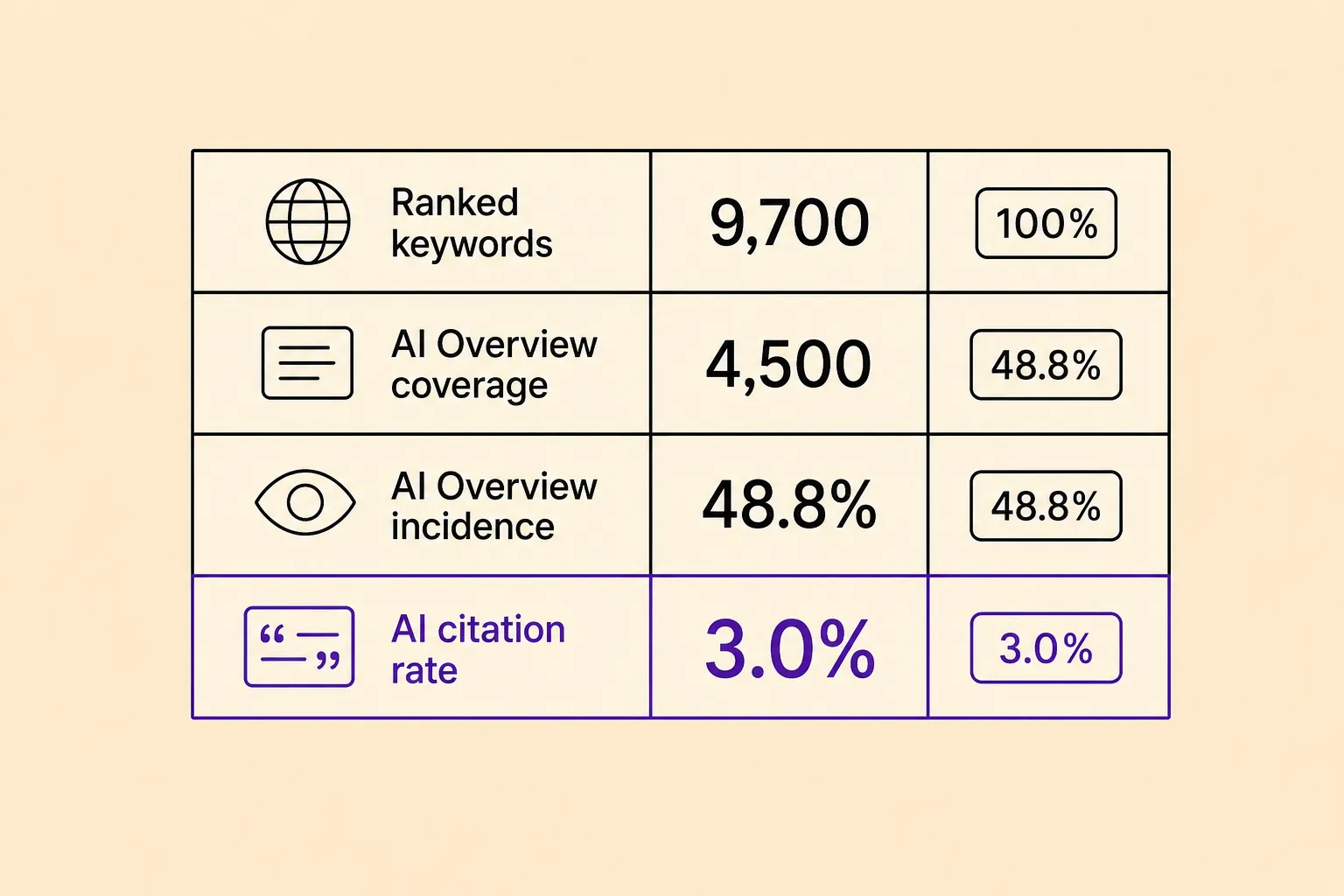
Access is one half of the problem. Quality is the other. The Walker Sands benchmark, written up in Search Engine Land (owned by Semrush), analysed 828 enterprise B2B companies and found the median brand ranks for about 9,700 keywords yet is cited in just 3% of the AI Overviews summarising those same searches. Ranking breadth did not predict citation. The brands cited consistently shared deep topical authority, structured explanations that answered buyer questions, and coverage across multiple relevant pages. For a PR strategy that is a useful brief: one press hit rarely moves the needle, while sustained, specific, well-structured coverage does. The benchmark is US-based, with no equivalent Australian figure yet published, so read the exact percentage as a US signal rather than a local one.
The access pressure is genuine in the local market too. The same reporting on Australia's AI Mode launch noted that AU news sites are down as much as 35% year on year in organic search since AI Overviews arrived. The coverage matters more, in other words, even as the clicks through to it fall away.
From AVE and reach to AI share of voice
All of this points to a reporting line clients are already asking for. The recurring question, "do we come up in ChatGPT?", is really a request for a share-of-voice number in AI answers. Let's give it a name an agency can own: AI share of voice, the frequency and quality with which an assistant describes and recommends a client across the tools buyers actually use.
It is a cleaner story than the numbers PR has leaned on for decades. Advertising value equivalents have been rejected by the industry's own standards body: AMEC's Barcelona Principles state plainly that AVEs do not measure the value of PR. Swapping a discredited proxy for a measure of how AI actually describes a brand is a credible upgrade. To be precise about the evidence, the rejection of AVE is the standards-body position; a measured decline in practitioner trust over time is harder to source, so treat the new-KPI case as a strong argument rather than a proven trend.
The demand is funded, and close to home. Sydney startup Hall raised $2 million to monitor how brands appear across ChatGPT, Perplexity, Claude, Gemini and Copilot, framing its product around precisely that client question. In the UK, London platform Searchable raised £3.1 million on the same premise, with a line a PR leader should sit with: "On Google, you could survive on the second page. In AI search, there is no second page."
Key takeaways
- The description an AI assistant gives of a client is assembled mostly from earned coverage, which makes off-site reputation the primary lever on AI brand visibility and puts it inside a PR agency's core competency.
- A recommendation counts even without a citation. Measure visibility, recommendation and brand association, not link position or click-through.
- Coverage only helps when assistants can reach it and parse it. Check which earned placements are accessible, and favour sustained, specific coverage over one-off hits, in line with what the Walker Sands benchmark found separates cited brands.
- Reframe the client's "do we come up in ChatGPT?" question as AI share of voice, a repeatable KPI that replaces AVE, which the Barcelona Principles already reject.
- The measurement market is funded locally (Linkby and Hall in Australia, Searchable in the UK), evidence the demand is live, not hypothetical.
Frequently asked questions
What is digital PR for AI search?
Digital PR for AI search is the practice of shaping the third-party coverage that AI assistants draw on when they describe a brand. Because grounding searches pull answers from wherever the best information lives rather than only a brand's own site, earned coverage becomes a direct influence on how ChatGPT, Perplexity or Google's AI answers characterise a client, as Moz's Tom Capper argues.
How is AI brand visibility different from SEO?
AI brand visibility is measured by how a brand is described and recommended in AI answers, not by where a page ranks. The two overlap, and Capper notes it is "still SEO" in many respects, but the emphasis shifts heavily toward off-site work and toward metrics like recommendation and brand association rather than clicks or URL position.
Can a brand be recommended by AI without being cited?
Yes. An assistant can recommend a brand while citing a different source, for example recommending a phone brand but citing a review site. For most brands the recommendation is the win that matters, which is why AI visibility should be tracked as recommendation and association, not only as citations.
How do you measure AI share of voice?
AI share of voice tracks how often, and how favourably, an assistant describes and recommends a brand across the tools buyers use, such as ChatGPT, Perplexity, Claude, Gemini and Copilot. Funded platforms in Australia and the UK now monitor exactly this, reflecting a shift toward visibility and recommendation metrics over legacy measures like AVE, which the industry's Barcelona Principles reject.
Turning the client question into a report
If a client has already asked how they show up in ChatGPT, that is the opening. M2.0 runs a PR-edition AI Visibility Check that produces a sample AI share-of-voice report, showing how a brand is currently described and recommended across the main assistants. No client names are needed to start the conversation, and the output is designed to sit next to the coverage reporting an agency already sends.