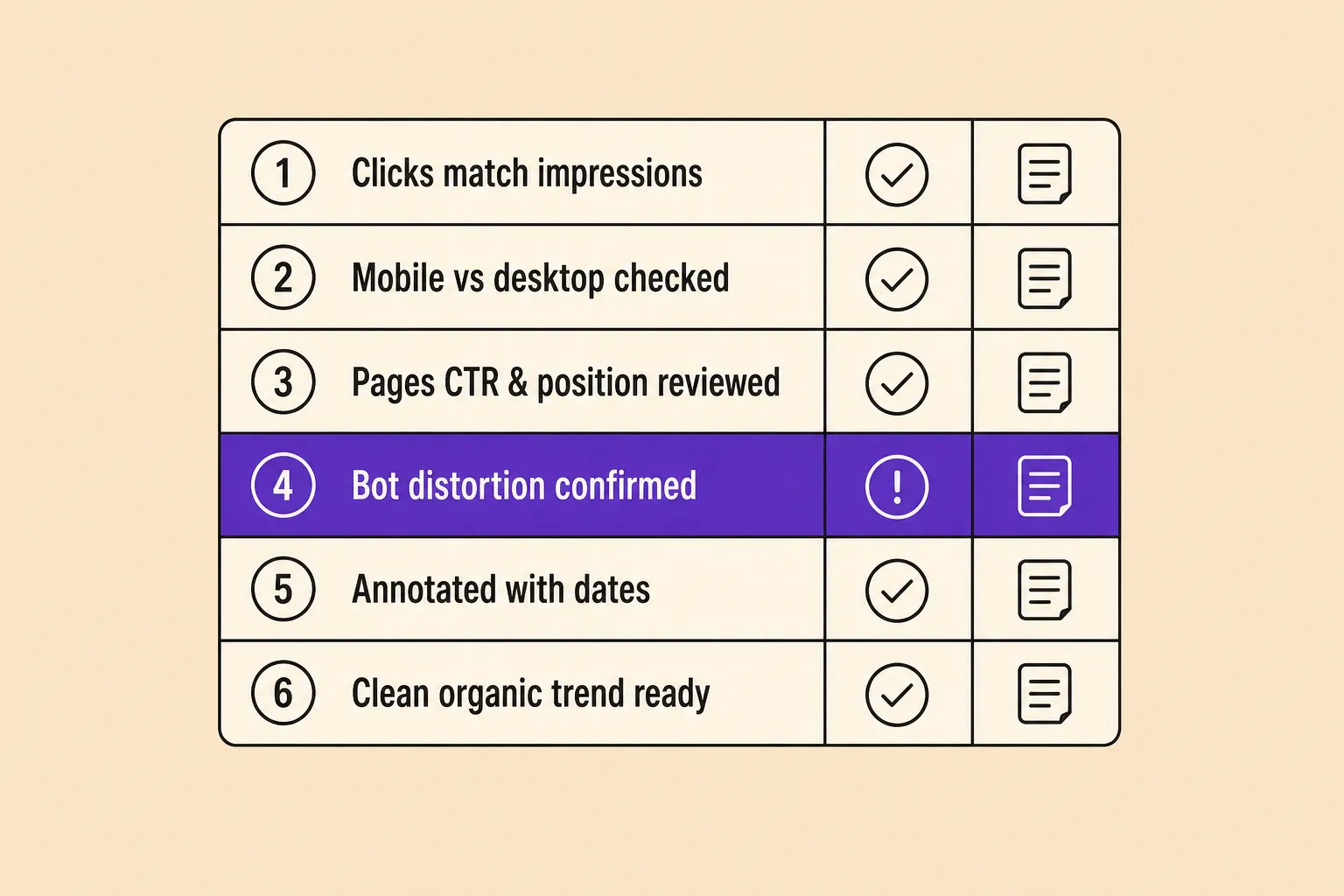
Before you report a Google ranking drop, check whether it reversed the next day and whether the usual competitors disappeared with it (signs of a poisoned tracker check), then compare the same query, date, country and device in Search Console: if impressions and position held, the drop was in the tracker's data, not in Google. Only after that gate do Discover, results-page changes, bots and real losses come into play.
The alert says a client fell out of the top 10 overnight, and the obvious reading is that the client lost rankings. Since mid-September, that reading has been wrong more often than any agency would like. Google has been answering suspected scrapers with results pages that look complete and normal but have most of the usual organic results swapped, with no error and no CAPTCHA, so trackers store them as real data, as Search Engine Watch's report on poisoned SERPs explains.
Add Discover, results-page changes, bots and update rumours, and one alert can have several explanations. Our recommendation: no drop reaches a client until Search Console has seen it, and the cheapest checks run first. An agency without an SEO specialist can run this list. What it can't afford is a call about a drop that never happened.
Why a drop needs checking now
Rank trackers across the market have reported the problem, and the vendors disagree on how much because they define a poisoned page differently. Nozzle analysed 27.5 million SERPs across 49 countries and found 8.0% came back poisoned from 13 September, against 0.17% before. AccuRanker, applying Nozzle's rule to its own data in its post on how it handles poisoned SERPs, put its share at 1.5% a day for 1 to 9 October, "about a fifth of theirs". SE Ranking said on X on 16 October that the issue "still affects roughly 2% of tracked results", and DemandSphere reported spurious results on about 11% of its daily collected SERPs on a single day, 7 October. Semrush, in a statement to Search Engine Roundtable, said "The impact on the rankings our users track has been limited", with remaining cases "most often beyond the first page of results". Keep each figure with its vendor and period. The fair summary is that vendors report between about 1% and 8% over these weeks, measured differently.
The market picture is just as contested for Australian agencies. Nozzle's research page puts Australia at 12.9% poisoned (532,709 judged SERPs) against 4.1% for the UK (2,858,335 judged SERPs), covering SERPs from 13 September to a 21 October data cut-off. AccuRanker reports an even 1.1% to 1.7% across the 22 markets it tracks and says "no market, device, or keyword type stands out". It does not name all 22. Its lowest was New Zealand, which sits among Nozzle's highest. So the vendors read the market next door in opposite directions, and UK agencies should treat Nozzle's lower figure as lower exposure, with the same checks still applying. Paul Hewett, CEO of In Marketing We Trust, argued in a Mumbrella opinion column that agencies "should already be shifting the weight of their reporting to data Google gives you directly". This checklist is built on that rule.
Google has been quiet. Its spam policies on machine-generated traffic already cover "scraping results for rank-checking purposes or other types of automated access to Google Search conducted without express permission", but it has said nothing publicly about swapped results. SEO consultant Brodie Clark suggests the aim may be stopping LLM competitors from using Google's data, leaving trackers as "collateral damage". That is his reading, and Google has not confirmed it. The Rundown tracks the news as it moves; this piece is the diagnosis.
How to use this checklist
Run it per drop, per client, in order, and write down the answer to each check. Stop as soon as a check explains the drop. Think of it like a mechanic's diagnostic: you rule out the flat battery before you price a new engine, because the cheap explanation is also the likely one right now.
The ranking drop checklist
Group 1: Is it the tracker?
- Check whether the drop reversed the next day. Poisoned spells are short: AccuRanker found more than nine in ten runs of poisoned days for a keyword last one day, and Nozzle found 77.9% of poisoned SERPs had their usual sites back within three days.
- Check whether most of the usual competitors vanished from the same page at the same time. On poisoned pages Nozzle found only 20.7% of the previous day's sites remained (against 88.5% normally) and the tracked project's own site was missing from the top 10 on 58.6% of them (against 2.7%), so a page full of unfamiliar sites, often with more Reddit and Facebook, points at the data.
- For local clients, check whether the results show businesses from the wrong city. AccuRanker says a poisoned local page "lists businesses from other cities, while the location line at the bottom of the page still names your city", and Nozzle found "near me" searches were poisoned 13.6% of the time against 8.6% for everything else, which is where Hewett says most Australian SMB search budgets sit.
- Ask the tracker whether it has re-checked the keyword, and how it detects and re-fetches bad pages. AccuRanker compares each new page one with the sites seen on at least two of the last three days, fetches again with another session when fewer than half remain, and says the second fetch returns normal results "about 3 times in 4"; Semrush asks users to report inconsistencies to its support team.
- Find out whether the tracker buys its results from an upstream SERP data provider. Providers that supply other tools have been slower to fix the problem, and SerpApi, which has an open issue, said on 14 October that an update "should reduce the number of instances".
Group 2: Did Search Console see it?
- Compare the same query, date, country and device in the Search Console Performance report. If impressions and average position held, the drop lived in the tracker's data, and this is the gate: nothing goes to the client until it passes here.
- Read the last two to three days as provisional, and line up the dates. Google says in its guide to Search Console data that collected data "should be available in 2-3 days" and that the Performance report "tracks daily data according to local time in California", so an Australian or UK "overnight" drop can straddle two Search Console dates.
- Check the data anomalies page before trusting a dip. Google's data anomalies page lists no September or October 2026 notices as of 26 October, but it recorded Discover logging errors in May, June and August this year, so it is worth a look before you read any Discover dip.
Group 3: Is it Google?
- Check the Search Status Dashboard for an announced update with a start time. As of 26 October 2026 the latest ranking entry on Google's Search Status Dashboard is the September 2026 spam update, released 24 September and complete 8 October (Pacific time) after 13 days 16 hours, the longest spam rollout of 2026. Re-check it on the day you call.
- The last core update was Google's May 2026 core update. Hewett's point still holds: "genuine ranking changes do not reverse within a day", even though the spam update overlapped the poisoning peak.
- Treat an empty month as "nothing announced", which is a weaker claim than "nothing changed". The dashboard lists only the updates Google chooses to announce, and the forum reports of an October update are mixed: one WebmasterWorld member reviewing more than 100 Search Console accounts saw a decline of "maybe .5 to 1%", while another reported traffic up over 35%. For UK readers, the CMA's fair ranking conduct requirement now obliges Google to "provide sufficient notice and information about material changes that could affect publishers", though the page does not say how or where that notice appears.
Group 4: Which surface lost traffic?
- Open the Search results, Discover and Google News Performance reports separately, since those surfaces run on systems separate from core web ranking. Use the Search results report, the Google News report and the Discover report, which appears only once a property reaches a minimum number of Discover impressions.
- Date when the problem started. Most forum members date their Discover and News problems to late August, a month before the spam update began, so a loss that started before 24 September points away from the spam update and towards those surfaces.
Group 5: Did the results page change around a stable ranking?
- If rankings held but clicks fell, look at those queries for new AI Overviews, ads or local units. A Sistrix visibility score "skyrocketing" while clicks stay flat fits results-page changes better than ranking losses, and ranking well and being cited in AI Overviews are different measures, so the conversation shifts to tracking AI Overview exposure, a field whose metrics (and labels like GEO) are still contested.
- Unsure whether a feature is new? Check it against a record of past features. One option is Search Engine Roundtable's Is It New AI scan tool: upload a screenshot, highlight the element and AI checks it against 23 years of the site's images; it is new, email-gated (it signs you up to Barry Schwartz's newsletter) and capped daily.
Group 6: Is it bots, or is it the site?
- When analytics and Search Console disagree, check server logs for bots first, then any recent bot-blocking rule changes. Several of the forum site owners were writing Cloudflare rules against scrapers, and bot filtering can skew SEO reports, so a change to the rules can move the numbers with no change in Google.
- Only now treat it as a real loss, and open an investigation. Work through the Page indexing report, recent site changes, migrations and template releases, then content quality, where pruning and consolidating weak pages may be part of the fix.
Priority: what to check first
Our ordering puts cost and likelihood first. The first two Group 1 checks take minutes and need nothing but the tracker's history. Then the Search Console comparison in Group 2, which is the gate for everything after it. Groups 3 to 6 only matter once a drop has passed that gate.
Three deal-breakers sit above the list:
- Never report a drop Search Console didn't see. If Google's own data held, the client's position held.
- Never call a one-day drop a trend. By AccuRanker's count, almost every poisoned spell lasts a single day.
- Never call it a core update before the dashboard does. Forum threads are a reason to watch the dashboard, and that's all they are.
The retainer rides on credibility far more than on any single drop. One false alarm costs more trust than one late warning.
What to do with the results
Each outcome maps to a different client conversation, and having the script ready is half the value of running the list.
"The tracker was wrong, here's the verified figure." Lead with the Search Console number for the same query, date, country and device, name the tracker issue in a sentence, and move on. Clients rarely mind a data problem you caught first.
"Your rankings held, but the page changed." Show the stable position next to the falling clicks, then the new AI Overview, ad or local unit on those queries. The question becomes what that page now rewards.
"This is a real loss, here's the investigation plan." Name what you have ruled out (tracker, surface, results page, bots), then list what you will check next and when you will report back.
Let's make it stick: add Groups 1 and 2 to every monthly report as a standing verification step, so each ranking figure carries its source. That habit is what makes ranking metrics defensible when a client or their board asks where a number came from.
Key takeaways
- Run the two free checks first: did the drop reverse the next day, and did the usual competitors vanish with it?
- Make Search Console the gate. Compare the same query, date, country and device, and treat the last two to three days as provisional.
- Keep vendor figures separate. Nozzle, AccuRanker, SE Ranking and DemandSphere measure poisoning differently, and they disagree on whether Australia is more exposed.
- Split Search, Discover and Google News before you diagnose a ranking loss; they are separate reports and separate systems.
- Add Groups 1 and 2 to every monthly report, so no client hears about a drop Google's own data never showed.
Frequently asked questions
Why did my Google rankings drop overnight?
An overnight drop is often a tracker problem rather than a real loss right now. Since mid-September, Google has served some automated collectors results pages with most of the usual sites swapped, and AccuRanker found more than nine in ten poisoned spells last a single day. Check whether the drop reversed and whether competitors vanished too, then confirm in Search Console.
Are rank trackers accurate right now?
Rank trackers are less reliable than usual, by an amount the vendors dispute. Nozzle found 8.0% of SERPs poisoned from 13 September, AccuRanker measured about 1.5% a day for 1 to 9 October under Nozzle's rule, and SE Ranking said on 16 October about 2% of tracked results were still affected. Treat tracker drops as leads to verify in Search Console.
Is there a Google core update in October 2026?
Google had not announced one as of 26 October 2026. The latest ranking entry on the Search Status Dashboard is the September 2026 spam update, which ran from 24 September to 8 October, and the last core update was in May. The dashboard lists only announced updates, so watch it for a start time rather than trusting forum threads.
How do I check if a ranking drop is real in Search Console?
Open the Performance report and compare the same query, date, country and device as the tracker reading. If impressions and average position held, the drop was in the tracker's data. Google says data normally takes 2 to 3 days to arrive and counts days in California time, so match dates carefully.
Why are my clicks falling when my rankings haven't changed?
Falling clicks with stable rankings usually point to a change on the results page. New AI Overviews, ads or local units can take clicks while your position holds, so check those queries directly. Also open the Discover and Google News reports separately, because a drop on those surfaces is a different problem from lost web clicks.
Rankings you can verify
Amina's SEO practice gets firms found in organic search, with the technical foundations, on-page structure and content that both rank and get cited, built to be found. For agencies without an SEO team, we run it white-label with Search Console-verified reporting built in: send us the drop, and we'll tell you if it's real before you call the client.