To measure AI share of voice, track a fixed set of your client's real buying questions across named AI platforms and competitors, divide the answers that mention the client by the answers that mention any tracked brand (weighted by demand if your tool does that), read each platform separately, and report the scope with the number. Changing prompts, competitors or platforms changes the score, so the written scope is also what explains a different figure from another tool.
The easy assumption is that AI share of voice got simple the day it landed in your SEO tool. Semrush now bundles AI visibility into its combined SEO plans, and Moz Pro includes AI prompt tracking from its entry tier, according to Semrush's own Semrush vs. Moz comparison. Open the report, paste the percentage into the client deck, move on.
The reality is more interesting, and riskier for whoever presents that deck. The number is now cheap. The method behind it is what a client will test, usually the week someone shows them a different figure from a different tool. Ahrefs, which sells its own version in Brand Radar, says so plainly in its guide to AI share of voice: change the prompts, platforms or competitors "and the percentage changes, which is also why two tools can report different AI SOV for the same brand without either being wrong." So let's set the report up properly: eight steps, built so the score survives that comparison. It's the practical companion to our piece on defensible AI visibility metrics for boards.
Before you start
- Who it's for: the client-services or reporting lead who puts an AI share-of-voice figure in front of a client and has to answer for it.
- What you need: an SEO tool with AI prompt tracking, or an AI-first visibility platform. The two camps are converging: Moz now supplies its link and site-level SEO data to Profound, an AI-first platform, and calls the deal "validation of the continued relevance of SEO." You also need the client's real buying questions (from sales calls, support tickets and the client's own team) and three to five competitors the client agrees are the real ones.
- Effort: our rough estimate is about half a day for the first setup, then a short monthly read.
One caution first. There is no agreed definition of AI share of voice yet, and the wider vocabulary of AI search visibility (GEO, AEO and the rest) is still contested. Each vendor calculates the score its own way, as Step 4 shows. That's exactly why the method has to live in your report, where the client can see it.
Step 1: Write the prompt set from the client's buying questions, grouped by topic
Start with the questions buyers actually ask the client's sales team, rewrite each one as a prompt, and sort them into named topic groups (pricing, comparisons, a specific use case). Only then open the tool's prompt generator, and use it to fill gaps.
Tool suggestions reflect the tool's keyword data, which is a different thing from the client's pipeline. Ahrefs tells Brand Radar users to treat generated prompts "as a starting point" and keep only the questions customers actually care about. Once your own list exists, vendor features help you find holes in it: Semrush's how-to points users to a "Missing" filter under Competitor Research, which lists prompts where AI mentions competitors but not you.
Groups matter because real buyers word the same need in wildly different ways. In a January 2026 SparkToro study, 142 human-written prompts for the same need had an average semantic similarity of just 0.081. Grouping also tells you where to act. In Ahrefs' example, a brand tracking 200 prompts around "email marketing software" is visible on broad comparison prompts but weak on automation, so automation is where new content, comparison pages and earned third-party mentions go first.
Done when: every prompt traces to a real buying question, each sits in a named group, and the client has seen the list.
Step 2: Name the client and each competitor, with their name variants and websites
Enter the client and each competitor as an entity: the main brand name, genuine variations (abbreviations, a former name after a rebrand, product names that should count together) and the associated websites. Ahrefs lets you group several names and sites into one entity for exactly these cases.
Entity setup decides what counts as a mention. Miss a variant and the tool undercounts the client; add a generic word and it overcounts. Your tool will also offer competitors. Semrush's Brand Performance reports take up to nine, chosen manually or from a "Mentioned competitors" list ranked by share of voice, and Ahrefs advises reviewing its suggestions "rather than accepting them blindly." Treat the list as a client decision, because the denominator moves with it. As Ahrefs puts it, 20% means something very different against one competitor than against nine.
Done when: the client has signed off on the competitor list in writing.
Step 3: Choose platforms, locations and frequency your plan can actually afford
Do the checks arithmetic before you add a single prompt. Ahrefs defines one check as one prompt run on one AI assistant in one location, so five prompts across three assistants in two locations use 30 checks every time the set runs. Multiply your full prompt set through before you commit.
Plan allowances then shape the choice. The two entry plans below are vendor-stated, in USD with monthly billing. All prices in this step, in the table and below it, are list prices; the vendor pages do not state whether sales tax or VAT is included.
Plan | Price (USD, monthly billing, list price; tax basis not stated) | Prompts tracked | Frequency | Platforms named | Source |
|---|---|---|---|---|---|
Semrush Starter (SEO + AI Search) | $199/month | 50 | Daily | Google Search, ChatGPT, Perplexity, Gemini and more | Semrush pricing page, November 2026 (vendor-stated) |
Moz Pro Standard | $99/month | 150 | Weekly | ChatGPT, Gemini, Google AI Mode, Perplexity | Semrush's comparison, October 2026 (a competitor's account; not confirmed on Moz's own pricing page) |
Above the entry tier, Semrush lists Pro+ at $299 a month with 100 daily prompts, and its comparison puts Moz's Medium and Large plans at 300 and 600 prompts. Semrush also sells its AI Visibility Toolkit on its own at $99 a month with 25 tracked prompts. Check Moz's own pricing page before you quote a Moz figure to a client.
Semrush frames the choice as daily tracking against prompt volume. Over a 30-day month, 50 prompts read daily give about 30 readings of each of 50 questions; 150 prompts read weekly give four or five readings of each of 150. Our recommendation for a monthly client report (analysis, not a vendor finding): cover the client's buying questions first, because no frequency fixes a gap in coverage, and trends need several periods to read anyway. Repeated runs do steady each reading (see Step 7), so if the full set fits a daily allowance, take it.
Pick platforms the client's buyers actually use, such as ChatGPT or Google's AI Mode, and only add one you can keep tracking. Dropping a platform later breaks the comparison.
Done when: the allowance covers the whole prompt set across your chosen platforms and locations, at a frequency you can hold for the full reporting period.
Step 4: Find out how your tool weights the score, and write it down
Read your tool's documentation and record, in one plain sentence, what it divides by, whether it weights prompts, and whether answer position counts. Vendors genuinely differ here, which is the main reason two tools disagree.
Vendor | What the score divides by | Weighting and related scores, as the vendor describes them |
|---|---|---|
Ahrefs Brand Radar | Estimated impressions of responses that mention any tracked brand | Demand-weighted by "AI-adjusted volume"; a multi-platform score is a weighted average in which platforms with more impressions count for more |
Profound | Total brand mentions ("20 mentions out of 100 total brand mentions gives a Share of Voice of 20%") | A separate Visibility Score uses responses that mention at least one brand |
Semrush AI Visibility Toolkit | Total AI mentions across all brands (the plain formula in Semrush's guide) | The toolkit's score also reflects how high the brand appears; Enterprise AIO adds the topic's search volume for ChatGPT |
Each row is the vendor describing its own product: Ahrefs' help article on AI-adjusted volume, Profound's glossary and Semrush's guide.
Weighting moves the answer more than most clients expect. In Ahrefs' worked example, three brands each appear in two of three answers, so each scores 67% unweighted. Weight the prompts by demand and the same brand drops to 31%, because its mentions come from the least-asked prompts.
Think of the weighting as an exchange rate: the same mentions convert into a different score depending on the rate the vendor sets. Ahrefs sets its rate by multiplying a keyword's Google search volume by a platform ratio: currently 0.115 for ChatGPT, 0.011 for Gemini and 0.01 for Perplexity, so a 20,000-search keyword counts as 2,300 on ChatGPT and 220 on Gemini. Those ratios "are derived from Ahrefs' aggregated website traffic data" relative to Google organic traffic, and Ahrefs' Brand Radar methodology calls the weighting "a modeling choice, not a measured relationship."
That choice is visible in the numbers. Marie Haynes' GA4 sample of 100 websites (12 months, over 145 million sessions) found ChatGPT sessions equal to 0.62% of Google organic's volume. Ahrefs' ChatGPT ratio describes the same relationship at 11.5%. So two published figures for one relationship differ by more than tenfold, and Ahrefs doesn't publish the unit, dataset or period behind its figure. Neither proves the other wrong. It does prove the weighting is an assumption to disclose.
Done when: your scope note states the formula and the weighting in plain words.
Step 5: Read each platform before the blended number
Open the per-platform scores first, and put them beside any blended figure in the report.
A blend can hide the platform that needs work. Ahrefs shows a brand at 28% on ChatGPT and 11% on Gemini combining to about 26.5%, because ChatGPT carries roughly ten times the impressions, which "hides the Gemini weakness almost completely." For a client whose buyers lean on one assistant, that hidden number is the story (and ChatGPT's own brand-visibility moves make it a platform worth reading on its own).
Go one level further. Agency Brainlabs advises segmenting by prompt intent, not just platform, so read your Step 1 topic groups against each platform as a simple grid.
Done when: the report shows each platform's score, and any blended number says it is weighted and by what.
Step 6: Lock the scope and record it beside every number
Save the report setup so every comparison uses the same configuration, then write a scope note that travels with every figure. Ahrefs lists the fields; we add the last two:
- Brands and aliases
- Competitors
- Market and location
- Platforms
- Dataset (broad index or tracked prompts)
- Prompt group
- Tracking frequency
- Date range
- Tool, formula and weighting (from Step 4)
- Date of the vendor's current method
A score without its scope is like a map without a legend: the colors are there, but nobody can say what they mean. Our standing rule is simple. No AI share-of-voice figure leaves the agency without its scope beside it.
Keep datasets apart. Ahrefs recommends reporting broad-index findings and tracked-prompt trends separately, and its methodology says the broad index updates monthly "using a 90-day reporting window," so it isn't a weekly tracker. Semrush's knowledge base says Brand Performance refreshes weekly, while its pricing page sells custom prompts tracked daily: treat those as separate datasets unless Semrush says otherwise.
Done when: someone else on your team could rebuild the number from the note alone.
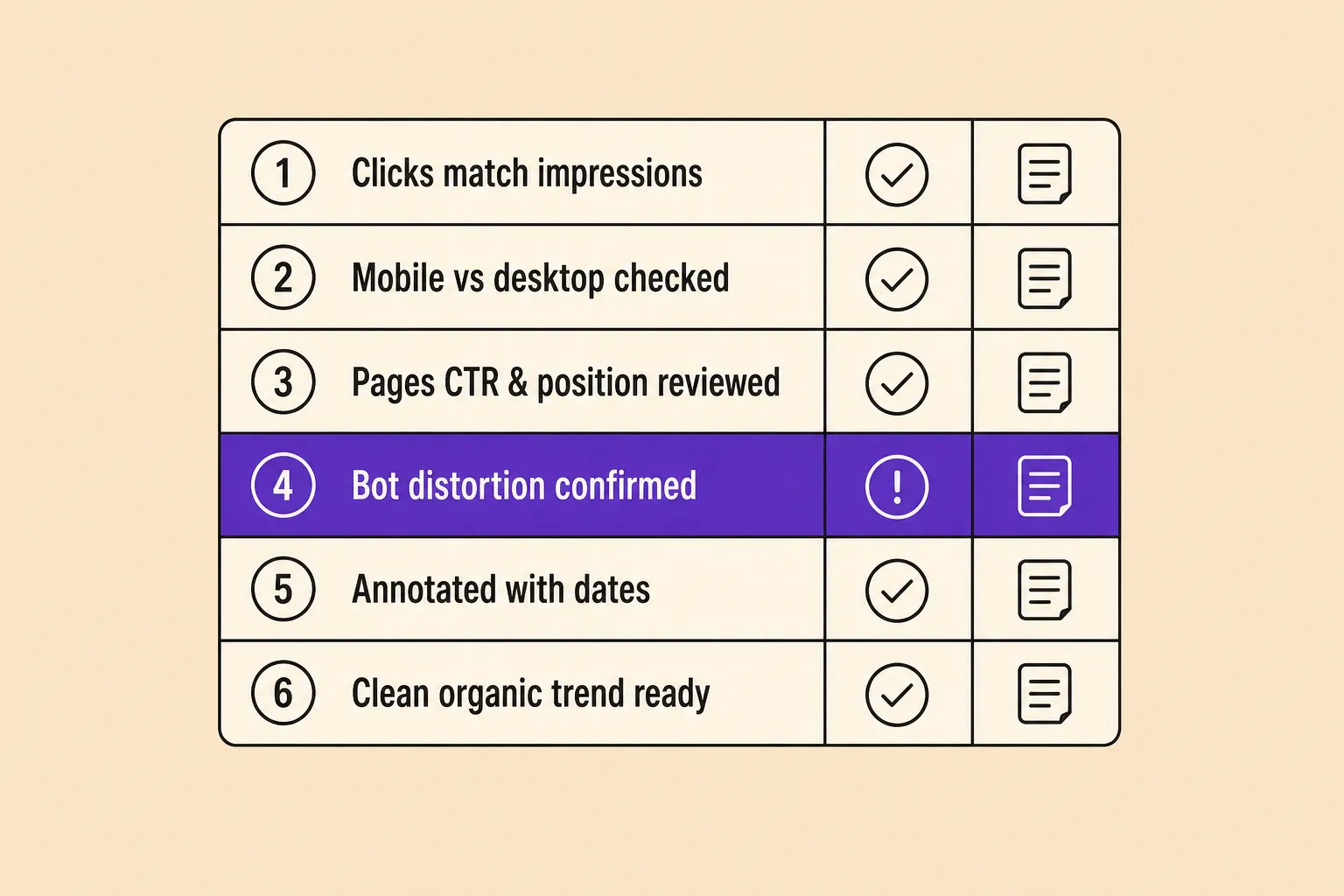
Step 7: Before calling a change, check which of three things moved it
Say the score went from 20% last month to 27% this month. Ahrefs names three possible causes, and your report should say which one applies.
1. A real change. You tracked the same prompts, competitors and platforms both months, and the client now appears in 95 of 300 responses instead of 60.
2. A scope change. You added prompts, removed a competitor or dropped a platform. In Ahrefs' words, "You changed the ruler, not your visibility." Vendors change rulers too: Ahrefs replaced its demand method on August 31, 2026 and warns that numbers fetched before then may not match current Volume and Impressions figures. On our reading, a July versus September Brand Radar comparison would carry that method jump.
3. Noise. AI answers churn. In SparkToro's study, run with Gumshoe.ai, about 600 volunteers ran 12 brand-recommendation prompts 2,961 times through ChatGPT, Claude and Google's AI Overviews and AI Mode in November and December 2025. ChatGPT and Google's AI returned the same brand list less than once in 100 runs, and the same list in the same order less than once in 1,000. How often a brand appeared was far steadier: Bose, Sony, Sennheiser and Apple each showed up in 55 to 77% of 994 headphone responses. Search Engine Journal's write-up reports the same figures. Weigh it fairly: the study is not peer-reviewed, Gumshoe.ai sells AI tracking tools (a conflict SparkToro discloses), and the data dates from late 2025, so newer models may behave differently.
The practical lesson from that study is to trust mention frequency and ignore rank position. City of Hope appeared in 69 of 71 ChatGPT answers but came first in only 25. Rand Fishkin's advice is to ask vendors to "show their math," so ask yours whether each prompt runs once or is sampled repeatedly. Ahrefs' methodology page doesn't say.
Our rule: call it a change only when the scope held and the movement lasted more than one period. Ahrefs makes the same point, advising you to trust trends that persist across several reporting periods.
Done when: every month-on-month movement in the report carries one of those three labels.
Step 8: Report it beside what it can't show
Put AI share of voice on a page with its companions. Ahrefs is candid that the score doesn't tell you whether mentions are positive, whether AI actually recommends you, or whether you get traffic or conversions, and a brand can be mentioned without its website being cited.
So pair it with two kinds of evidence. First, mention quality: how accurately and favorably AI describes the client (our piece on brand reputation in AI answers covers this) and whether it recommends the brand or just names it. Second, lagging outcomes. iPullRank, in a piece republished by Search Engine Land (which is owned by Semrush), splits channel metrics such as share of voice, mention frequency, citation position and sentiment from lagging outcomes such as branded search, direct traffic and self-reported attribution, read quarterly. Brainlabs takes the same line: report AI visibility beside organic traffic, Search Console and conversions, never instead of them, and lead with direction, not decimals.
Done when: each thing the score can't show has its own line in the report.
Common mistakes
- Accepting the tool's suggested competitors and prompts unedited. You end up measuring the tool's idea of the market instead of the client's.
- Reporting only the blended score. A strong platform can hide a weak one almost completely.
- Changing the prompt set mid-quarter and reporting the jump. Rebaseline instead, and say so in the scope note.
- Comparing your score with an industry "average" built on a different method. Ahrefs calls that comparing "two percentages that happen to have the same symbol after them."
- Promising the client a target percentage. There's no universally good score, and answers vary from run to run, so commit to a method and a direction of travel.
How you'll know it worked
- A client asks "what does 24% mean?" and the report answers it on the same page.
- Next month's number is like-for-like, or the report says exactly what changed and why.
- When a client brings a figure from a different tool, your team explains the gap from the two methods (denominator, weighting, prompts, platforms) instead of arguing about who's right. Brainlabs' habit of testing several data sources and looking for convergence is a good one to borrow here.
Key takeaways
- Build the prompt set from the client's real buying questions, grouped by topic, and treat tool suggestions as a gap-filler.
- Get written sign-off on competitors and name variants, because the denominator moves with them.
- Record your tool's formula and weighting: Ahrefs, Profound and Semrush each divide by something different.
- Read each platform before the blend, and call a change only when the scope held and it lasted more than one period.
- Send every figure out with its scope note, beside sentiment, recommendations and branded demand.
Frequently asked questions
What is AI share of voice?
AI share of voice is the share of AI answers that mention your brand compared with the competitors you track, across the prompts you choose. It measures relative visibility in AI responses. It does not measure sentiment, recommendations, traffic or conversions.
How is AI share of voice calculated?
The common formula divides the responses that mention your brand by the responses that mention any tracked brand, then multiplies by 100. Some tools weight each prompt by estimated demand or by where the brand appears in the answer, which can change the result sharply.
Why do two tools show different AI share of voice for the same brand?
Two tools usually differ because they track different prompts, platforms or competitors and use different formulas. Vendors divide by different things (responses, total mentions or impressions) and weight them differently, so neither figure has to be wrong. Compare the scopes before comparing the numbers.
What is a good AI share of voice?
There is no universally good AI share of voice. A score means something different against one competitor than against nine, and a figure from another tool's method may not be comparable. Judge it against your tracked competitors and your own trend over several periods.
How often should you track AI prompts?
Track AI prompts at least weekly for a monthly client report, and daily if your plan's allowance covers the full prompt set. AI answers vary from run to run, so repeated readings across many prompts give a steadier figure than a single precise snapshot.
Numbers your clients can check
Amina helps firms get cited in AI answers as well as ranked in Google. We run a method-transparent AI Visibility Check and white-label AI share-of-voice reporting that slots into your existing retainers, so every number is built to be found and built to be checked. See Amina's AI SEO and visibility service.