SEO reporting software is about to lose the part of the job that was easiest to bill: assembly. Microsoft's new Copilot Code workspace lets staff describe a dashboard in plain English and host it inside their own Microsoft 365 tenant, and agency research puts assembly at roughly a third to a half of reporting time. What survives is deciding what belongs on the report and proving its numbers are true.
The assumption doing the rounds in client-services meetings this week is that Microsoft has just taught your clients to write code, and that the reporting line item is finished. Code generation has been available to anyone with a browser for years, and it changed almost nothing about how agencies bill.
What changed sits further down the announcement. Microsoft will now host the thing your client builds, inside their own tenant, with governed access to their own data. That is what turns a weekend prototype into a tool somebody opens on a Monday. So one question now sits in front of every head of client services: if assembling the report stops being work, what is the reporting fee for?
The reporting deliverable just got commoditised from the inside
Copilot's new Code workspace lets people describe an app, dashboard, tracker, automation or workflow in natural language and have Copilot build it, using the same underlying technology as GitHub Copilot but aimed beyond developers. Interactive dashboards, desktop widgets and cloud-hosted internal apps sit on Microsoft's own list of outputs, per Search Engine Watch's report on the Copilot redesign.
Most of what a client-services team does on a monthly report is fetching and formatting, and the numbers back that up. Research by Fluent, a reporting-automation vendor, drawn from interviews, workflow audits and time-tracking across 104 marketing agencies, splits the workflow into data extraction at 21%, cleaning at 9% and report creation at 20%, against analysis and insights at 26% and commentary at 14%. Its summary of where agency reporting time goes is that only one in three minutes reaches insight generation. A second vendor survey cuts the other way. Databox, which sells reporting software, put analysing what happened at 30% of report-making time, explaining the data at 20% and recommendations at 18%, from 241 eligible respondents of 300 collected, fielded between August 2022 and April 2023.
Call it a third to a half. Nobody publishes it as a share of the fee, so treat the money version as reasoning, but the deliverable is load-bearing: AgencyAnalytics' 2025 benchmark, from over 220 agency leaders across Australia, the UK and three other markets, found 70% say client reporting plays a critical role in retention. The thing your client might now build themselves is the thing keeping them.
Hosting is the part that actually changed
Code generation without somewhere to run is a recipe without a kitchen. Somebody still has to find a server, get data access approved, and own it when it breaks at 8am before a board meeting. Copilot Managed Runtime supplies the kitchen: sandboxed hosting for apps built through Code, Cowork and Copilot Studio inside the customer's own Microsoft 365 tenant.
The pattern is corroborated outside Microsoft's own copy. Computer Weekly's coverage of Cowork as a single M365 data store reports data staying inside the customer's tenant, with SharePoint, OneDrive, Outlook and Teams content remaining permission-based, bundled into Microsoft 365 E7 at US$99 per user per month. A Constellation Research analyst quoted there projects uptake could be slow, since E5 dominates existing contracts and E7 only arrives as renewals fall due. That is your timeline: it reaches the client when the retainer is renegotiated.
Australia's most security-conservative buyer has already crossed this bridge. The Attorney-General's Department has certified Copilot Chat and Google NotebookLM at PROTECTED in controlled cloud tenancies rather than public instances, while requiring humans to verify generated outputs and retain ownership of final work products. Hosting is solved. Verification is written into policy as the obligation that remains. The institutional default runs the same way in both markets: the Digital Transformation Agency's five-year Volume Sourcing Arrangement for Copilot and Microsoft 365, on Microsoft's own account of its own deal, and Britain's SPA24 memorandum from 1 November 2024, open to public sector bodies of any size.
Two qualifications. Home and Code are still rolling out through Microsoft's Frontier early-access programme, Autopilot enters private preview at the end of September, and no public statement covers whether either is live in Australian or UK tenants. Exposure is uneven too: over a third of Australian SMEs have adopted AI, but regional take-up sits at 29% against 40% in metropolitan areas. Your enterprise and metro clients are exposed this year. The rest are not, yet.
The billing footnote matters more than the feature
Chat, summaries and drafting stay covered by user subscription licences. Cowork, Code and Autopilot move to usage-based billing, with new controls for organisations and individuals to track that spend.
That is a pattern rather than a one-off. Salesforce moved Agentforce to consumption-based Flex Credits in May 2025, at $0.10 per action, replacing a $2-per-conversation model. Microsoft then did it to its own developer product: GitHub Copilot shifted to token-metered billing effective 1 June 2026, converting tokens into AI Credits at $0.01 each, with premium-model multipliers jumping sharply. GitHub's chief product officer, Mario Rodriguez, said the flat premium-request model "is no longer sustainable" because a quick chat and a multi-hour autonomous session cost the same. Salesforce in May 2025, GitHub in June 2026, Microsoft 365 next. Same vendor twice inside a year.
Australian clients have already lived through Microsoft repricing an AI capability underneath them, which makes this an easier conversation here than almost anywhere. The ACCC alleges that after Copilot was integrated from 31 October 2024, the annual Microsoft 365 Personal plan rose 45% from $109 to $159 and the Family plan rose 29% from $139 to $179, and that subscribers were told their only options were to accept Copilot at the higher price or cancel, when an undisclosed "Classic" tier existed. Those proceedings are live in the Federal Court and nothing has been found against Microsoft. In November 2025 Microsoft offered refunds to roughly 2.7 million Australian subscribers switching to Classic, conceding it "could have been clearer about the availability of a non-AI-enabled offering". Britain's Competition and Markets Authority opened a preliminary investigation in July 2026, where the Classic alternative was a £25 annual difference. No finding there yet either.
Now put that next to your own retainers. A fixed monthly fee that quietly absorbs platform costs works while those costs are per-seat and predictable. It becomes a different instrument once the compute-heavy half of the stack is metered.
What is genuinely left to sell: definition, verification, judgement
Search Engine Watch made the strongest point against its own story: building a dashboard from a prompt is one thing, making sure its calculations are correct, maintainable and cheaper than the tool it replaces is another.
We already have a catalogue of what "correct" costs. A senior SEO at Intuit QuickBooks documented ten failures from running an AI assistant across a 41-site audit and an app build in Search Engine Land, which is owned by Semrush. A static one-page HTML site was diagnosed as a JavaScript single-page application. A venue was told to claim a Google Business Profile that was already claimed. "No sitemap submitted to Google Search Console" appeared on every one-sheet, printed by a system with no Search Console access. Each arrived with the same confidence as every correct finding, which is the author's point: if you replaced your SEO team with an assistant, who would catch it? Familiar territory for anyone who has watched AI-assisted builds relocate failures rather than remove them.
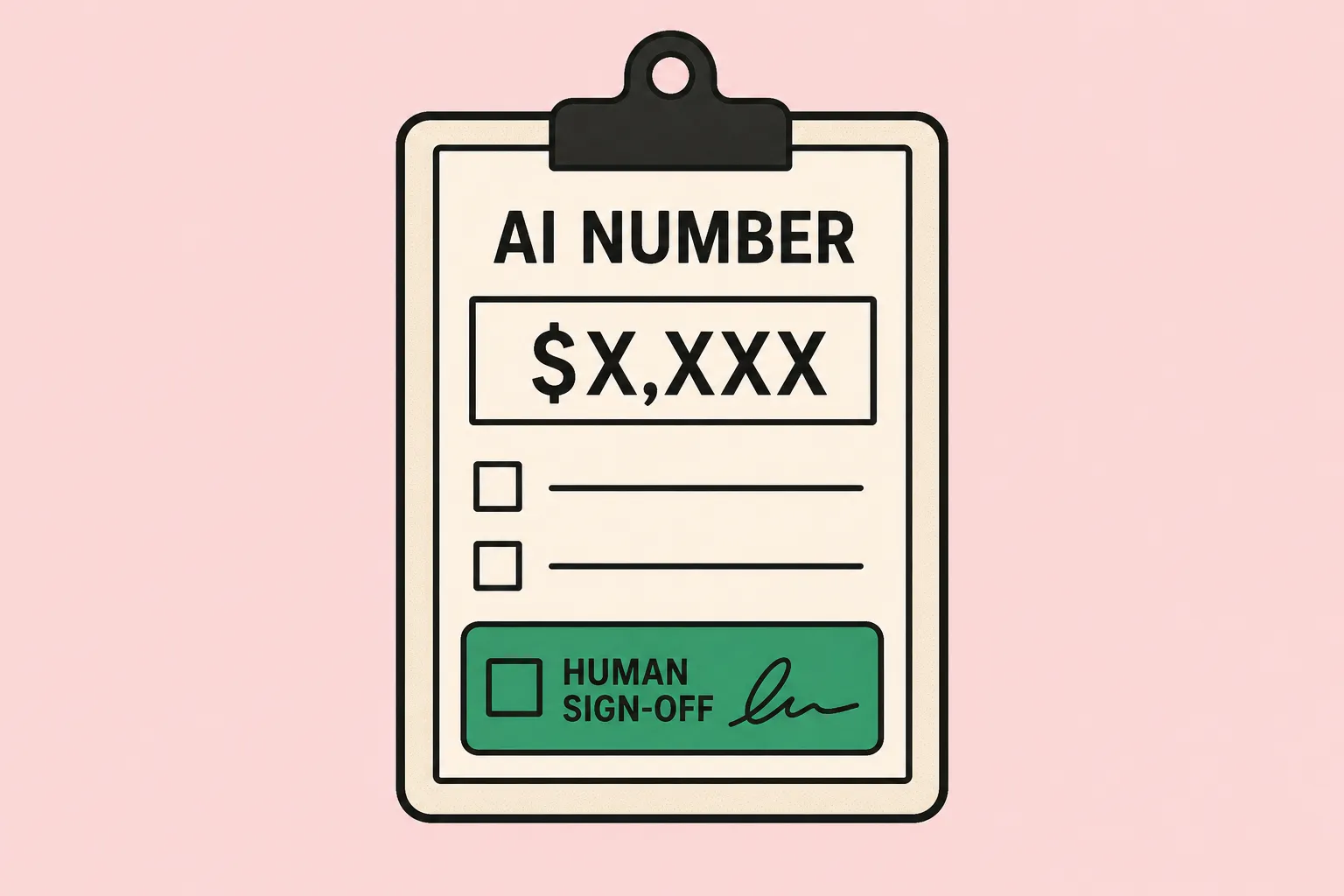
The Australian regulator has written the sentence for you. The OAIC's guidance on commercially available AI products advises documenting that generative outputs are "probabilistic assessments rather than fact", recommends human oversight and monitoring, and points to APP 10, which requires reasonable steps to keep personal information accurate and up to date. Standing guidance, not news, which makes it stronger: the obligation predates the tool. Verification is what clients pay for once production is free, the same argument as judgement being the scarce asset.
Then there is definition, because a client prompting Copilot will build last year's dashboard beautifully. In Ahrefs' testing, five major AI systems ignored JSON-LD, hidden Microdata and hidden RDFa and read visible HTML instead, while 44.2% of AI citations came from the first 30% of a page, citing Kevin Indig's research. NP Digital's work on earning AI citations with original data recommends surfacing important original statistics within roughly the first third of a page. Hold the terminology loosely: Google's position, repeated in that Ahrefs guide, is that its AI search features still rely on core search systems, so AI search visibility stays contested ground rather than settled doctrine. Extractability and citation are becoming reportable alongside rankings, tooling is following via the Bing AI performance report, and choosing which of those numbers a board sees is the work behind defensible AI-visibility metrics.
Two things to check before your next QBR
Let's make this concrete, because the reframe only works if you get there before the client does.
Map every fixed-fee commitment sitting on a metered platform. List the retainer deliverables that depend on tooling whose pricing has moved, or plausibly could move, to usage-based billing. You are not after a number today. You are after the clauses that would eat your margin if consumption tripled, and the renewal dates that give you a window to change them.
Rewrite the reporting line item around interpretation. Say out loud what was always true, which is that assembling the report was never the hard part. Price the definition of the metric set, the verification of the numbers, and the recommendation that follows.
Two questions belong in the same meeting. Ask the client's Microsoft partner whether Managed Runtime is live in Australian tenants and where those apps physically sit, because no public answer was available at the time of writing. And ask who maintains the privacy-policy disclosure for anything their team builds. From 10 December 2026, entities covered by the Privacy Act that use personal information in automated decision-making with the potential to affect rights or interests must state in their privacy policies the kinds of personal information used and the kinds of decisions made, with OAIC guidance still in development. Neither the OAIC nor Britain's Information Commissioner's Office has published guidance aimed at staff-built internal tools. Raise that as a governance gap, not an obligation that exists.
Key takeaways
- Assembly runs between about a third and about half of reporting time across the two vendor surveys available, and neither expresses it as a share of the fee. Price the half that survives.
- Sanctioned hosting inside the client's own tenant is what removes the assembly work. Code generation on its own never did.
- Audit fixed-fee commitments against platform pricing moving to usage-based billing: Salesforce in May 2025, GitHub in June 2026, Copilot's Cowork, Code and Autopilot next.
- Sell verification explicitly. The OAIC already calls generative output "probabilistic assessments rather than fact", and the Attorney-General's Department writes human verification into its own AI policy.
- Update what goes on the dashboard before a client builds last year's version of it.
Frequently asked questions
What is SEO reporting software for if clients can build their own dashboards?
It is for the parts a prompt cannot do: defining which metrics belong on the report, verifying the numbers, and interpreting what they mean. Vendor research from Fluent and Databox puts assembly at roughly a third to a half of reporting time, leaving analysis, commentary and review as the durable work.
Can Microsoft Copilot replace SEO analytics reporting tools?
Not wholesale, but it can replace the assembly layer. Copilot's Code workspace builds dashboards from a natural-language description and Managed Runtime hosts them inside the customer's own Microsoft 365 tenant, per Search Engine Watch. That publication's own caution stands: correctness, maintainability and total cost are separate questions from whether the dashboard renders.
What should an enterprise SEO dashboard include in 2026?
Rankings and traffic, plus the extractability and citation measures AI answer systems reward. Ahrefs found five major AI systems read visible HTML rather than JSON-LD or hidden structured data, and that 44.2% of AI citations came from the first 30% of a page. Treat AI search visibility as contested terrain, since Google maintains its AI features still rely on core search systems.
How should agencies price reporting when AI tools move to usage-based billing?
Separate metered costs from the fixed fee, and review renewal dates before consumption rises. Microsoft is moving Cowork, Code and Autopilot to usage-based billing, after Salesforce's Flex Credits in May 2025 and GitHub Copilot's token-metered shift effective June 2026. A retainer that absorbs compute costs is a different instrument once those costs are metered.
Built to be found
This is the work Amina does every day. Our AI-visibility service measures how often your firm is named across the major AI assistants and closes the gap, reported in a form you can put in front of a client or a board without spending a week assembling it.