A prospect leans back on the Zoom call and says the line you've started to dread: "Look, the strategy makes sense — but for the content, can't we just run it through ChatGPT?" For a fractional CMO in Melbourne or an independent consultant in Bristol, that sentence is doing more damage to your margin than any competitor's rate card. It reframes your work as production — words per dollar — and production is exactly what a chatbot appears to commoditise overnight.
Here is the case for holding your fee. The evidence cuts the other way: unsupervised AI output is frequently insecure, generic, or quietly wrong, and the human judgement that makes work trustworthy is the same thing AI search engines increasingly reward when they decide whom to cite. This piece is a strategic frame you can forward to a sceptical client — built to reposition your offer around the one asset a model can't manufacture.
The objection that's eating your margin: "can't we just use ChatGPT?"
The "just use AI" objection is now near-universal, and the adoption data explains why clients feel emboldened. GitHub's developer survey, released in August 2024 and cited in CSS-Tricks' essay Stack Overflow: When We Stop Asking, found that over 97% of respondents had used AI inside or outside their work. When a tool is that pervasive, buyers stop seeing it as a specialist capability and start seeing it as a free input — and they reasonably ask why they're paying you for something the whole market now has.
The trap is accepting the premise. If you let the conversation sit on production — volume, turnaround, cost per asset — you've already lost, because that is the one axis where a generative model genuinely wins. The move is to relocate the argument to where the model is weak and where your fee actually lives: judgement. Australian and UK advisory work has always been priced on expertise, not headcount. The task now is to make that explicit before the client mentally re-bands you as a typing service.
What the data actually shows: the well is running dry
There's a deeper signal under the hype that's worth showing a client. In Stack Overflow: When We Stop Asking, CSS-Tricks charts the collapse of public question volume on Stack Overflow — from a peak of more than 200,000 questions in a single month around 2014 to under 3,000 a month by 2026. The author is careful to note the decline started before ChatGPT, driven by heavy-handed moderation, but argues generative AI was "the final nail in the coffin."
Why does a developer forum matter to a fractional CMO? Because it's the clearest available illustration of a feedback loop now running across every knowledge domain, marketing included. Models are trained on human-generated material. As people stop publicly asking and answering — and increasingly just ask the bot — the supply of fresh, human-authored signal thins out. The CSS-Tricks piece poses the uncomfortable question directly: if we stop asking and answering, what trains the next generation of models? For your client, the practical translation is blunt: as everyone routes the same prompts through the same handful of models, the output converges. "Just use AI" is a recipe for producing the median of your category — and being indistinguishable is a commercial problem, not a content one. (This is a global dynamic; there's no AU- or UK-specific version of it, and you shouldn't pretend otherwise.)
Unsupervised AI ships risk — and someone has to be accountable
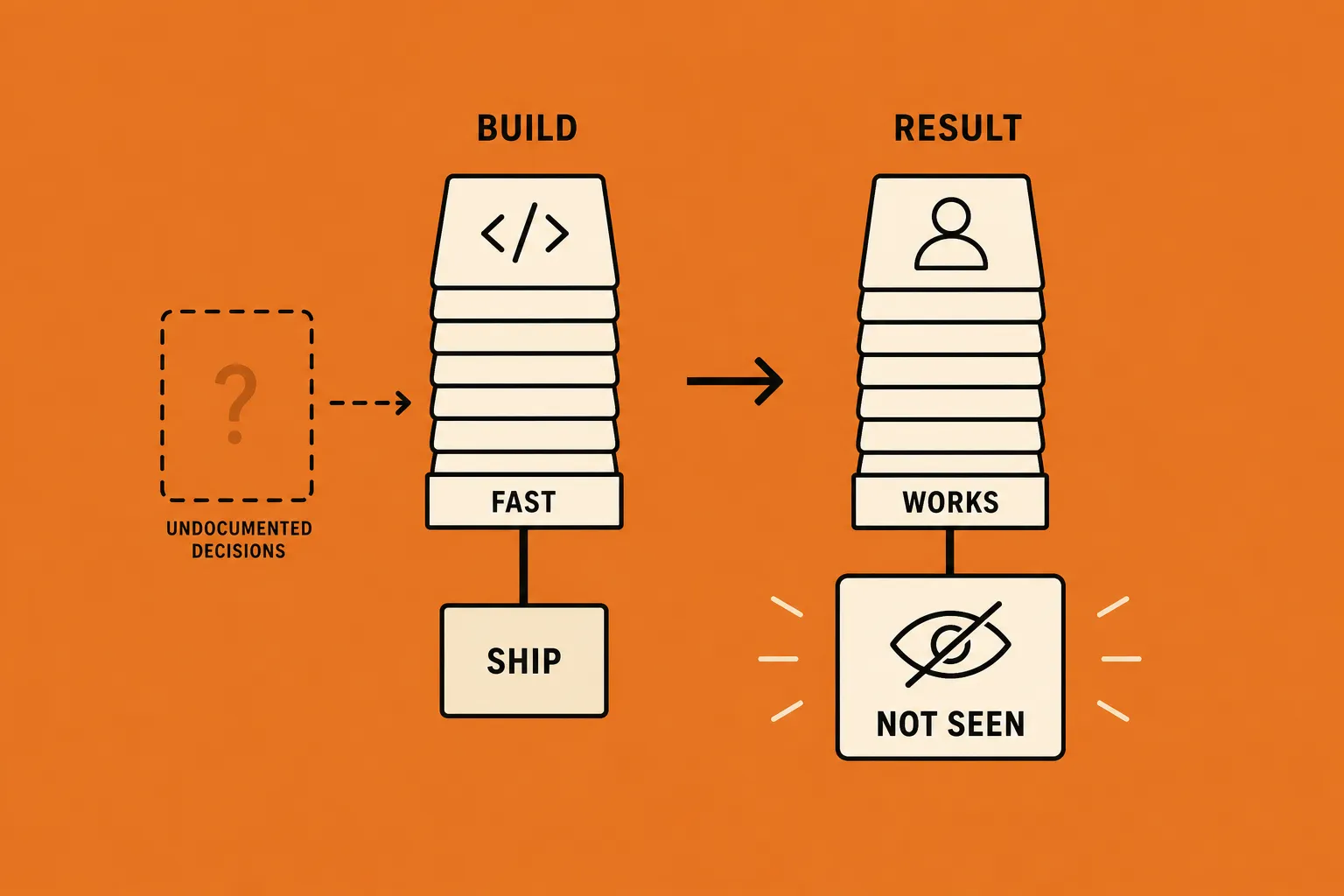
The strongest part of your rebuttal isn't that AI is bad. It's that unsupervised AI carries measurable risk, and that risk lands on a named human. The same CSS-Tricks essay cites Veracode's testing across 100 AI models, which found that roughly 45% of AI-generated code contained security flaws. That figure is from software, not marketing copy, so don't overstate it — but the principle transfers cleanly. Code has tests, linters and security scanners to catch the 45%. A generic blog post, a misattributed statistic, or an off-brand claim in a regulated sector often has nothing between the prompt and publication except a person willing to put their name to it.
That person is the product you sell. Frame it as a board-level question, because for UK readers operating under directors' duty-of-care expectations, and for Australian professional-services norms, it genuinely is one: who is accountable when the AI output is wrong? A chatbot cannot be on the hook. An offshore content mill rarely is in practice. A named fractional CMO or accountable advisory partner is — and that accountability is not a soft benefit, it's the thing a serious client is actually buying. Keep this honest rather than alarmist: you're not claiming AI is dangerous, you're pointing out that quality assurance and ownership are unpriced in the "just run it through ChatGPT" model, and unpriced risk is still risk.
Why judgement is what AI search rewards, too
Here's the connection that turns a defensive argument into a confident one, and it's our own synthesis bridging two sources rather than a quoted finding. The judgement that justifies your fee is the same judgement that earns visibility in AI answers — which means an AI search strategy for B2B and a defensible fee structure are, in practice, the same project.
CSS-Tricks' Technical Writing in the AI Age argues that clear, human-authored structure and genuine experience — solving real problems, getting into the edge cases, writing for a specific audience — are what survive in a landscape where generic documentation is already regurgitated by every model. Tellingly, that same piece is sceptical of chasing "AIO" (AI optimisation) as a settled discipline, calling it an evolving space of "fluid and inconsistent best practices." That scepticism is useful for you: it means the durable play isn't a vendor's secret GEO checklist (Google's own line is that "good SEO is good GEO"), it's the unglamorous, expert work of saying something specific, correct and well-organised. Whether being cited by AI is even the right goal is still genuinely contested — but if you're going to compete for it, generic AI sludge is the worst possible raw material.
The harder evidence sits in Search Engine Journal's 2024 SEO Blueprint, which recounts researchers at the University of Reading submitting ChatGPT-4 answers under more than 30 fake psychology-student accounts. ChatGPT-4 outscored real students on the easier first- and second-year exams — but lost to third-year students on the questions demanding deeper analytical skill. The Blueprint's conclusion is the line to read aloud to a client: embrace AI as a powerful tool, "but one that requires someone with education, expertise, and experience to use it effectively." Production is the first-year exam. The strategic layer — the analysis, the positioning, the judgement call — is the third-year exam, and that's where both your fee and your citations are won.
Repositioning the offer: sell the strategic layer, the audit, the QA
So stop selling words and start selling the wrapper around them. Concretely, that means three things in the way you package and price.
First, lead with the strategic layer — audience research, persona-led targeting, positioning. The 2024 SEO Blueprint makes the case that moving beyond guessing intent toward genuine audience understanding is the differentiator, and it's precisely the part a prompt can't originate.
Second, productise judgement as a service line a client can name on an invoice: an AI content quality review, an editorial QA gate, a strategy-and-audit retainer. The deliverable isn't "20 articles," it's "20 articles you can stake your reputation on." Same words, different — and defensible — fee.
Third, if you're an agency or consultant who still needs the production muscle, don't fight the model on cost; partner for it. A white-label SEO partner lets you buy execution wholesale while you keep and sell the judgement, accountability and QA layer at full margin. That's the inversion of the client's objection: they think AI removes the need for you, when in fact it makes the accountable human the only scarce input left in the chain.
Key takeaways
- Don't argue on production — relocate to judgement. A model wins on volume and cost; you win on analysis, accountability and trust. Reframe the conversation before the client re-bands you as a typing service.
- Make the well-running-dry point. As everyone prompts the same models, output converges on the category median. "Just use AI" quietly makes a brand indistinguishable — a commercial risk, not a content one.
- Price the QA gap. Veracode found ~45% of AI-generated code carried security flaws; unsupervised marketing output has even fewer safety nets. Ask the board-level question: who's accountable when it's wrong?
- Tie the fee to citations. The same human-led structure and expertise that justify your rate are what AI search appears to reward (hedge it — "AIO" is contested). Generic AI sludge is the worst raw material for visibility.
- Productise the wrapper, partner for the muscle. Sell strategy, audit and QA as named line items; use a white-label partner for wholesale execution so the defensible judgement stays yours.
Buy judgement and accountability, not raw output
If a client is genuinely asking "can't we just use AI?", the most persuasive answer isn't a rebuttal — it's a demonstration. That's the logic behind our white-label / wholesale SEO retainer: you keep the client relationship, the strategy and the accountable QA, and you buy the production and technical execution from us at agency-wholesale rates. You're not reselling output; you're reselling judgement your client can't get from a chatbot. As a low-friction way to prove the point, run a single AI Visibility Check on the prospect's brand and show them exactly where generic, unsupervised content has left them invisible in the answers their buyers now trust. It tends to end the "just use ChatGPT" conversation faster than any deck.