Every agency owner is now fielding the same question from clients, and it usually arrives as a challenge: "Can't AI just do the design?" The honest answer, the one that keeps you in the room, is that AI already does a lot of it. Production, prototyping, the first rounds of comps: that work is being absorbed in real time, and pretending otherwise makes you sound like a taxi firm arguing with a map app.
The question is a trap dressed as a threat, though. As AI swallows execution, it doesn't kill design. It relocates the value. The scarce, billable asset stops being the pixels and becomes the judgement behind them: deciding what should be built and how it should behave. This piece maps where that value moved, why the market is already paying a premium for it, and how to price it into your next pitch.
Concede the production point, because it's the credible move
Let's start by giving the objection its due. AI genuinely has taken over the entry ramp of the craft: the layout variations and boilerplate flows, the throwaway prototypes juniors used to cut their teeth on. Waving that away loses the client's trust before you have made your case.
The panic skips a detail, though. Australian workers themselves aren't buying the full-replacement story. Only 7% believed AI would fully automate their tasks, with most expecting it to augment their work rather than take it, according to a Technology Council of Australia survey of more than 2,500 employees. The design profession bears that out. The World Economic Forum's Future of Jobs Report 2025 ranks UI/UX designers as the eighth fastest-growing role through 2030. A discipline being automated out of existence does not climb that list.
What AI can't absorb: the judgement layer
So if the making is commoditised, what is left? Think of it like construction. AI is now an extraordinary set of power tools, but nobody confuses a nail gun with an architect. The scarce skill is systems thinking: deciding what to build in the first place, setting the confidence thresholds, designing the failure modes, mapping how data moves through the experience.
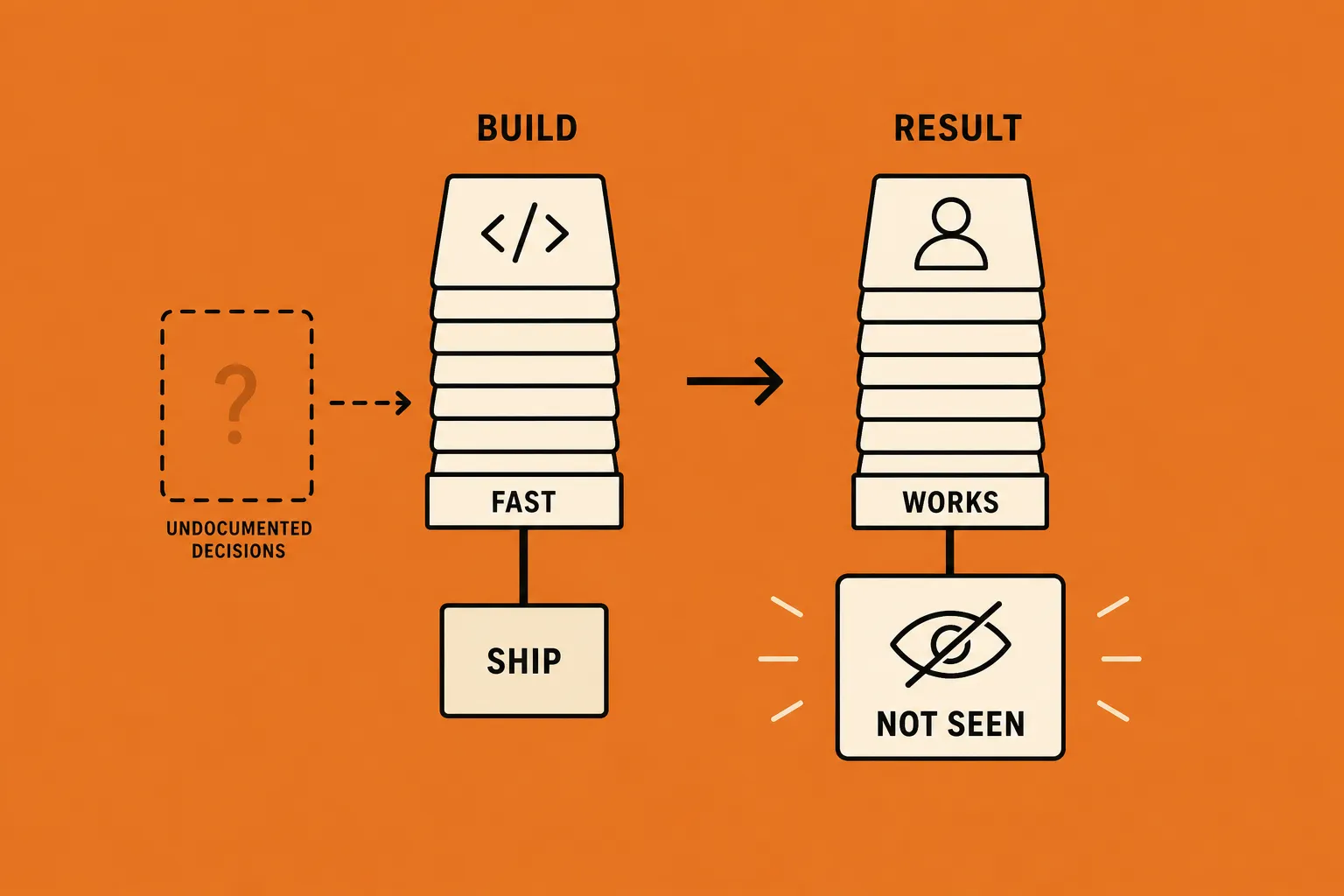
Jon Friedman, Chief Design Officer at Microsoft 365, put the risk plainly. "We can now build the wrong things faster than ever before," he said, as covered in UX Collective's "While everyone talks about AI, design is gaining power." Speed without judgement just gets you to the wrong destination sooner.
The clearest evidence that judgement was underpriced is the wave of firms quietly reversing their AI-for-headcount cuts. Klarna is the cautionary tale. Its headcount fell around 22% to roughly 3,500 during an AI-focused hiring freeze, and in February 2024 it claimed its AI assistant did "the work of 700 customer service agents." By 2025, CEO Sebastian Siemiatkowski conceded the AI produced lower-quality output and the company began rehiring humans for "quality human support." The reversal goes wider than one firm. Gartner projects that by 2027, half of the organisations that attributed headcount reductions to AI could rehire for similar work under new titles, a forecast based on 321 customer-service and support leaders. And a March 2026 Orgvue study found 32% of organisations that cut jobs expecting AI savings later had to rehire.
Australia sits inside the same pattern. As far back as May 2025, an Australian report captured the reversal: 55% of business leaders admitted they were wrong to lay off staff for AI, and Telstra's roughly 2,800-role AI-driven reset was named alongside Klarna's rehiring. The lesson for a design shop has nothing to do with AI failing. Removing the judgement layer, the humans who catch the wrong thing before it ships, is the expensive mistake.
There is a trust dimension too, and it is sharpening into law. Poorly designed AI workflows erode trust faster than traditional interfaces, precisely because the system appears to be the one deciding. [AU] From 10 December 2026, Australia's Automated Decision-Making transparency obligation, introduced by the Privacy and Other Legislation Amendment Act 2024, requires organisations that use personal information in decisions affecting people's rights or interests to disclose, in their privacy policy, the kinds of data used and the decisions the system makes, per the OAIC. [UK] The ICO is consulting on draft guidance for automated decision-making and profiling that points the same way, toward an expectation that meaningful human involvement is recorded rather than assumed. Designing for a point where the human stays in the loop is turning into a compliance asset, well beyond a UX nicety.
The market is already voting
You do not have to take the trend on faith. Watch where the seniority is going. Design is climbing into the C-suite: Microsoft, Samsung (under Mauro Porcini) and Shopify (under Carl Rivera) have all installed design leadership at Chief Design Officer level, as UX Collective documents in "While everyone talks about AI, design is gaining power." The concept doing the work there is "form × function fit," the gap between a slick demo and a product people actually adopt. Nielsen Norman Group frames it more bluntly: "powered by AI is not a value proposition." Capability is table stakes. The experience is the differentiator. (No verified AU or UK agency has published a comparable CDO-elevation story this cycle, so treat these as the global signal they are.)
The clearest price signal is in the UK labour data. [UK] PwC's AI Jobs Barometer found roles enhanced by AI grew 39% since 2018, versus just 17% for roles where AI mainly simplifies the work. UK AI hiring jumped 61% year-on-year, climbing from 112,000 to 180,000 roles, but the demand is for people to deploy and oversee AI, what The Register neatly called "babysitting the bots." Those AI-skill roles now command a 34.2% average wage premium, up from 11% a year earlier, while developer and model-builder roles rose by only about 2,600. The premium is flowing to the people who can direct the tools, not merely operate them.
What this means for your agency's pitch
Walk into your next new-business meeting with the reframe already loaded. You are not selling pixels. You are selling the decision layer that stops AI from confidently building the wrong thing. Price that, not the production hours AI has already discounted toward zero.
The UK's 34.2% wage premium is your evidence that clients will pay for judgement over execution. You are simply moving that logic from an employment line to an invoice. And the fear driving the "can't AI just do it?" question is softer than it looks. Australia's "jobpocalypse" has not materialised, with Indeed data showing graduate job postings actually rose 6% year-on-year across the first five months of 2026, and Indeed senior economist Callam Pickering attributing entry-level softness to broader economic weakness and over-hiring rather than AI.
There is a through-line worth naming, because it connects design judgement to the other question clients keep asking: "will we show up in AI answers?" The terminology around that (GEO, AEO, "AI search visibility") is contested. Google has argued that good SEO is still good GEO, so treat it as an emerging practice rather than settled doctrine. The underlying logic rhymes with everything above. AI systems tend to surface content that carries first-hand experience and clear editorial judgement over commodity output. The same human judgement that makes a product worth adopting is what makes its content worth citing. Sell the judgement layer once, and you defend margin on both fronts.
Key takeaways
- Concede the production point. AI has absorbed layout, prototyping and first-draft comps. Leading with that makes your reframe credible instead of defensive.
- Sell systems thinking over screens. The billable asset is deciding what to build, setting confidence thresholds and designing failure modes: the judgement that stops fast production from shipping the wrong thing.
- Use the reversal as proof. Klarna's rehiring, Gartner's projection (based on 321 leaders) and Orgvue's 32% rehire rate show judgement was underpriced rather than obsolete.
- Price against the premium. The UK's 34.2% wage premium for AI-oversight roles is your benchmark for charging for direction over execution.
- Bank the compliance angle. With AU ADM-transparency rules live from December 2026 and the UK ICO consulting on similar ground, keeping a human in the loop is becoming a defensible deliverable rather than a nicety.
Frequently asked questions
Will AI replace designers?
No. On current evidence it is relocating the value rather than removing it. AI absorbs production and prototyping, yet the World Economic Forum's Future of Jobs Report 2025 still ranks UI/UX designers as the eighth fastest-growing role through 2030, and high-profile AI-for-headcount cuts (Klarna, plus others tracked by Gartner and Orgvue) are being reversed as firms rediscover the value of human judgement.
What is design judgement, and why can't AI do it?
Design judgement is systems thinking: deciding what should be built, setting confidence thresholds, designing for failure modes, and mapping how data flows through an experience. AI can generate options at speed but cannot own the accountability for which option is right. As Microsoft 365's Jon Friedman put it, "we can now build the wrong things faster than ever before."
How should agencies price design now that AI does the production?
Price the decision layer rather than the production hours. The UK's AI Jobs Barometer shows roles that oversee and direct AI command a 34.2% average wage premium, evidence that clients already pay more for judgement than execution, which is the value an agency should put on the invoice.
Does design judgement affect AI search visibility?
Likely yes, though the terminology (GEO/AEO) is contested and Google maintains that good SEO is still good GEO. Framed as reasoning rather than settled rule, AI systems tend to cite content with first-hand experience and clear editorial judgement over commodity output, so the same judgement that makes a product worth adopting tends to make its content worth citing.
Where this leaves your next pitch
If clients are asking whether AI can just do the design, they are really asking what they are still paying you for. That is an opening rather than a threat. A structured look at where judgement lives in a client's product, and how AI-ready that product actually is, turns the objection into scope. M2.0's Website Review pairs a design and UX-judgement read with an AI-readiness assessment, and can be delivered white-label as an agency partnership, so you can walk into the room with the reframe already evidenced.