ChatGPT ads are now self-serve and buyable in Australia and the UK, but OpenAI states that ad spend buys advertising inventory, not an organic recommendation or citation. For a budget-constrained B2B team, the defensible sequence is to audit your organic AI share of voice first, then test paid AI inventory against a pre-agreed evidence budget.
Every new ad surface arrives with the same pitch: pay, and skip the queue. ChatGPT ads carry that pitch into the AI answer itself, and they are now live for Australian and UK businesses through a self-serve Ads Manager. The complication is that the company selling the slot is also the company telling you the slot is not a recommendation.
For a growth-stage B2B team watching its paid-search budget get squeezed, that changes the order of operations. Before you rent a place in the AI answer, you need to know whether the AI already names you for free. So audit your organic AI share of voice first, then test paid inventory against an evidence budget you set before you spend.
The channel is real, and it's buyable in Australia and the UK
Let's start with what's actually on the table, because this is not a US-only or waitlist story. OpenAI's self-serve Ads Manager is available to Australian businesses in beta, with CPC bidding, budget and bid controls, pixel-based measurement plus a Conversions API for purchases, sign-ups and leads, and aggregated performance dashboards. According to SmartCompany's report on the Australian rollout, OpenAI announced the expansion in early May 2026, and the University of New England joined the local pilot in April. The UK is buyable too: The Register's coverage of OpenAI's ad terms records that OpenAI extended ChatGPT Ads beyond the US to the United Kingdom and several other markets as of mid-August 2026.
"Self-service" is doing a lot of work in that sentence, so it's worth being precise about what it means. It means you create the advertiser account, complete verification and billing, build the campaign and submit the creative yourself. A practitioner walkthrough from Search Engine Watch's beginner's guide to ChatGPT ads confirms the operational fine print: eligibility depends on where the billed legal entity is based, ads appear only on the Free and Go tiers (Plus, Pro, Business, Enterprise and Edu are ad-free), the suggested starting maximum CPC bid is $3 to $5 on an auction basis, and financial, health and legal services carry specific restrictions and approvals. Think of the account country, currency and time zone as poured concrete: OpenAI says they cannot be changed after creation, so the setup decision is the one you can't walk back.
What the platform actually sells: inventory, not a recommendation
Now the part that should govern your whole strategy. Search Engine Watch is blunt about the line OpenAI draws: "OpenAI says advertising does not influence ChatGPT's answers," and so "an ad purchase buys advertising inventory; it does not buy an organic recommendation or citation." The ad-group descriptions you write are treated as context hints about where an offer might be useful, not exact-match keywords or a way to reserve a particular conversation.
OpenAI has been policing that boundary for a while. When Australian and US users started seeing shopping prompts inside ChatGPT late last year, OpenAI's Nick Turley told SmartCompany that the placements weren't ads, framing them as recommendations tied to third-party app integrations with "no financial component" and drawing an explicit distinction between paid placement and organic recommendation. That piece predates the Australian ad launch, so read it as framing rather than a current signal. The framing is the point: the organic answer and the paid slot are meant to be two different things, and money moves only one of them.
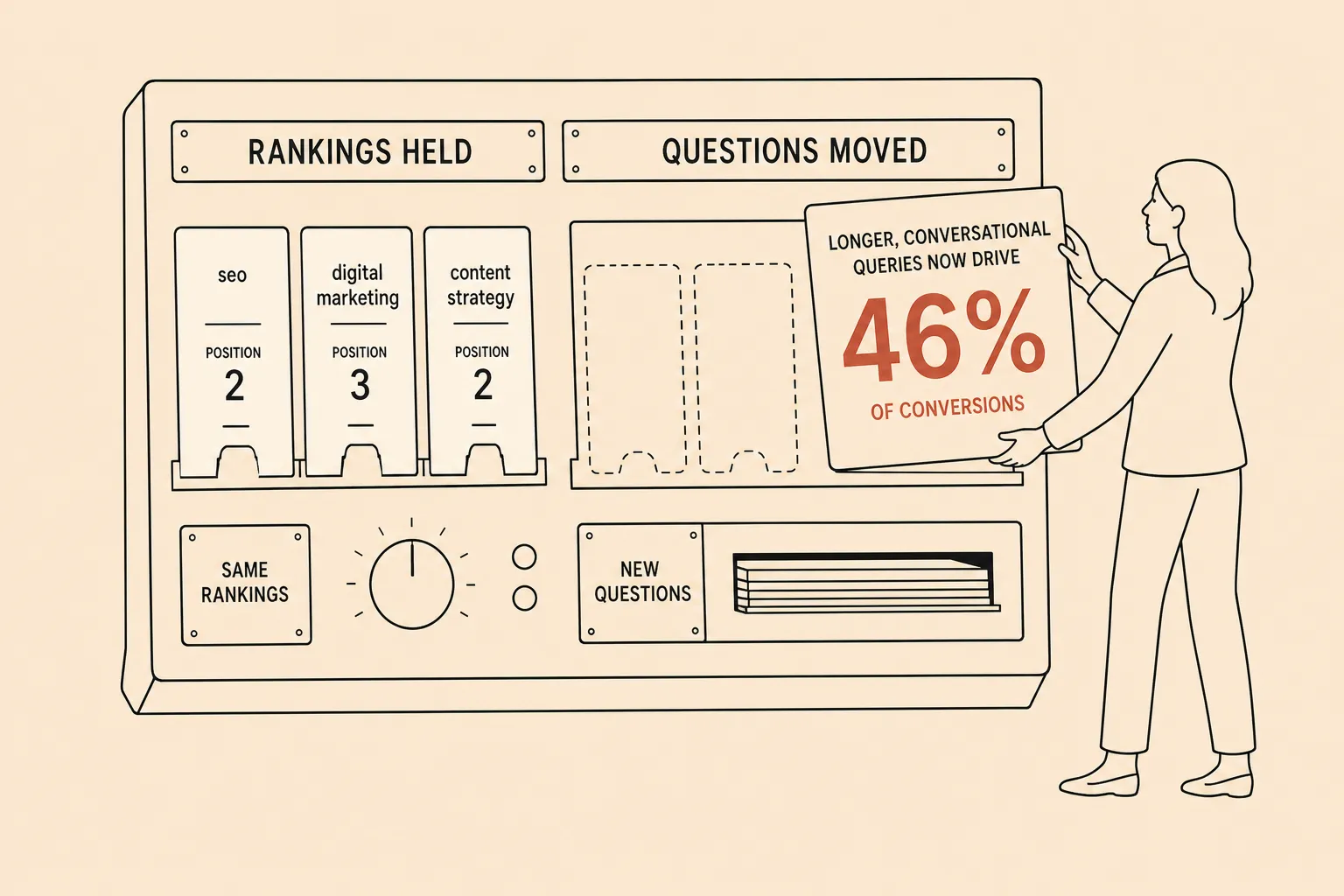
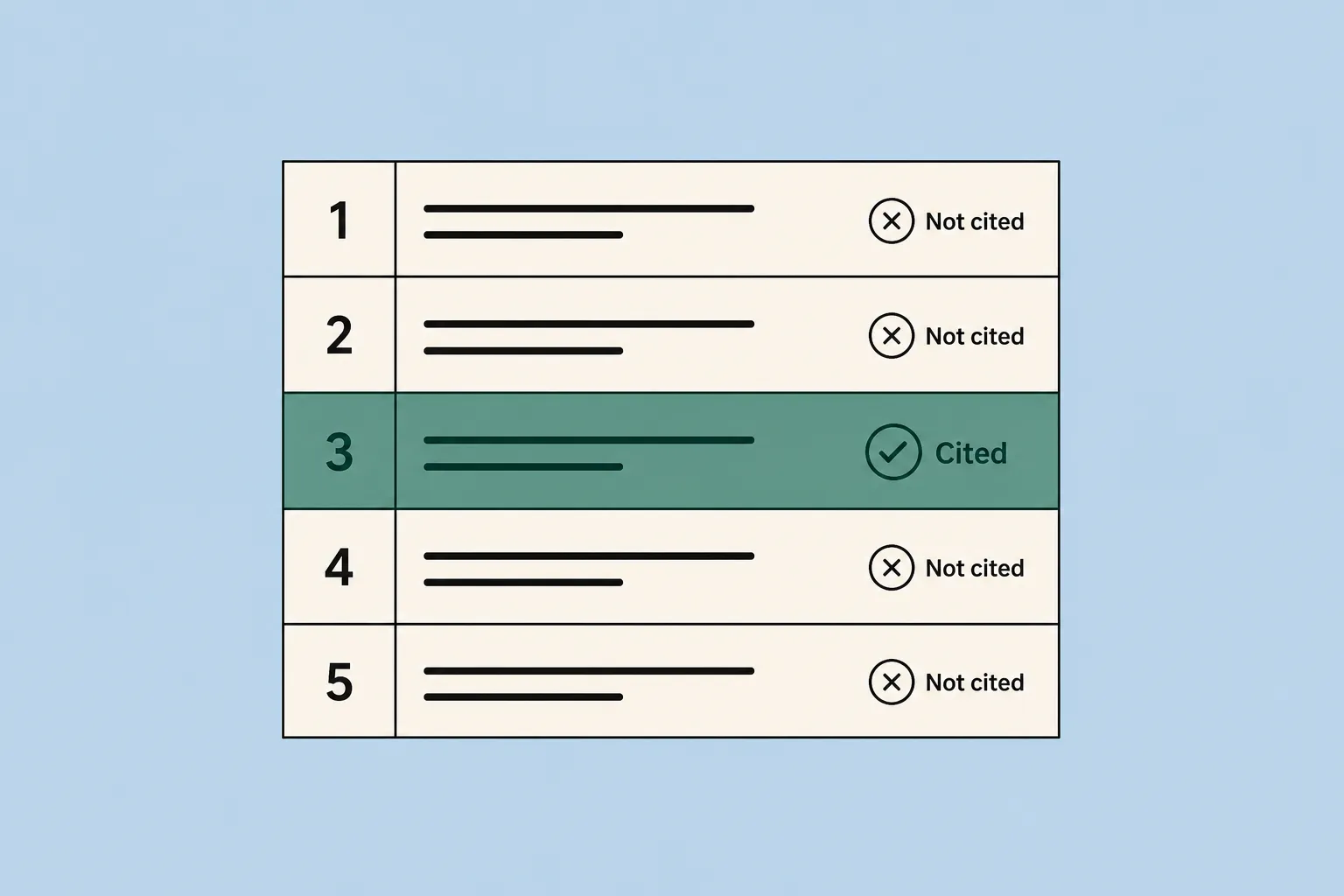
This is where a lot of budgets are about to go wrong. Ranking, or in this case being cited, and being paid to appear have split into separate mechanics, much as they long have in classic search. If your brand isn't the answer ChatGPT gives when nobody has paid it to, an ad places you beside that answer without changing it. Earning the organic mention is a different job, and it's the one worth understanding before you buy. Our note on earning AI recommendations from B2B buyers walks through that shift from ranked to recommended, and the broader gap between breadth of ranking and actual AI-citation rate is exactly the gap a paid slot cannot close for you.
Why paid-first is the wrong reflex under budget pressure
Here is the assumption worth challenging: that a new paid lane is the fix for weak AI visibility. Under budget pressure, "we can just buy our way in" is a tempting reflex, and it usually skips the cheaper question of whether you're already there.
Australian buyers are already shortlisting vendors inside AI assistants, which is what makes the organic question urgent rather than academic. In a survey of 1,076 B2B software buyers, G2 research distributed via PR Newswire found that 71% now rely on AI chatbots for software research (up from 60% seven months earlier), 51% start research with AI chatbots more often than with Google, 63% use ChatGPT as their primary chatbot, and AI chatbots were named the single biggest source influencing which vendors make a shortlist. A separate survey of 622 respondents, run by SEO vendor Semrush and reported in its analysis of how AI shapes the B2B buying process, points the same way, with 92% saying AI shaped their vendor shortlist and 83% saying it influenced the final decision. Both are vendor-run studies on self-selected samples, so treat them as respondent counts rather than market-wide truth. Two independent surveys agreeing on direction is still a strong signal that the shortlist is being drafted inside the chatbot.
So paying to appear beside an answer that never names you is renting a spotlight on a stage you haven't earned a seat on. The lights go off the moment the budget does, and the underlying problem, that the AI doesn't consider you the answer, is exactly where you started. That's a poor trade when the paid economics are also unsettled. Advertiser-reported CPCs range from "$3 to $22 across advertisers," and OpenAI "does not yet have performance benchmarks," according to Search Engine Journal's look at six months of ChatGPT ads; the $3 to $5 figure is OpenAI's recommended starting bid, not a proven click price. Any confident "ChatGPT ads are cheaper than Google" claim runs into a fair "says who?", because no credible source yet makes an apples-to-apples CPC or CPA comparison for lead generation.
The sequence: audit your organic AI share of voice, then test paid
The order that protects the budget is simple to state. Measure first, then buy.
Auditing organic AI share of voice means establishing a baseline: for the buying questions that matter, which AI assistants name you, how often, and against whom. Australian data shows why the baseline is worth having before you spend. Across 115 Australian businesses using first-party GA4 data, SmartCompany reported that ChatGPT drove 90.2% of identifiable AI visits (Perplexity 4.25%, Gemini 2.5%), yet Perplexity and Gemini users converted several times higher than ChatGPT users, with AI traffic overall trailing organic on add-to-cart (16.2% versus 27.4%) and purchase (2.9% versus 6.0%). That dataset runs to September 2025, so read it as directional rather than fresh. The lesson holds regardless: volume is not conversion, and you can't manage either without a baseline.
Real AU brands are already meeting buyers in that channel. Carsales built an app inside ChatGPT to surface listings to shoppers, and iTnews reported the company's finding that 35% of car buyers now use AI tools when shopping, predominantly ChatGPT, with its EGM for technology and data, Michelle Low, describing those users as arriving with "much higher intent" and "better informed." That's a consumer auto figure rather than a B2B one, but it grounds the same behaviour a growth-stage marketer should assume: your buyers are forming a shortlist inside the assistant before they ever reach your site.
Only once you know your organic position does a paid test earn its place. The content and structure that make you the organic answer are the durable asset here, and if that's where the gap sits, our Content Engine is built to close it. Whatever you call this work, and the labels (GEO, AEO, AI search visibility) are still contested rather than settled doctrine, treat it as a measurement question first and a media-buying question second.
What a defensible test looks like, and how to take it to the board
If you do test paid, make it defensible. The single most useful discipline Search Engine Watch recommends is to "decide in advance how much evidence you can afford to collect." An evidence budget, a fixed sum you're willing to spend to answer one question, keeps a first test from quietly becoming a standing line item.
Set hard spend caps, and factor in a detail that has already caught advertisers out. The Register notes that under Section 11.1 of OpenAI's advertising terms, ads can keep running and billing for up to one business day after a campaign is cancelled; one advertiser reported charges for hours after pausing and was refused a refund. Scope the pilot correctly, too. Amazon's move to place advertisers inside ChatGPT began on 10 September as a US-only pilot, according to Digiday's Future of Marketing briefing, so it is not a route Australian or UK teams can assume access to. That same briefing notes bots and AI agents now make up over half of web traffic, which is a reason to keep paid visits cleanly tagged so a real ad click is never confused with an unpaid AI referral.
Watch the disclosure environment while you're at it. Australia has no blanket AI-disclosure rule for ads yet, but SmartCompany reports that Ad Standards and the AANA are reviewing the Code of Ethics, with executive director Greg Wallace calling AI's "potential to mislead" a growing area of public concern and the next update expected later in 2026. Adjacent to that, Digiday flags a proposed Australian "digital duty of care" law with fines of up to A$109.2 million, a reminder that expectations around algorithmic and AI-mediated placement could tighten. None of this is aimed specifically at ChatGPT ads today, but a defensible test assumes disclosure norms move, not that they stay still.
For the board, that reframes the whole decision. The report isn't "we bought ChatGPT ads." It's "here is our organic AI share of voice, here is the gap, here is the fixed-budget test we ran against it, and here is what the evidence told us." Framing the paid-versus-organic call in those terms is what our guide to measuring AI visibility for boards is built around, and it's the difference between a channel experiment and a defensible strategy.
Key takeaways
- ChatGPT ads are self-serve and buyable in Australia and the UK now, on the Free and Go tiers only, with an auction-based CPC and a suggested $3 to $5 starting bid.
- OpenAI states that ad spend buys inventory, not an organic recommendation or citation, so a paid slot appears beside the AI answer without changing it.
- Audit your organic AI share of voice before you buy: Australian buyers are already shortlisting vendors inside ChatGPT, and you can't tell if a paid test is a rescue or a top-up without a baseline.
- Treat "ChatGPT ads are cheaper than Google" as contestable; advertiser CPCs reportedly range $3 to $22 and OpenAI publishes no benchmarks yet.
- Make any test defensible: fix an evidence budget, set spend caps (allowing for billing up to a business day after pausing), tag paid visits, and report it to the board as organic gap plus scoped experiment.
Frequently asked questions
Are ChatGPT ads available in Australia?
Yes. OpenAI's self-serve Ads Manager is available to Australian businesses in beta, with CPC bidding, budget controls and pixel-based measurement, per SmartCompany's report on the rollout. The UK is also buyable as a secondary market, according to The Register, and eligibility depends on where the billed legal entity is based.
Do ChatGPT ads improve my organic recommendation in AI answers?
No. OpenAI says advertising does not influence ChatGPT's answers, and Search Engine Watch summarises the line as an ad purchase buying advertising inventory rather than an organic recommendation or citation. The paid slot sits beside the answer; it does not change which brand the assistant names on its own.
Are ChatGPT ads cheaper than Google paid search?
There is no settled benchmark to say so. Search Engine Journal reports advertiser CPCs ranging from $3 to $22 and notes OpenAI has no cross-advertiser performance benchmarks yet, so any apples-to-apples "cheaper than Google" claim is currently contestable. Treat the $3 to $5 figure as a recommended starting bid, not a proven click price.
Should I audit organic AI visibility before buying ChatGPT ads?
Yes. Because B2B buyers are already using AI chatbots to build vendor shortlists, the cheaper first question is whether AI already names you organically. Auditing your AI share of voice gives you a baseline, so a paid test can be judged as a scoped experiment against a known gap rather than an open-ended spend.
About Amina
Amina helps professional-services firms get cited in AI answers, not just ranked in Google. We measure your share of AI visibility and build the content and structure that earn the citation, so a paid slot becomes a choice rather than a rescue. See Amina's AI SEO and visibility service.