Share of Model, also called AI share of voice, measures how often AI models cite and recommend a brand and whose content they draw on to do it. For PR teams, it reframes earned coverage as the raw material AI retrieves, and offers a client-ready KPI to replace AVE and reach. Report it as a leading reputation indicator, not yet a revenue guarantee.
For years the scoreboard for earned media read the same way: column inches, reach, and an AVE figure everyone in the room quietly knew was fiction. The assumption underneath it was that visibility meant being seen by people. That assumption is now only half the picture. Buyers increasingly ask an AI assistant before they ask a colleague, and the models answering them draw on a specific, trackable set of sources. So your coverage has a second audience, one made of machines that recommend brands. The metric that measures it is Share of Model, and a PR leader can report it without overpromising.
Your brand now has a second audience, and it can't be charmed
The reflex in most agencies is still to win the human: the journalist, the follower, the room. The more useful truth is that a second reader now sits behind the first, and it decides which brand an assistant names when a buyer asks. Agencies are already rewiring around it. According to Digiday's reporting on the creator shift, AI visibility has climbed from roughly a tenth to about a quarter of the factors Tinuiti weighs when building a creator strategy, in six to eight months, and the "how do we do this" conversation now touches around 60% of its roster. Crystal Duncan, evp of brand engagement at Tinuiti, put it plainly: the topic is "front and center right now." At Jellyfish, more than 90% of the marketers it works with rank AI's impact on discovery and sales among their top three concerns.
Buyer behaviour is what makes this a shift to watch, not another agency talking point. Roughly a quarter of Americans now begin their search on ChatGPT, an Adobe figure reported in a Moz analysis of multi-channel authority. The money is following the eyeballs too. In a Conductor survey of 250-plus enterprise marketing leaders, respondents reported allocating an average of 12% of digital marketing budgets to answer-engine and generative-engine optimisation in 2025, with 56% calling their investment significant or high; 94% said they intend to increase that spend in 2026, an intention rather than a settled fact. The same figures were independently reported by eMarketer, which helps separate a real reallocation from vendor enthusiasm; Conductor sells AEO software, so read its survey as directional. This is the move from being ranked to being recommended, a shift Amina has written about for B2B buyers.
Long-form and credible out-cites loud and viral
If reach were the currency, the biggest accounts would win the citations. They mostly don't. What the models pick up is depth and durability. "It's not necessarily built on engagement rates or follower counts," Lauren Lyster, vp and head of social media at Go Fish Digital, told Digiday. "What we're seeing probably get cited is a lot more long-form information." Shorts rarely make the cut; most of that citation groundswell sits on YouTube, which every major LLM now treats as a key source. On the same logic, The Now Agency's Gabe Feldman argues that a creator with 100,000 followers and real domain depth can outweigh one with five million, because depth reads to a model as authority a bigger, shallower account cannot fake.
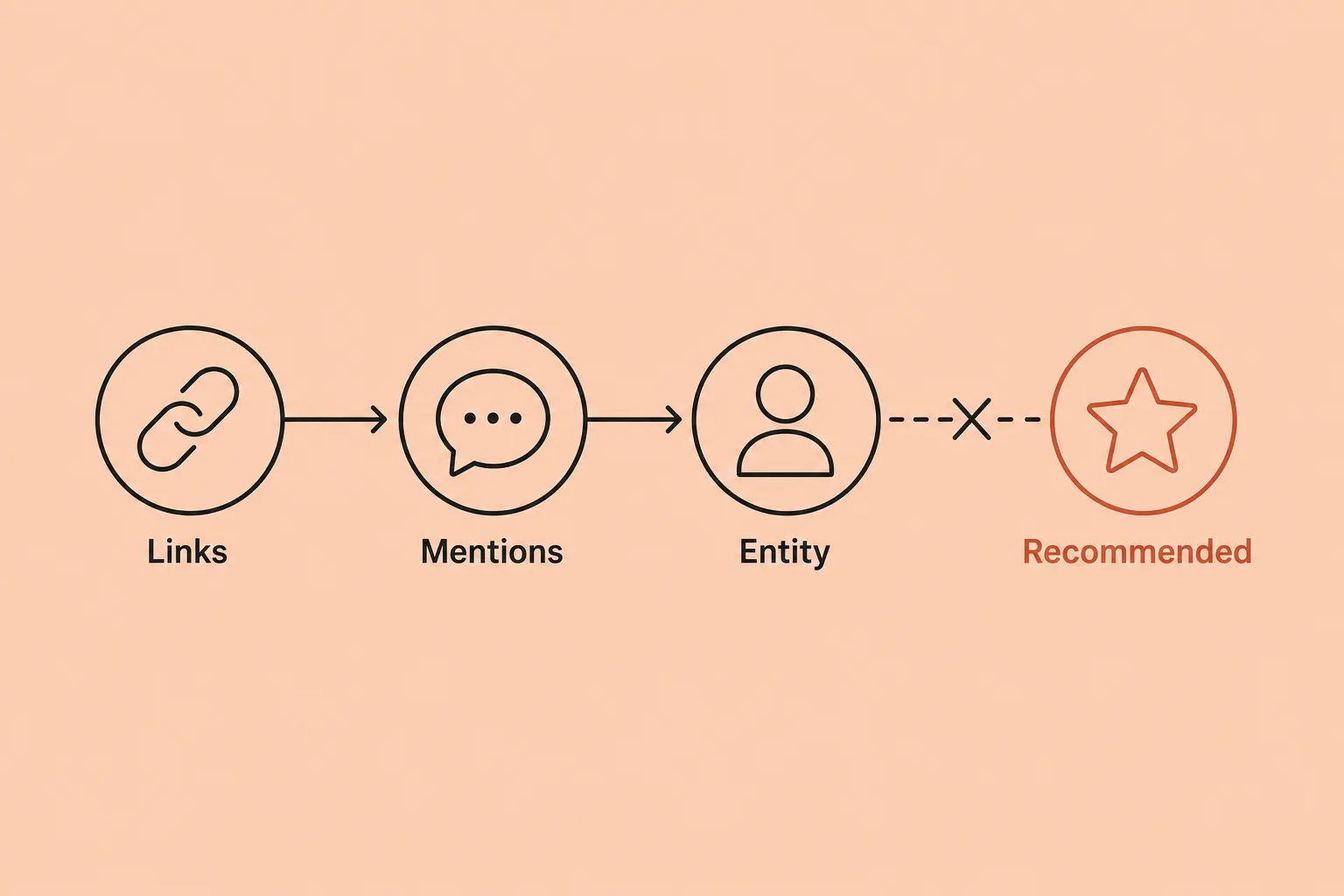
Think of an LLM less like a search box and more like a cautious researcher who quotes only sources it can name and verify. That instinct shows up in the data by source category. Muck Rack's analysis of more than 25 million AI citations across ChatGPT, Claude and Gemini found earned media accounting for 84% of all citations, with journalism alone at 27% and paid or advertorial content at 0.3%; that earned-media share has held across three editions since July 2025. Muck Rack is a PR-software vendor, so read it as credible for this audience rather than neutral, and note its "earned media" bucket lumps journalism in with encyclopedic, academic and third-party content, so it does not isolate a clean "brand-owned" number. A separate primary study backs the direction: an Orbit Media analysis of 13,184 citations across four assistants found the most-cited sources were third-party platforms, and only 10 to 30% of AI-cited domains ranked in Google's top ten. Earned credibility is a distinct currency from rank, and it is the one PR already trades in. That is why earning AI brand citations through digital PR now matters more than another placement nobody measures.
The metric that finally retires AVE
Every PR leader has wanted a defensible number to hand a client instead of AVE. Share of Model is the closest thing yet. Jellyfish coined it as a working tool: it runs large batches of prompts against the major LLMs and tracks which sources get cited across tens of thousands of results, then analyses the cited content to explain why it was picked up, not just that it was. The category is broader than one agency's tool. Moz points practitioners toward LLM share-of-voice platforms such as STAT and llmrefs.com, and in the UK the practice is already established enough to support a roundup of AI search monitoring tools that measure citation frequency, share of voice and sentiment across ten or more models.
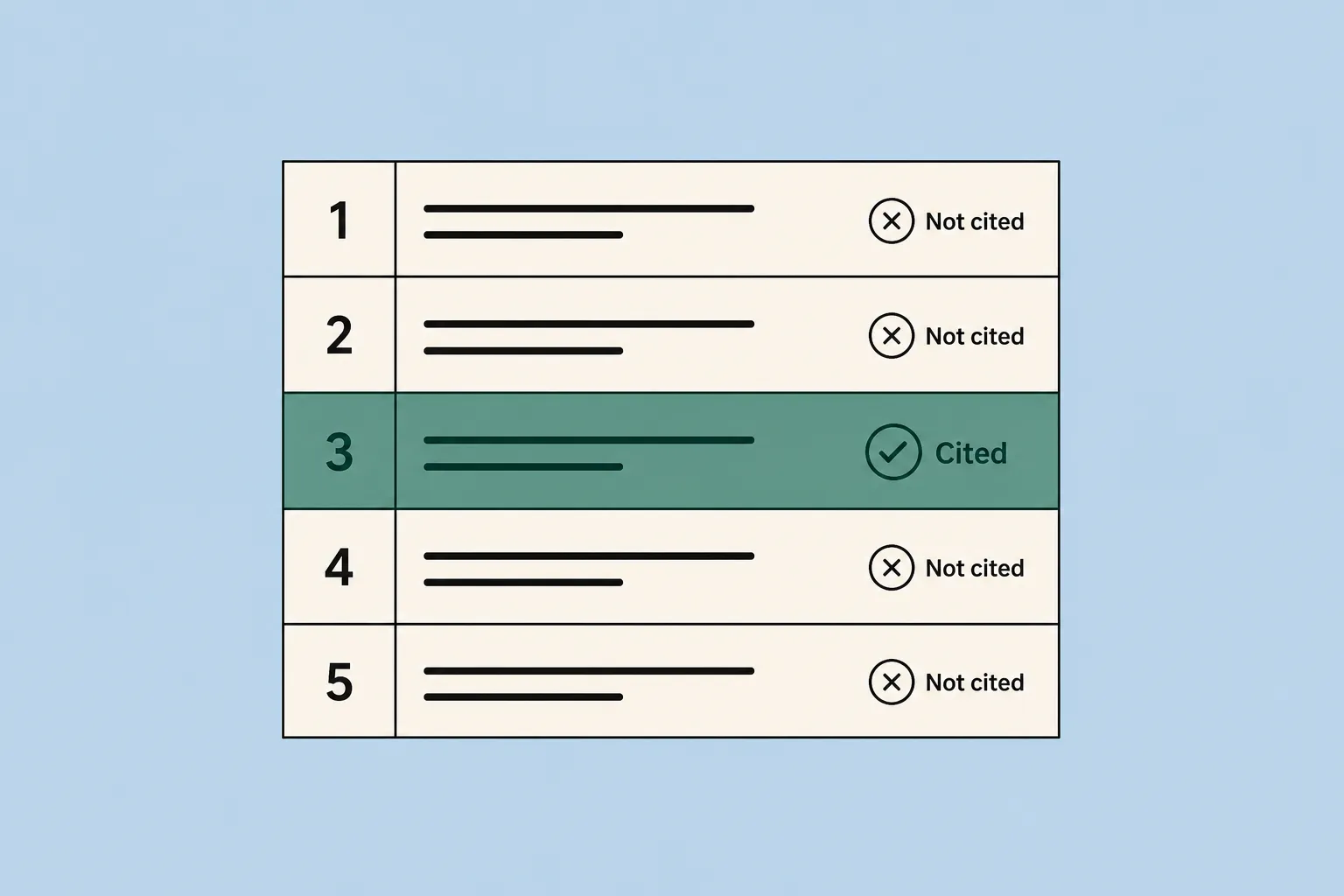
It beats reach in a client report because citation, not clicks, now sets the stakes. Moz cites a Seer Interactive study showing click-through rate falls 65% when an AI Overview appears and your brand is not cited, versus 49% when you are cited, against 46% when no AI Overview shows at all. Being in the answer is the outcome; the click is a bonus. One caveat to keep: the acronyms flying around this space, GEO and AEO among them, are contested, and Google's own line is that "good SEO is good GEO," so present Share of Model as a useful lens, not a settled discipline with fixed rules. Used carefully, it is the AI visibility KPI that turns "we got coverage" into "the coverage is the source AI quotes," and it belongs in the same conversation as measuring AI visibility for boards.
What actually moves your Share of Model
A metric only earns its place if you can move it on purpose. The levers are the ones PR already owns, sharpened for a machine reader. Dept, for one, now hands creators a reference list of exact product names and verifiable claims to script from, structures chapter markers around the real questions people ask rather than plain timestamps, and insists on clean transcripts instead of letting a model parse error-riddled auto-captions. Earned coverage in credible outlets, expert-led explanations, original data worth quoting, and clean structure are what a model retrieves and reuses. That is also why the discipline of producing original, well-structured content at cadence matters more than volume: unstructured or thin output is simply harder for an assistant to parse and cite.
Localise the execution, though. In Australia, the ACCC's influencer disclosure guidance is clear that promotional posts and any free products, gifts or incentives must be disclosed clearly and immediately, and that vague tags like "sp," "spon" or "ambassador" do not cut it [AU]. A brief engineered to feed LLM citations still has to meet those rules, so build disclosure into the creative rather than bolting it on afterward.
Report it as a reputation signal, not a revenue promise
The credibility of the metric is the whole sell, so the biggest risk is overclaiming. Digiday's own reporting warns that much of the activity here still looks more like positioning than practice, agencies bolting AI language onto existing work. Charlie Coney, creative and strategy officer for Ogilvy's UK and EMEA regions, is candid about the limits: "It's not like I can stick a million quid into Google and see my SEO rankings change overnight. LLMs take longer to train, and the way those algorithms work together isn't hugely public, so there's a bit of guesswork in here" [UK]. Pricing reflects that caution. Rate cards have not moved, and executives expect citation value to reshape them only in the next six to twelve months, an expectation rather than a certainty.
The Australian picture argues for the same restraint. An Optimising study of 115 Australian businesses found ChatGPT drives about 90% of AI-referred website visits locally, yet AI-attributed revenue was still only around 0.1% of the sample even as AI sessions surged roughly 1,200% year on year [AU]. Those figures are about ten months old, so treat them as a direction of travel. The rule for a client report is measure before you monetise: present Share of Model as a leading reputation indicator, the share of the conversation your brand owns inside the models, and resist attaching a revenue figure the data cannot yet support. The plumbing for exactly this is being built locally. Tracksuit's acquisition of Sydney startup Hall, whose technology tracks how brands appear across ChatGPT, Claude and Gemini, shows citation-share measurement being commercialised in the ANZ market, not just talked about. As Tracksuit CEO Connor Archbold framed the demand, marketers want to "influence those models to say the right things about their brand."
Key takeaways
- Treat AI models as a second audience for earned media, and report AI share of voice alongside your existing coverage metrics rather than instead of them.
- Prioritise long-form, credible, domain-deep content, since earned and third-party editorial dominates AI citations and depth beats follower counts.
- Position Share of Model as the defensible replacement for AVE, framed around citation, because click-through collapses when a brand is in an answer but not cited.
- Move the metric with levers PR already owns: earned coverage, expert-led content, original data, and clean formats a model can parse.
- Report it as a reputation signal, not a revenue promise, while AI referral revenue stays tiny locally and citation pricing has not settled.
Frequently asked questions
What is Share of Model, or AI share of voice?
Share of Model, also called AI share of voice, measures how often AI models cite or recommend a brand and which sources they draw on to do it. Tools run large batches of prompts against the major LLMs and track which brands and sources appear across the results, as Jellyfish and similar platforms do.
How is Share of Model different from AVE and reach?
AVE and reach estimate how many people might have seen a placement, while Share of Model measures whether AI systems actually cite and recommend you when buyers ask. It is grounded in observed citations rather than a notional advertising value, which makes it more defensible in a client report, though the category is still maturing.
What kind of content earns AI citations?
Credible, long-form, domain-deep content earns the most citations. Muck Rack's analysis of over 25 million AI citations found earned media accounted for 84% of them, with paid or advertorial content at just 0.3%, so third-party editorial and expert-led material outperform brand-owned or short-form promotional posts.
Can PR promise clients revenue from Share of Model yet?
Not reliably. In an Australian study of 115 businesses, AI-attributed revenue was still only about 0.1% of the sample even as AI traffic surged, so Share of Model is best reported as a leading reputation indicator rather than a revenue guarantee for now.
Do creator briefs built for AI citations still need disclosure?
Yes. In Australia the ACCC requires that promotional posts and any gifts or incentives be disclosed clearly and immediately, and vague tags are not enough. Content engineered to be cited by AI must still meet the same disclosure rules as any other paid or incentivised creator work.
Amina helps professional-services firms get cited in AI answers, not only ranked in Google. We measure your share of AI visibility and build the content and structure that earn the citation, so you are the answer when a buyer asks. See Amina's AI SEO and visibility service.