SEO value is shifting from hand-built reports to owned data and callable tools that a client's own AI can query directly. For a fractional CMO, that changes the supplier question from "what does your report look like?" to "is your capability agent-ready?" The specialists exposing verified, guard-railed data will hold the relationship. The ones still shipping static PDFs risk being commoditised.
For as long as anyone has hired an SEO specialist, the deliverable has been the report. A deck, a PDF, a monthly readout you forward to the client and half-hope someone opens. That habit is quietly breaking. The systems your client now trusts to answer questions are increasingly not people at all, and those systems would rather call a supplier's tools than read a supplier's document.
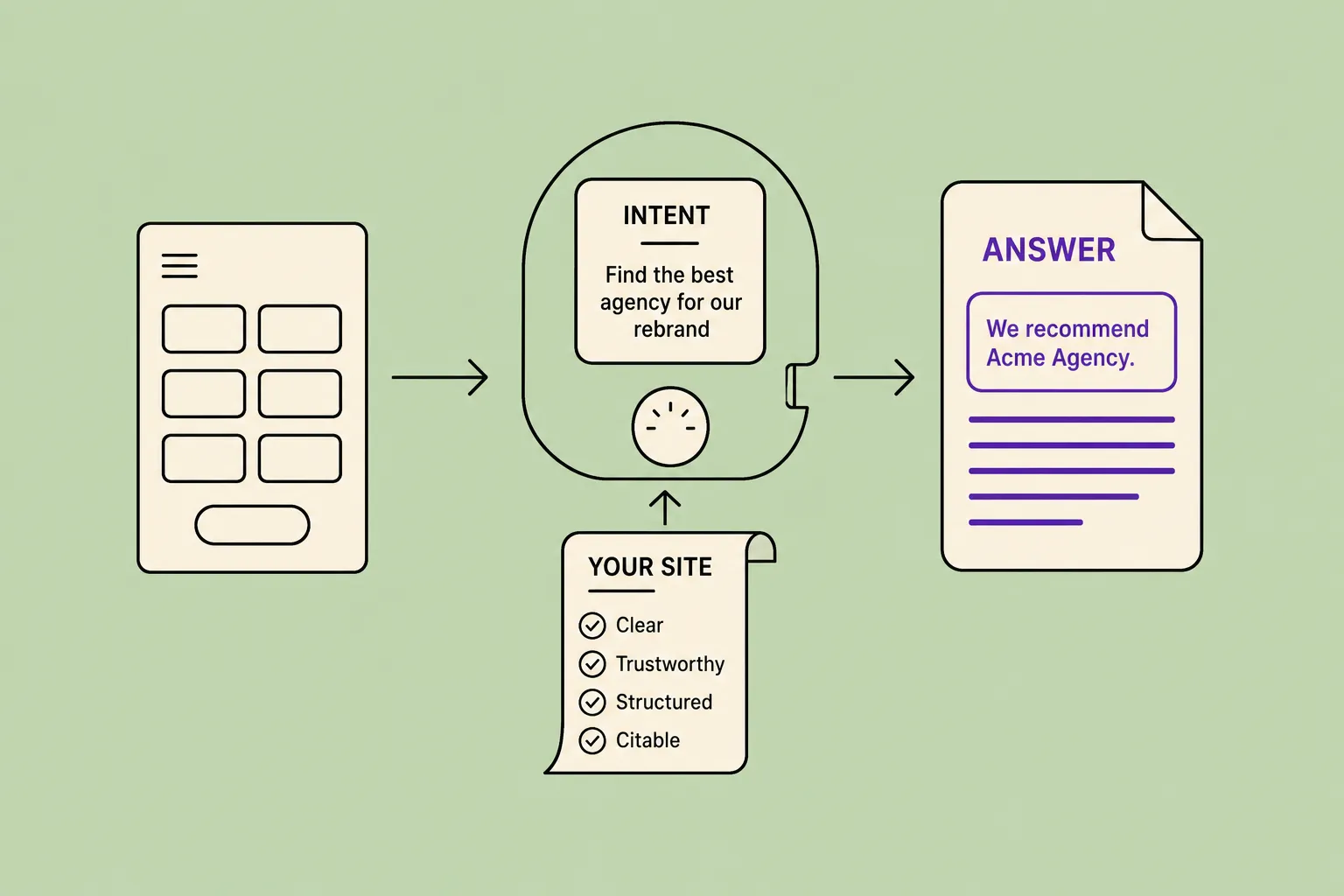
Two SEO practitioners published work this month that point at the same future from different angles, and together they reframe how you should vet a specialist supplier. The question is no longer how polished the report is. It is whether the capability behind it is agent-ready: something your AI, and your client's AI, can query directly and trust the answer.
The one-week convergence: from reports to callable tools
Consider two pieces of work that landed within days of each other. Neither is a manifesto about the future of the industry. Both are practitioners quietly rebuilding their craft as something a machine can call.
The first is a keyword-research method. Semrush published a repeatable Claude-and-Semrush workflow that pairs Claude (loaded with a business-context file) with the Semrush MCP and Google Search Console exports, then mines competitor reviews, Reddit threads and sales-call transcripts for the exact language real buyers use before validating volume and difficulty. Worth noting: the post is published by Semrush and the workflow runs on Semrush's own paid tools, so read it as a vendor demonstration. The mechanism is the interesting part. The specialist's tooling is being wired into an AI the strategist already uses, rather than exported into a spreadsheet the strategist has to interpret alone.
The second goes further. Marie Haynes turned roughly 15 years of Google algorithm-update history into an MCP server so that a user's own agent can query verified update dates on demand to diagnose a traffic drop. Ask your LLM why organic search fell between two dates and, as she describes it, "your AI agent automatically queries the MCP server in the background, pulls verified dates and observations from my archive, and uses that ground truth to analyze your site." She is candid that she is "not an expert developer" and built it with AI help, which is rather the point.
This is not a distant Silicon Valley preview. In Australia, a Sydney tech-services firm is already using MCP connectors and API integrations to orchestrate work across multiple platforms for clients, running what it calls a purpose-built AI agent factory. It is an IT integrator rather than an SEO shop, so treat it as a signal of direction rather than a like-for-like case. The direction is unambiguous. Agent-ready delivery is being sold in this market now, not sketched for a keynote in 2028.
"Use my agent to use your tools": what the agentic web changes
Haynes reduces the whole shift to one borrowed line: "I don't want to use your agent. I want to use my agent to use your tools." Sit with that, because it inverts a decade of software strategy. Every vendor spent years trying to own the interface a client logs into. The agentic web wants the opposite. The client brings their own AI and expects your capability to answer it.
So what is an MCP server, in plain terms? Think of it as a universal power adapter for AI. Instead of every tool needing a bespoke plug for every assistant, Model Context Protocol gives an agent one standard way to discover what tools you offer and call them safely. That standard is no longer experimental plumbing. MCP has had an "enterprise makeover", now governed under the Linux Foundation's Agentic AI Foundation, moved to a stateless model for standard DevOps, and given a deprecation policy that promises minimum 12-month change timelines. That last detail matters more than it sounds. Building capability as callable tools is now a bet on governed, versioned infrastructure, not a fad. (That coverage is from The Register in the UK, so read it as an international trend rather than an AU-specific data point.)
The commercial consequence is what a fractional CMO actually cares about. When value lives in a static report, the report is the product, and reports commoditise fast. When value lives in verified data and tools an agent can call, the supplier becomes part of the client's operating system. Haynes puts the underlying principle plainly: "It is no longer information that makes a website valuable, but rather, providing value that helps the user accomplish a goal." That is the same argument for why judgement, not production, is the asset clients now pay for, extended from people to their tooling.
The backdrop makes this a live question rather than a hypothetical. 86.4% of marketing teams now say they use AI in at least a few areas, according to HubSpot's 2026 survey of more than 1,500 marketers. Agent use specifically is earlier and harder to pin down: HubSpot's separate 2026 marketing predictions put the share of marketers already automating work end-to-end with AI agents at 19.2%, a figure from the predictions post that could not be confirmed on the primary report, so treat it as directional. Closer to the actual work, a 2026 survey of 250 agencies by Digital Applied found 41% now run at least one AI agent in production, up from 9% a year earlier, with SEO audit agents live at 51% of them. That last survey is a self-published agency study rather than a Tier-1 benchmark, so lean on it as a direction of travel, not a settled number. Locally, GTIA research on ANZ IT service providers found 53% now rank AI among their top revenue-growth categories and flags that "the rise of AI agents is adding another layer of complexity." No high-authority, SEO-specific adoption benchmark for agents exists yet, so treat agent-native SEO delivery as an emerging, attributed trend, not a proven norm.
The guardrail question: verified facts versus AI advice
This is where the story stops being about technology and starts being about trust. The most instructive part of the Haynes build is not the server. It is the guardrail.
Every tool instruction, she explains, "strictly forces the AI to output two separate sections," splitting verified facts from AI advice, precisely so an LLM cannot invent bad guidance and attribute it to her. Her design is also private by default: the server "never logs user queries, search terms, URLs, or client identifiers," tracking only aggregate usage. And because "there is zero LLM token cost on my side," as she puts it, "your client agent does the thinking." The supplier provides ground truth. The client's AI reasons on top of it.
That separation is the whole accountability model, and it is exactly the risk Australian operators are being warned about. Australian SME commentary cautions that as agents are allowed to act across more tools, "the scale of potential errors grows," and a single hallucinated output or misconfigured workflow "can trigger knock-on effects across connected systems." A supplier who hands your agent unlabelled opinions dressed as fact is not a convenience. It is a liability wired into your stack.
The wider market agrees on where the friction sits. Marketing-data vendor Supermetrics, reporting a December 2025 Stacklok survey, found 45% of software-industry technical leaders had MCP in limited or broad production use, while 64% named security as their top obstacle. Read the vendor lens into that, since Supermetrics sells a marketing data and MCP product, but the shape is telling: the technology is ready, and trust is the gate.
For a fractional CMO, the gate has a name in this market, and it is the Privacy Act. The OAIC's guidance on commercially available AI products is blunt: privacy obligations "apply to any personal information input into an AI system, as well as the output data generated by AI," and under Australian Privacy Principle 6 you can generally only use personal information for its original purpose. Privacy Commissioner Carly Kind has said "robust privacy governance and safeguards are essential for businesses to gain advantage from AI and build trust." [AU] When a supplier's tools feed your client's AI, "agent-ready" has to include "safe about whose personal information passes through the pipe." Haynes's no-logging default is not a nice touch. It is the compliant posture. UK teams should treat the ICO and UK GDPR as the equivalent frame, though verify the current ICO position directly.
A briefing checklist for choosing an agent-ready supplier
You do not need to become an engineer to vet this. You need to ask better questions than "can I see a sample report?" Bring these to the next supplier conversation.
- Can your capability be called, not just read? Ask whether they expose an MCP server or an equivalent way for an agent to query their data directly. A "no" is not disqualifying today, but it tells you where they sit on the curve.
- Do your tools separate verified facts from AI advice? This is the single most important guardrail. Verified data and model-generated interpretation must be labelled distinctly, so nobody attributes a hallucination to your supplier or to you.
- What is your privacy-by-default posture? Confirm what is logged, whether client identifiers and URLs are stored, and how that squares with the Privacy Act and OAIC guidance. Get it in writing.
- Is the data current and owned? The durable asset is proprietary, maintained data, not a wrapper around a public model. Ask what they own and how often it updates.
- Who pays for the reasoning? If the supplier's model does the thinking, token costs and limits become your problem to scope. Clarify the commercial model early, especially since ANZ providers themselves have no standard way to price agent-delivered work yet. [AU]
The same discipline you apply to core SEO delivery applies here. Verify the work exists behind the deliverable, then verify you can trust it unsupervised.
Agent-ready, not agent-threatened
The instinct, if you are the strategic layer, is to feel the agents closing in. Resist it. The commoditisation risk in this shift does not fall on the people who own verified data and build tools. It falls on the people still shipping the static PDF.
Let's be honest about the pace, though, because the trend is real without being finished. Supermetrics also reports that 80% of marketers feel pressure to adopt AI while only 6% have fully embedded it into established workflows, from a survey of 435 marketers across markets including Australia and the UK. Demand is loud. Full agent-native delivery is still early. That gap is the opportunity: the supplier who is genuinely agent-ready right now is scarce, and scarcity is leverage for the consultant who can find and brief one.
Your job as a fractional CMO was never to write the report. It was to choose the right specialists and stand behind their work to the client. That job gets more valuable in the agent era, not less. The strategist who understands what earning an AI recommendation now requires, who can brief a supplier once and trust their tools to feed a client's AI verified answers, and who can still explain it in the boardroom, is the trusted layer that stays trusted. Being able to translate all of this into a defensible way to report AI visibility to a board is what keeps you in the room.
Key takeaways
- Value is migrating from reports to callable tools. Owned, verified data an agent can query is the durable asset. A static PDF is the commoditising one.
- The guardrail is the trust test. A supplier's tools must separate verified fact from AI advice, or a hallucination lands on your name. This is an accountability issue, not a technical nicety.
- Privacy is part of "agent-ready" in this market. Under the Privacy Act and OAIC guidance, personal information flowing into and out of an AI pipeline is your responsibility. No-logging defaults are the compliant posture.
- Vet capability, not decks. Ask whether it can be called, whether facts and advice are separated, what is logged, what data they own, and who pays for the reasoning.
- Treat the trend as real but early. Agent SEO delivery is emerging, not benchmarked. The scarce, genuinely agent-ready supplier is the opportunity for the consultant who can find one.
Frequently asked questions
What is an MCP server in SEO?
An MCP (Model Context Protocol) server is a standard way for an SEO specialist to expose their data and tools so a client's own AI agent can query them directly, rather than reading a report. For example, Marie Haynes built one that lets an agent look up verified Google algorithm-update dates on demand to help diagnose a traffic drop.
What does "agent-ready" SEO delivery mean?
Agent-ready delivery means the supplier's capability can be called by an AI agent and returns verified, guard-railed answers, instead of being packaged only as a static PDF or dashboard. In practice it also means separating verified facts from AI advice and handling client data safely, so the output can be trusted without supervision.
Should I replace my SEO reports with AI agents?
Not yet, and not wholesale. Adoption is real but early: a survey of 435 marketers by Supermetrics found 80% feel pressure to adopt AI while only 6% have fully embedded it into workflows. The practical move is to start choosing suppliers whose capability is agent-ready, so you are positioned as the shift accelerates.
What should a fractional CMO ask an SEO supplier about AI agents?
Ask whether their capability can be queried by an agent, whether their tools clearly separate verified facts from AI-generated advice, what client data is logged, what proprietary data they actually own and maintain, and who bears the token cost of the reasoning. Those answers reveal far more than a sample report.
Is client data safe when a supplier's tools feed our AI?
It depends on the supplier's design, and the responsibility is yours to check. The OAIC states that privacy obligations apply to personal information both entering and generated by an AI system, and Australian Privacy Principle 6 limits use to the original purpose. Favour suppliers with privacy-by-default settings that avoid logging queries, URLs and client identifiers.
Ready to be the answer, not just the report?
Amina helps professional-services firms get cited in AI answers, not only ranked in Google. We measure your share of AI visibility and build the verified content and structure that earn the citation, the kind of capability a consultant can brief once and trust. See Amina's AI SEO and visibility service.