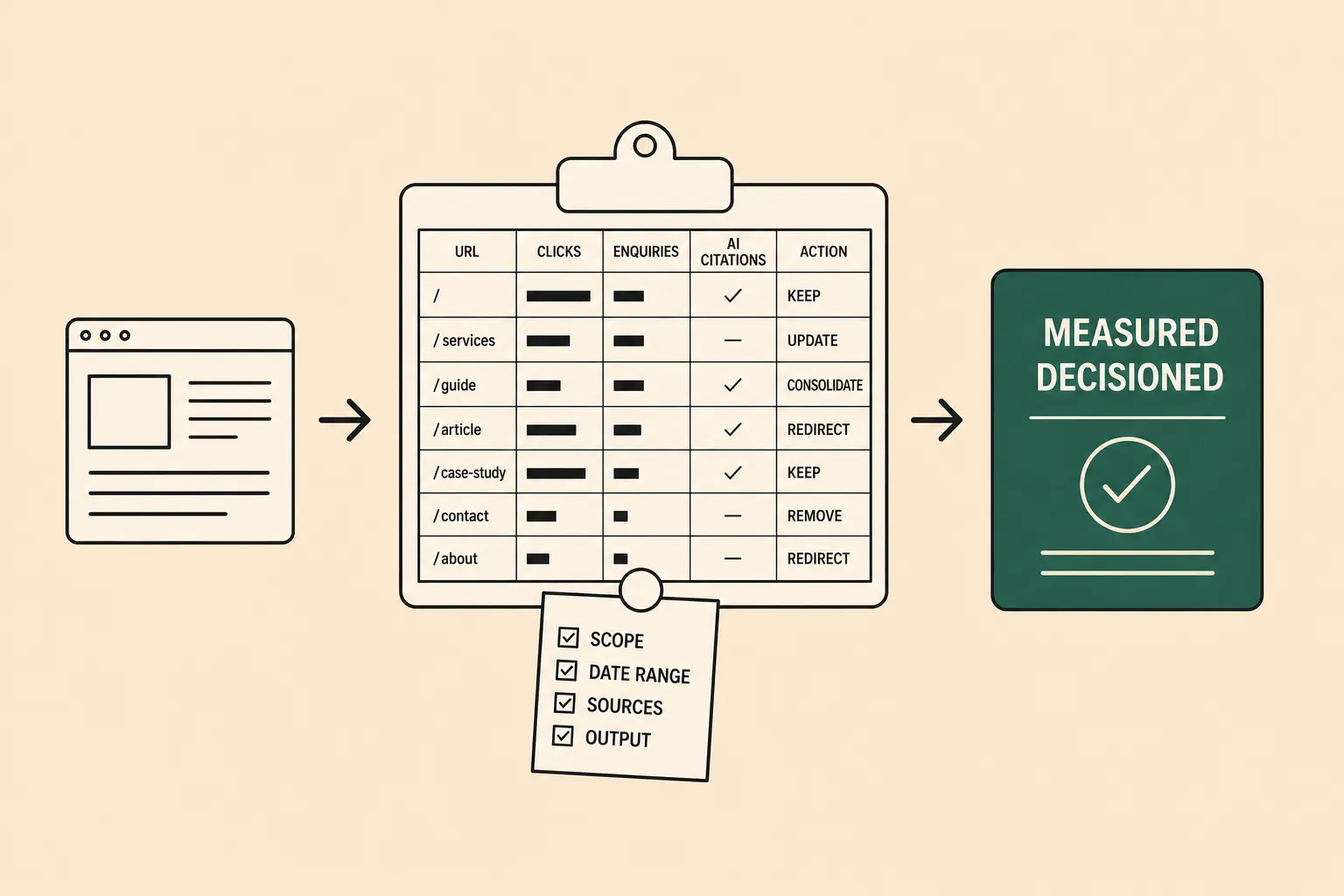
Audit AI-assisted content by listing every page produced with AI, checking for evidence that a person reviewed it, and testing each page's facts, originality and usefulness. Then fix, consolidate or remove the pages that fail, starting with pages that make factual claims or came from a template, and keep a review log you can show clients. Google now calls that review critical.
Ask an agency owner what Google's September 2026 spam update went after and the answer usually comes back fast: AI content. It's a tidy story. Google never told it. The company has not said what the update targeted, and its spam policy is written to catch low-value pages at scale, whoever or whatever wrote them.
What Google did change, in the same fortnight, was its documentation. Its guidance now asks for a person to factcheck and review AI-generated content before it goes live. For an agency publishing across dozens of client sites, often through freelancers and white-label partners, that turns a vague worry into a specific question: for each page, can you show who checked it? The defensible position isn't "we don't use AI". It's "we can show who checked every page". The checklist below finds the pages where you can't, and helps you decide what to do with each one.
Why this audit, this month
The update has now finished. Google's Search Status Dashboard shows it running from 24 September (early on 25 September in Australia) to 8 October, a span of 13 days and 16 hours and far longer than this year's earlier spam updates. Barry Schwartz at Search Engine Roundtable tracked a second wave from 30 September. Those waves are his reading of tracking tools; Google announced no phases, and it would not say what share of queries the update affected.
Impact data is thin and early. Diib's study of 32,569 websites with connected Google Analytics found the median share of visits from unpaid Google search slipping from 34% to 31% over 24 to 26 September, while sites losing half or more of that share doubled, from a 5% baseline to 10%. Diib itself calls it "an early read, not a verdict". It is vendor data, it measures share rather than traffic, it has no country breakdown, and nothing in it shows why any site dropped.
The documentation change is firmer. On 1 October Google updated its guidance on generative AI content: "It is critical to manually factcheck and review all AI-generated content for accuracy and trustworthiness before publishing." The reason is mechanical, since generative models "don't retrieve facts, but predict a likely sequence of words". Google's documentation changelog says the change syncs the page with the Search Quality Raters guidelines, and Search Engine Roundtable's 2 October recap reported a related change to Google's helpful content documentation, explaining what main content is and how quality raters review it.
None of this makes the update an AI detector. Google's spam policies describe scaled content abuse as large amounts of unoriginal content "no matter how it's created", and the generative AI example is specific: "Using generative AI tools or other similar tools to generate many pages without adding value for users." The guidance page even calls AI "particularly useful when researching a topic, and to add structure to original content." Our reading is that the risk lives in pages nobody reviewed, produced at volume and adding little. Which tool drafted them is a secondary question.
The checklist
The list runs to 19 items in six groups. Let's work through it one client site at a time; a shared spreadsheet with one row per page is all the tooling you need.
1. Find the pages
- List every AI-assisted page by client, partner and publish date. You can't check review evidence on pages you can't name, and the date lets you line pages up against the 24 September to 8 October update window.
- Add templated pages and programmatic sections. Location pages, service-area variants and glossary entries are where "many pages" happens, which is the exact pattern Google's scaled content policy describes.
- Ask every freelancer and delivery partner for their own list. A page a white-label or offshore partner drafted still sits on your client's domain and on your invoice.
2. Evidence of review
The UK offers a useful parallel. The Competition and Markets Authority's guidance on AI agents holds a business responsible for what its AI does "in the same way you are responsible for what an employee does", even when a third party built or supplies it, and tells firms to "make sure there is a human in the loop". That guidance covers chatbots and automated customer service rather than published web pages, so treat it as an analogy. The logic still transfers to content a partner delivers.
- Find a named reviewer, a review date and a note of what they checked. "Someone looked at it" won't hold up, because Google's wording asks for a factcheck for accuracy and trustworthiness and the record should show one happened.
- Pull the brief and the version history for each page. A page published in a single revision straight from a draft is the clearest sign nobody edited between prompt and publish.
- Get each partner's review step in writing. If a partner can't say who reviews their drafts and against what, assume nobody does and move their pages up the queue.
3. Facts and claims
Australian rules care whether content misleads, whoever or whatever wrote it. "Regardless of how the content is created, AI or otherwise, the advertising rules still apply," Ad Standards' executive director told SmartCompany in February. That covers advertising rather than every web page, and the AANA is still reviewing its Code of Ethics, including whether to add a specific AI rule, with a new Code expected in 2026. The direction is clear enough to put factual claims first.
- Check every price and product spec against the client's current list. Google warns that generative models predict words rather than retrieve facts, and a plausible wrong price is the hallucination most likely to reach a customer.
- Check every regulatory statement, statistic and named person. A wrong licence requirement or a misattributed quote is exactly the kind of error a fluent, polished page hides well.
- Confirm each statistic links to its source. An unlinked number can't be rechecked by the next reviewer or by the client, so it fails the evidence test by default.
- Flag claims that have dated since publishing. A fee, threshold or rule that was right at launch and wrong today misleads a reader just as much as one that was never right.
4. Originality and usefulness
- Test whether the main content adds something beyond what already ranks. Google's policy example targets pages generated "without adding value for users", and its documentation now spells out what main content is, so judge the body copy rather than the sidebar.
- Look for first-hand detail only the client could supply. Their own data, cases, process and photos are the parts a model can't predict from training data, which makes them the fastest way to lift a thin page.
- Compare near-duplicate pages across clients. The same AI draft reskinned for two clients in one niche creates a duplicate content problem for both sites and a trust problem for your agency.
5. Template and technical defaults
Google's review expectation reaches past body copy. The same guidance says the review "also applies to metadata like `<title>` elements, meta description elements, structured data, and alternate texts for images". Despina Gavoyannis, a Senior SEO Specialist at Ahrefs, makes the operational case in Ahrefs' guide to static-site SEO: titles, meta descriptions, canonicals and schema often come from shared templates, so "one bad default can affect hundreds of pages at once". It's the same pattern behind AI-assisted builds that relocate failures rather than removing them. (Ahrefs sells a site-audit tool, and the piece points to it.)
- Review AI-generated titles, meta descriptions and alt text in bulk. Template errors repeat, so checking one page per template misses how far a bad default has spread.
- Validate schema against each page type. Ahrefs notes an AI-generated template can produce markup that looks reasonable without matching the page type, and Google's guidance asks you to validate structured data.
- Check internal links and URL formats on AI-built and static sites. AI-generated components can mix `/about` with `/about/` and relative with absolute URLs, and Ahrefs admits a misconfigured rule in its own blog migration nofollowed every internal link.
6. Decide and document
- Give every flagged page one decision: fix, consolidate, noindex or remove. A list of flags with no decision attached changes nothing on the client's site.
- Fix before you delete when the page has a real job. A reviewed, thorough page is also the kind AI answers tend to cite, with 64% of citations going to ordinary pages rather than listicle-style formats in NP Digital's study of 9 million AI answers.
- Record the decision, reviewer and date in the client's review log. The log turns a one-off audit into evidence you can produce the next time rankings wobble.
Where two thin pages answer the same question, merge them; our guide to content pruning for AI search covers how to pick the page that survives. Keep NP Digital's figure in proportion: it comes from an agency that sells AI-visibility work, measured across nine platforms and 400+ enterprise brands, and AI search visibility is still a contested discipline without settled rules.
Priority: what to check first
If the full list feels heavy across a portfolio of client sites, work in this order. Treat the first two as deal-breakers: no page in either group stays live without a named reviewer.
1. Unreviewed pages making factual or regulated claims. Prices, health, legal and financial statements carry the most risk to the client's customers and to the client. The ACCC has warned that AI makes professional-looking content cheap to produce, and a polished page tells you nothing about whether anyone checked it.
2. Bulk templated pages. Volume is where Google's scaled content policy and the bad-default problem overlap, and one fix to a template can clear hundreds of pages at once.
3. Pages that lost traffic between 24 September and 8 October. Check Search Console impressions and clicks rather than rank trackers. SEOmonitor reports that many trackers showed sudden ranking changes from 26 September that searchers never saw, caused by incomplete results Google returned to automated searches. A drop in that window still doesn't prove the update hit the page, or why. If a client's losses look real, that's a ranking recovery job for SEO, separate from the audit.
What to do with the results
With clients. Lead with the log rather than reassurance: which pages you checked, who checked them, and what changed. Australian audiences are primed for that conversation. Most worry that AI-generated advertising could mislead them: an Ad Standards and Roy Morgan survey of 1,000 Australians aged 18 and over found 72% concerned about AI-generated content in ads. That survey covered advertising rather than organic web pages, but the people answering it are your clients' customers.
With partners. Make a written, named review step a condition of every brief. A partner who can't supply a reviewer's name for a page sends that page back for review before you pay for it.
As a standing deliverable. Think of the review log as a vehicle logbook. Nobody asks to see it while the car runs well, and it's the first thing everyone wants when something goes wrong. Add to it monthly and attach it to client reports, so that when a client asks why a page dropped you can answer with a dated record of who checked what. That record is worth more in a ranking dispute than any amount of reassurance, and it's the kind of judgement clients now pay agencies for.
Key takeaways
- Google's generative AI guidance, updated 1 October 2026, calls manual factchecking and review of all AI-generated content critical, and the review covers titles, meta descriptions, structured data and alt text.
- Google hasn't said what the September 2026 spam update targeted; its scaled content policy turns on volume and missing value, whatever tool produced the pages.
- Audit for evidence of review first: a named reviewer, a date and what they checked, including on pages your partners delivered.
- Work in priority order: unreviewed factual or regulated claims, then templated pages, then pages that lost Search Console clicks between 24 September and 8 October.
- Keep a review log for every client and treat it as a deliverable rather than paperwork.
Frequently asked questions
Does Google penalise AI-generated content?
Not for being AI-generated alone. Google's spam policies target large volumes of unoriginal content "no matter how it's created", and its own example is using generative AI to produce many pages without adding value for users. Google does now say it is critical to manually factcheck and review AI-generated content before publishing.
What is a content audit for SEO?
A content audit for SEO is a page-by-page review of a site's content to decide what to keep, fix, consolidate or remove. For AI-assisted content it now starts with evidence that a person reviewed each page, then tests facts, originality and usefulness, along with AI-generated titles, meta descriptions and structured data, which Google's guidance says the review also covers.
Should I delete AI-written pages or improve them?
Improve them when the page has a real job and its facts can be verified, consolidate pages that overlap, and noindex or remove pages that add nothing. Thorough ordinary pages also matter for AI answers: in NP Digital's study of 9 million AI answers, 64% of citations came from ordinary pages rather than listicle-style formats.
Did the September 2026 spam update target AI content?
Google hasn't said. The update ran from 24 September to 8 October 2026, and Google gave no spam category or share of affected queries. Early vendor data from Diib showed more sites losing unpaid Google share in the first three days, but it cannot show why any page dropped.
Work with Amina
If you'd rather not run this across every client site yourself, an Amina Website Review does it as an AI-content risk audit, and our white-label SEO retainers build a named human review step into every page we deliver. Amina's Content Engine turns industry research into original, fact-checked content structured to be found in search and quoted by AI, the same engine behind this article.