Most of what makes a website usable by an AI agent is content and structure work a marketing team can run, not a development project. Agent-driven traffic is growing quickly from a small base, and consumer appetite currently stops well short of autonomous checkout, so the commercial case sits at the recommendation stage. For Australian and UK agencies, that makes agent-readiness a fixed-scope pass over transactable elements, documentation, CTA markup and factual consistency.
One category of AI bot traffic grew more than fifteenfold across 2025, and it was not the training crawlers. Cloudflare's 2025 year in review recorded "user action" crawling, meaning bots fetching pages in real time because a person asked an assistant to go and do something, rising more than 15x over the course of the year. That is a network-level observation from one provider rather than a universal measure, but it is the clearest dated signal available that agents are now moving through ordinary websites on someone's behalf.
The tempting conclusion is that agents have become a traffic channel worth building for. They have not, yet. The distance between those two sentences is exactly where an agency can sell something useful this quarter, because the work that prepares a site for agents is content and structure work that a marketing team already knows how to do.
Agent traffic grew 15x and still accounts for a rounding error
Growth rates flatter small numbers, so the comparator matters more than the multiple. Across the first 28 days of July 2025 and the first week of August 2025, Cloudflare's breakdown of AI crawler traffic by purpose found training crawling responsible for nearly 80% of all AI bot crawling, while user-action and undeclared purposes together accounted for less than 5%. Those are the most recent purpose-split percentages confirmable on a Cloudflare page, so treat them as a mid-2025 snapshot rather than today's reading.
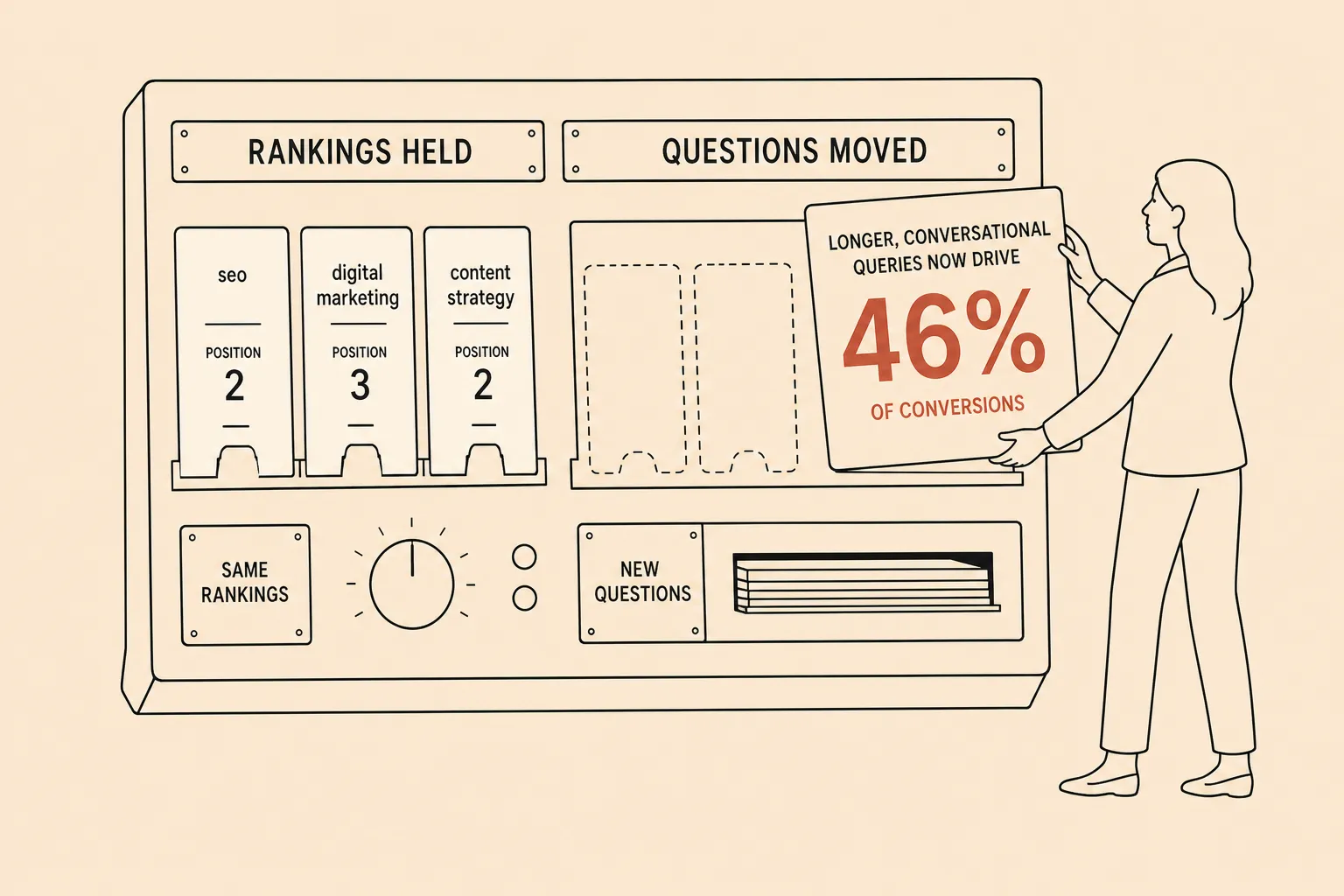
Referral data tells a similar story with a sharper edge. Contentsquare's 2026 Digital Experience Benchmark, drawn from 99 billion sessions across 6,500 sites, put AI-referred traffic at 0.2% of total visits in 2025, up 632% year on year. The number that should interest an agency with service-business clients is the sector split: services led every other category at 0.5% of visits, against 0.3% for software. That traffic converted at 1.3% in 2025, up 55% year on year, which puts it within sight of the 1.9% email benchmark and comfortably ahead of display and paid social on bounce rate. Contentsquare is an analytics vendor publishing its own benchmark, and referrer-based measurement systematically undercounts assistant traffic because much of it arrives with no referrer header at all. Read 0.2% and 0.5% as floors.
The honest position, then, is that agent sessions are genuinely hard to isolate in analytics, which is itself the reason no credible agentic-browser session share exists for ordinary business sites. Anyone quoting you one has made it up.
In Australia this has already crossed from trade-press curiosity into the regulator's in-tray. The ACCC's snapshot on AI developments states that "use of agentic AI has the potential to impact how users deal with businesses online, or use digital platform services such as searching the internet". That is a regulator watching a category form, not a rule that changes what anyone has to build, but it does settle the question of whether agents transacting with businesses is a serious conversation here.
Telling an agent things is cheap. Letting it act is the part nobody has scoped
The most useful framing published on this comes from Moz, in a walkthrough of getting a website ready for AI agents that splits the problem into five practices across two categories: telling agents things, and letting them act. The piece is written by an employee of a website platform and carries a fair amount of product proof, which is worth discounting. The framework underneath it stands on its own.
That split is what turns a vague technical anxiety into a quotable scope of work. Declarative work, the telling, is content, markup and documentation. Imperative work, the letting, is APIs, endpoints and protocol compliance. The first half can be delivered by a content and SEO team on a fixed price. The second half is where a developer belongs, and where most agencies are right to wait.
Four of the five moves never reach a developer
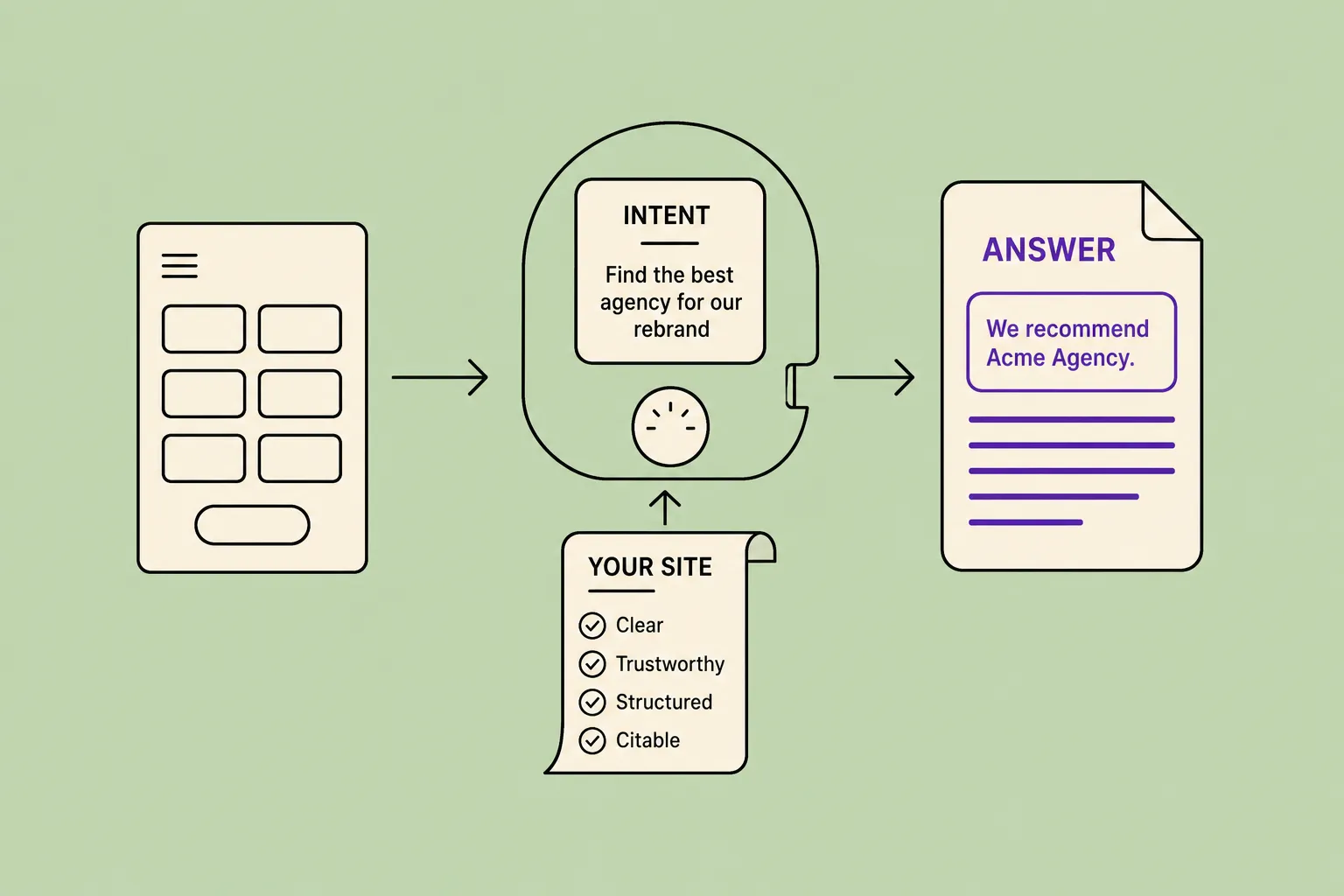
The five practices in the Moz framework are: increase the transactable elements on the site, so there are forms, product pages, booking pages and downloads where something can actually be done rather than only read; update documentation and support pages so a task can be completed from them; write clear calls to action in correct HTML, meaning "book this" rather than "click here", with the right elements carrying the intent; build for screen-reader navigation, because agentic browsers parse ARIA tags and structural markup the same way screen readers do, site search included, which agents use as a shortcut; and guide agentic actions with content by removing factual contradictions across the domain. The example Moz uses is a building entrance listed on Sixth Street on one page and Seventh on another, with the agent having no way to adjudicate.
Only the protocol work in that list needs engineering. The rest is a content audit with a deadline.
Australian evidence points at the same two moves from a completely different direction. Search Scope recorded 2,400 AI responses across 20 industries and found the Australian directory Starworks appearing 199 times, the most observed domain after Google and Reddit, and a June 2026 test across 12 trades on four AI platforms reached the same finding, as SmartCompany reported. Founder Ben Adler's practical advice in that piece is directory presence plus a requirement to "ensure websites are machine-readable with clear service/pricing information", which is the transactable-elements and factual-consistency moves restated in an Australian accent. The same article cites a 2026 study of 11,500 queries finding only 11% to 18% overlap between the sources surfaced by Google Search and those surfaced by AI Overviews and Gemini, which is the cleanest argument available that a readiness pass is separate work from an existing SEO retainer rather than a rebadge of it.
Moz's framing of the consequence is worth keeping, with one qualification: your work on generative engine optimisation today shapes what an agent says about you tomorrow. The terminology around GEO and answer engine optimisation is genuinely contested, and Google has pushed back on the idea that it is a distinct discipline, so treat it as a useful label for a real effect rather than settled doctrine. The effect itself is not in dispute. An agent asked whether a product suits a use case will answer from what the training data supports, including by recommending competitors.
Sponsored guidance being published to Australian SMEs lands in the same place, recommending machine-readable product data, delivery and review information, and automating one function at a time. Its most quotable line is also its most honest: if you try to automate a process that is broken, it is still going to be broken. The readiness pass is not a fix for a bad booking flow. It is a fix for a good booking flow that machines cannot see.
The protocol layer has a version number and a date, which is all you need from it
WebMCP is the one protocol name worth knowing, and knowing it properly is mostly about knowing how early it is. Google introduced it at I/O 2026 as a proposed open standard that lets a site expose structured tools such as JavaScript functions and HTML forms to browser-based agents, and the Chrome team's I/O round-up names Expedia, Booking.com, Shopify, Credit Karma, TurboTax, Redfin, Etsy, Instacart and Target among those experimenting with it. That list is almost entirely booking and commerce, which tells you where the standard is aimed. Google's own wording is that Gemini in Chrome "will soon support WebMCP APIs", and it is worth keeping that as stated rather than upgrading it.
The dates are the useful part. Chrome Platform Status records an origin trial running from Chrome 149 to Chrome 156 across desktop, Android and WebView, with the feature stage listed as "Proposed", the spec incubating in a W3C community group, TAG, security and privacy reviews all pending, and both Firefox and Safari registering "No signal". Shipping in 2026 is an anticipated year on a vendor's own tracker, so read it as a projection. Chrome 149 reached stable on 2 June 2026, which is the plain-English way to say the trial window opened in the middle of this year.
Alongside it sits something an agency can genuinely run on a client site today. Lighthouse added an Agentic Browsing category in version 13.3, and Chrome's own scoring documentation states plainly that the category and WebMCP support "are experimental and based on proposed standards", require Chrome 150 or later, and deliberately produce a pass ratio rather than a weighted score out of 100. DebugBear's walkthrough of the category records its four checks as accessibility-tree validation, WebMCP form and tool annotation, llms.txt compliance and layout shift, and confirms a site is not marked down merely for lacking AI features.
It is young enough to still be visibly buggy. A Lighthouse issue opened on 18 June 2026 shows the Agentic Browsing llms.txt audit running on PageSpeed Insights infrastructure with an open P1 defect: it fails llms.txt files that comply with the spec. Reachable in Google's public tooling as of mid-2026, then, and not yet something to put a client's score in front of a board with.
Which brings up llms.txt itself, and the correction that makes this section worth reading. Version 1 was widely promoted as a growth lever for AI visibility, and the research did not support that claim. What survived is narrower and more defensible: an agent-navigation role, which is why Chrome's llms.txt audit documentation explains the check exists because "without this file, agents may spend more time crawling the site to understand its high-level structure and primary content". A missing file currently returns Not Applicable rather than a failure, because the file is optional. That is the correct size for it. Agentic Commerce Protocol profiles and A2A agent cards are real, but implementation is complex and may require a developer, and nothing in this section changes what a service business should do next week.
The honest ceiling: 65% will take a recommendation, 7.5% will hand over the keys
Comfort with AI in the customer journey collapses as autonomy rises, and the shape of that collapse is the business case. In a Dept survey of 2,606 consumers reported by Adweek, 65% of people who have used AI for shopping are comfortable with it through the recommendation stage. Only 15% will let it move into preparation or transaction, and just 7.5% are comfortable with fully autonomous action. Against the 65% at the top of that funnel, the autonomous tier is roughly one ninth the size.
The figure sitting beside those three is the one that should change a scope of work. The same research found 56% of people who recently used AI while shopping chose a different brand than they had originally planned. Put those two findings together and the recommendation stage is already redirecting more than half of the purchase intent it touches, via an assistant working from whatever it could find, while the autonomous tier stays a rounding error. Transactable elements are how a site gets read accurately at the stage where the money is actually moving, which is a very different purchase from a bet on autonomous checkout.
Australia makes that argument more strongly than the global numbers do, because the autonomous rails were not switched on here first. When OpenAI launched in-app shopping, Instant Checkout was not available in Australia, with the company saying only that it would expand to more regions in the months ahead. That report is roughly a year old and availability should be re-checked before anyone quotes it to a client, but the direction of the point holds: the local ceiling on agentic transaction has been lower than the global one, and buying readiness for the recommendation layer has been the rational purchase for longer here than elsewhere.
The accessibility work that lost a decade of budget arguments just found a sponsor
Agentic browsers read sites through ARIA tags and structural markup, which is the same machinery screen readers use. That single technical fact has a commercial consequence that accessibility advocates have been waiting years for, and Google has now put it in writing by scoring the same markup twice. An accessibility-tree validation check sits inside Lighthouse's agentic category, not only its accessibility one.
The UK has the most current version of the duty side of this. The Equality and Human Rights Commission's statutory Equality Act 2010 code of practice for services was updated on 5 August 2026 and states that the service-provision duty "applies to the provision of services on a website", requiring reasonable adjustments and a duty to "review regularly whether services are accessible to disabled people", access audits included. For publicly funded clients the bar is already explicit at WCAG 2.2 AA for public sector bodies, monitored by the Government Digital Service through annual sampling. In Australia the underlying duty runs through the Disability Discrimination Act 1992, and an agency selling into Commonwealth or state clients should confirm the current standard directly rather than take a blog's word for it, including this one.
The practical upshot is the same in both markets. Structural markup, correct heading order, labelled forms and working site search are now load-bearing for two separate obligations, and information architecture built for AI search and structure built for assistive technology have converged on the same deliverable. If the accessibility budget line has failed to clear on ethical and legal grounds for ten years, it now has a second argument attached to it that a commercial director will listen to.
So what does an agency actually sell here?
A fixed-scope readiness pass, priced like an audit rather than a build, covering the four moves that never touch a developer: transactable elements, documentation that lets a task be completed, CTA and markup hygiene, and factual consistency across the domain. Call it what it is on the quote: SEO web design for a reader that happens to be a machine. It is the only part of the agent problem that can be scoped, priced and finished this quarter.
The Australian booking reality makes the case for that product better than any protocol does. Melbourne's Chime Labs raised $900,000 in pre-seed funding for an AI receptionist aimed at Australian trades and services, answering calls around the clock and booking jobs to the calendar, as Startup Daily reported. Founder Alexis Griveau's claim, and it is a founder's claim rather than independent research, is that a single missed call can cost a tradie up to $12,000 a month in lost revenue. Note what that tells you about where the money currently goes. For a large share of Australian trades and clinics the real booking surface is still the phone, which is precisely why the web booking flow has been under-invested, and precisely why a readiness pass sells as an addition rather than a competing spend.
For agencies without an in-house SEO team, the sequencing is straightforward. Run the readiness pass on the client's booking or enquiry flow, because that flow is the surface an assistant would have to transact on. Pair it with the AI visibility work that determines whether the client is in the recommendation set at all, since being read accurately is worthless if you are never read. Then handle the structural and performance layer as web design and build work rather than a bolt-on. If clients are asking why they appear in Google but not in an assistant's answer, the shift from ranked to recommended is the conversation underneath that question, and the accessibility and performance gate is where most sites actually fail it. For clinic and practice clients in particular, the allied health sector is where booking flows and informational content collide hardest.
And with that, the protocol question answers itself. Watch WebMCP, which arrived alongside the rest of the agentic announcements at Google I/O 2026, and implement nothing on it until a second browser signals support.
Key takeaways
- Scope agent-readiness as a content and structure audit, not a development project. Four of the five practices (transactable elements, completable documentation, CTA and markup hygiene, factual consistency) need no developer.
- Sell it against the recommendation stage, not autonomous checkout. In Dept's survey of 2,606 consumers, 65% are comfortable with AI through recommendation while 7.5% accept fully autonomous action, and 56% of recent AI-assisted shoppers changed brand.
- Treat WebMCP as watchable rather than buildable. The Chrome origin trial runs from version 149 to 156, and neither Firefox nor Safari has signalled support.
- Run Lighthouse's Agentic Browsing category on a client site for a directional read, but state that it is experimental and carries known defects, including an llms.txt check that fails spec-compliant files.
- Use the accessibility overlap deliberately. The same ARIA and structural markup serves agentic navigation and the UK's refreshed statutory expectation that providers review website accessibility regularly.
Frequently asked questions
What does "agent ready" actually mean for a website?
It means an AI agent can complete a task on the site, not just read it. The Moz framework splits this into five practices across two categories, telling agents things and letting them act, with most of the work sitting in content, documentation and markup rather than engineering.
Do you need a developer to make a website agent ready?
For most of it, no. Increasing transactable elements, rewriting documentation so a task can be completed, using correct HTML on clear calls to action, and removing factual contradictions across the domain are all content and structure jobs. Protocol work such as Agentic Commerce Protocol profiles and A2A agent cards is where a developer is genuinely needed.
Should we implement WebMCP now?
Not yet for most businesses. WebMCP is in a Chrome origin trial running from Chrome 149 to Chrome 156, its specification is still incubating in a W3C community group, and Chrome Platform Status lists both Firefox and Safari as "No signal", so any implementation today is a bet on a standard that has not settled.
Does agent-readiness overlap with accessibility and SEO UX work?
Substantially. Agentic browsers parse ARIA tags and structural markup the same way screen readers do, and Google's Lighthouse Agentic Browsing category includes an accessibility-tree validation check, so the same structural work serves assistive technology, search crawlers and agents at once.
Is AI actually sending traffic to ordinary business sites yet?
Yes, but at small volume and with measurement caveats. Contentsquare's benchmark across 99 billion sessions put AI-referred traffic at 0.2% of visits in 2025, with the services sector highest at 0.5%, and because assistant traffic often arrives without a referrer header those figures are best read as a floor rather than a total.
Built to be found, by people and by the things acting for them
See where your clients' sites stand in search, in AI answers and in the hands of an agent trying to finish something on them. Start a conversation with Amina.