The updates that actually mattered for being found, from a near-weekly run of cheaper AI models to Google's AI-answer payouts and one real deadline for Australian firms.
June made the AI answer the default, and August made the tools to measure it standard. September belonged to the models themselves. Barely a week passed without a new one, and two patterns ran through the lot: the price of capable AI kept falling, and the assistants began to work on their own rather than wait for a prompt. Around that, Google carried on reshaping the economy of AI answers, from paying a handful of publishers to running an unusually long spam update. And Australia's privacy regulator quietly published the playbook for a disclosure rule that commences in December. Most of September asks nothing of you this week. One item has a date worth writing down.
Capable AI got cheaper, almost by the week
The month opened with Claude Fable 5.1 on 1 September, which held its headline prices flat at $10 and $50 per million tokens but cut the cost of reading cached material by three-quarters, to $0.25 per million. A day later Google released Gemini 3.8 Flash, its everyday model, and wired it straight into AI Mode answers in Search. On 3 September OpenAI unveiled GPT-6 Astra, a new flagship whose headline trick is "computer use," navigating forms, spreadsheets and web pages the way a person would.
Then, in the last ten days, the real pattern showed itself: the flagship got cheaper. On 22 September Anthropic released Claude Opus 5.5, which it says costs around 40 percent less than Opus 5 on typical work and runs more than 30 percent faster. The same day OpenAI added GPT-6 Sol and Luna below the Astra flagship, a cheaper tier it says costs more than 50 percent less to run than the models they replace. A week on, on 28 September, Claude Sonnet 5.5 brought the same more-for-less logic to everyday work, and on 29 September GPT-6.1 Sol, launched at OpenAI's DevDay, claimed to come close to the Astra flagship on demanding tasks at about a fifth of the cost. Every one of those speed and cost figures is the maker's own, measured on its own tests, so read them as claims rather than independent results.
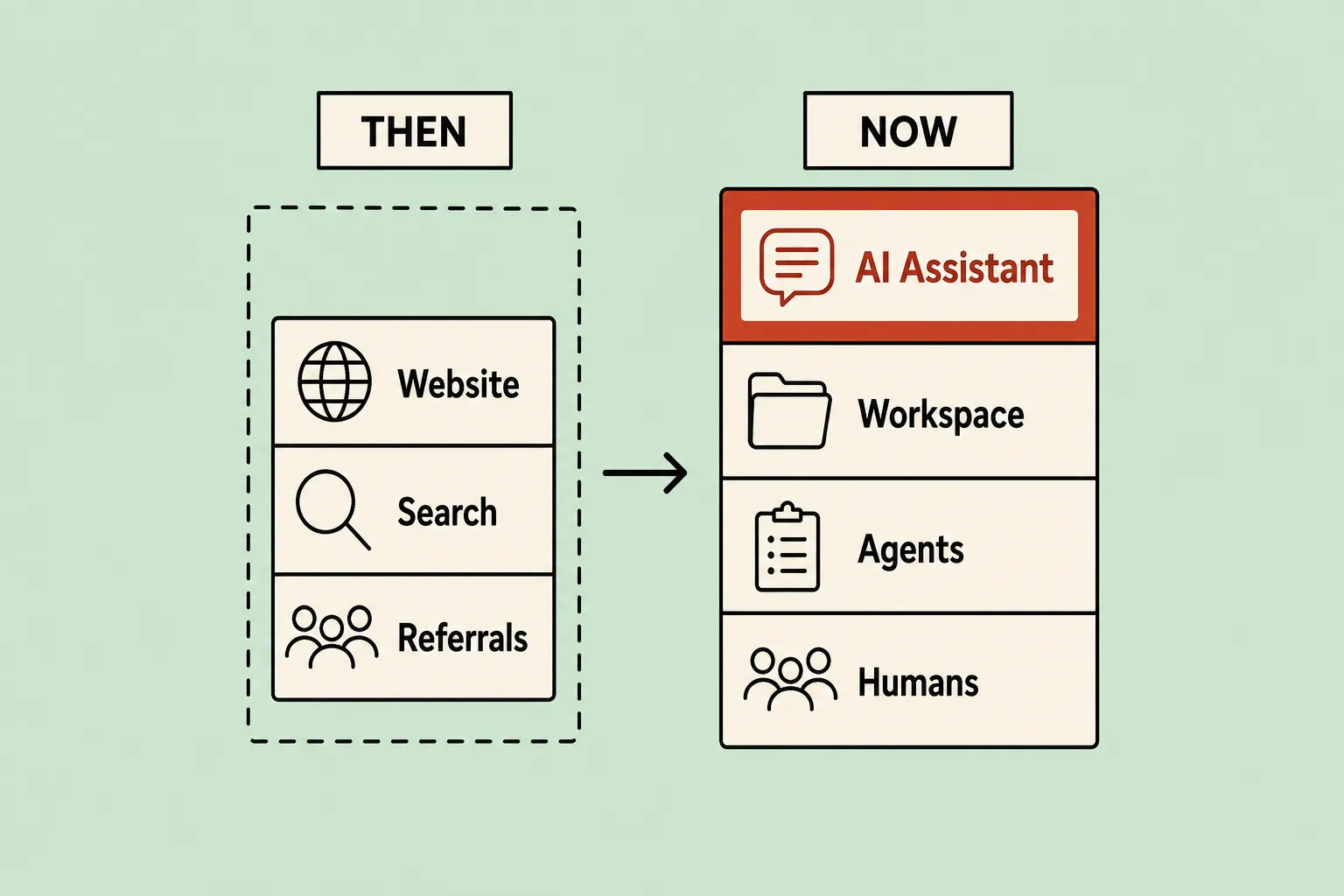
The detail worth holding is that most of this never reaches your desk directly. You meet these models second-hand, inside the tools your team and your providers already run and inside the assistants your buyers use to research firms like yours. When capable answers get cheaper to produce, they turn up in more products and on more questions, including the question of who a buyer should call. Nothing here changes how you rank. It raises the stakes on being a firm these assistants can describe accurately, which is the heart of earning a recommendation from AI rather than hoping to be guessed at.
And the assistants started working unsupervised
The second pattern was autonomy. At its DevDay event on 29 September, OpenAI introduced more than 20 changes to ChatGPT, two of which matter for how buyers work. Dots are always-on agents that run quietly in the background, each with its own cloud computer and browser, holding a standing responsibility rather than waiting to be asked. ChatGPT Space is a shared workspace where colleagues, ChatGPT and a person's Dot gather around the same documents. Both are rolling out to paid tiers rather than switched on everywhere at once.
Google matched the capability note at the top end. On 30 September it named Gemini 4 Argon its new frontier model, lifting the output limit to a million tokens from 64,000, though for now access is gated to trusted cyber defenders and almost no firm can switch it on. Earlier, on 15 September, Google had rolled Gemini 3.8 Live into Search Live, so a spoken search answer now talks back with web links in tow. That is one more surface where an AI reads the open web and cites it.
The thread under all of it is the same. As more of the early research and shortlisting happens inside an assistant that can act on its own and pull a team's shared context into one place, what that assistant knows about your firm, and can accurately say, carries more weight. Being named in those answers is still an emerging and contested area rather than a settled ranking factor, so treat any guaranteed "get cited by AI" pitch with care. The durable move is unglamorous: keep the public facts about your firm clear, correct and easy to quote.
Google kept reshaping the ground around AI answers
Three Google changes landed on the being-found side of the ledger. The first put numbers on a pilot that had been a rumour. Google's AI contribution programme, which pays some sites when their content feeds AI Overviews, Google's AI Mode and Gemini, drew fresh reporting around 30 September. Search Engine Roundtable's write-up, tracing detail to The Information, put the pilot at roughly 100 publishers and the payment for several small and mid-sized sites at less than one-tenth of one percent of their advertising revenue. Google has confirmed the pilot exists but has published no payout formula, so treat the figures as reported and unconfirmed. For a professional-services firm the read is unchanged: you cannot be paid for feeding an answer yet, but you can be the clear page an answer draws on, where being cited rather than merely ranked is what earns the mention.
The second was a new way to measure image search. On 24 September Google added a Web: multimodal filter to the Search Console performance report, grouping the traffic from Google Lens, Circle to Search, image uploads and Chrome's "search this image" under one label. It reports clicks, impressions, CTR and average position at the page level, with no query data behind an image, so read it as a page-level visibility trend. It is a reporting addition with nothing to switch on.
The third asked for patience. Google's September 2026 spam update began on 24 September with an unusually long window of up to two weeks, and that length produced more than one burst of movement, including a distinct second wave around 30 September that site owners flagged. Movement during a live rollout, up or down, is expected behaviour while Google recalculates, not a verdict on your site. Google is expected to mark the update complete on or around 8 October. If your traffic slipped, the steady course is the one that pays off during a core update: confirm nothing technical has broken, check whether the dip is broad or sits on a few pages, and hold your core SEO steady rather than reacting to a daily chart.
Measurement and paid search shifted underfoot
A few quieter items are really about not misreading your own numbers. Early in the month, Ahrefs switched its default traffic model from static to adaptive across Site Explorer, worldwide and including Australia and the UK. It re-weights the search features it accounts for, AI Overviews among them, and recalculates more often, so your estimated organic traffic and traffic value may have moved without your rankings changing at all. It is a methodology change, not a penalty, and the static model is still available on request.
For firms that buy clicks, Microsoft Advertising moved Optimization Experiments to general availability on 30 September, letting you A/B test a bidding, targeting or creative change against your live campaign before committing budget. It is narrow by design, relevant only if you run Microsoft Ads, and it changes nothing on Google or in organic search. If Bing is part of how you get found, it pairs well with ordinary paid-search account hygiene. Chrome also added four experimental ad-load metrics to its public CrUX report on 15 September, explicitly not a ranking factor and thin for the ad-light sites most professional-services firms run.
One more to note and not chase: Google cut the follower threshold for its Search profiles to 10,000 on a single platform around 16 September, but the feature stays US-only, so there is nothing to action in Australia or the UK beyond keeping your public profiles and business name consistent.
The one date to put in the diary
The single item on September's list with a real deadline is Australian. On 30 September the Office of the Australian Information Commissioner published its transparency resources for automated decision-making, the how-to firms had been waiting on since the rule was set in July. From 10 December 2026, if your firm uses a computer program to make, or substantially inform, decisions that could significantly affect a person, your privacy policy must say three things: that a computer program is involved, the kinds of personal information it uses, and the kinds of decisions it makes. The rule is not limited to AI, so a rules-based eligibility or scoring tool is caught too. For accounting, advisory and law firms, the work now is to map where those tools sit and get the wording right before December, using the OAIC's flowchart and worked examples as a template. It is a writing and review task rather than a rebuild, and it is the same habit of human oversight that judgement over raw output asks for everywhere else.
What it adds up to
Line September up and the theme is clear: capable AI got cheaper and more autonomous, almost weekly, while the ground under being found barely moved. The assistants your buyers lean on are faster, cheaper to run and increasingly able to act on their own, which puts more weight on whether they can describe your firm correctly. Google kept refining the machinery of AI answers around you but handed most firms nothing to switch on. The measurement tools shifted enough that your own dashboards deserve a second look. And one real obligation, Australia's automated-decision disclosure, now has a clear path and a December date.
None of it calls for a rebuild. The calm response is the one that keeps holding up as the models multiply: be a firm these systems can find, read and quote. Keep your public facts current and consistent, state your expertise plainly where search and AI answers reach it, and treat AI-search visibility as its own line of work. The cheaper and more capable the assistants become, the more they reward the firms that are already easy to see.
Frequently Asked Questions
What changed in search and AI in September 2026 that affects whether my firm gets found?
September 2026 in search and AI was dominated by AI model releases. Anthropic, OpenAI and Google each shipped new models almost weekly, and the clear pattern was capable AI getting cheaper and more autonomous, from Claude Opus 5.5 and GPT-6 Sol and Luna to agents that run on their own, announced at OpenAI's DevDay. Alongside that, Google put reported numbers on its publisher-payment pilot, added an image-search filter to Search Console, and ran a long September spam update, while Australia's privacy regulator published its guidance for a December automated-decision disclosure rule.
Do I need to do anything after the September 2026 search and AI updates?
For most firms, the September 2026 search and AI updates need no emergency action. The model releases are background upgrades to tools you already use, with nothing to switch on. The one item with a real deadline is Australian: if your firm uses an automated tool to make or inform decisions that significantly affect people, your privacy policy must disclose it before 10 December 2026. It is also worth a quick look at your traffic reports, since Ahrefs changed how it estimates organic traffic in early September.
Do September 2026's new AI models mean my firm needs to switch to one?
September 2026's new AI models do not mean your firm needs to switch to one. You meet these models second-hand, inside the tools your team and providers already run and the assistants your buyers use to research firms, so there is nothing to adopt or configure. What matters is that the assistants fielding buyers' questions keep getting cheaper and more capable, so being a firm they can describe accurately, through clear and quotable public pages, matters more over time.
Did Google's September 2026 spam update cause my firm's rankings to move?
Google's September 2026 spam update may well explain rankings that moved at the end of the month. It began on 24 September with an unusually long window of up to two weeks, and that length produced more than one wave of movement, including a distinct second wave around 30 September. Movement during a live rollout is expected while Google recalculates and can reverse before it finishes, so it is not proof of a penalty. Google is expected to mark the update complete on or around 8 October, so hold off on big changes until then.
What is the OAIC's December 2026 automated-decision rule, and does it apply to my firm?
The OAIC's December 2026 automated-decision rule applies from 10 December 2026 to Australian firms that use a computer program to make, or substantially inform, decisions that could significantly affect a person. Those firms must disclose three things in their privacy policy: that a computer program is involved, the kinds of personal information it uses, and the kinds of decisions it makes. The rule is not limited to AI, so a rules-based eligibility or scoring tool is caught too. On 30 September the OAIC published a flowchart and worked examples, so updating your policy is a writing and review task you can complete well ahead of the deadline.